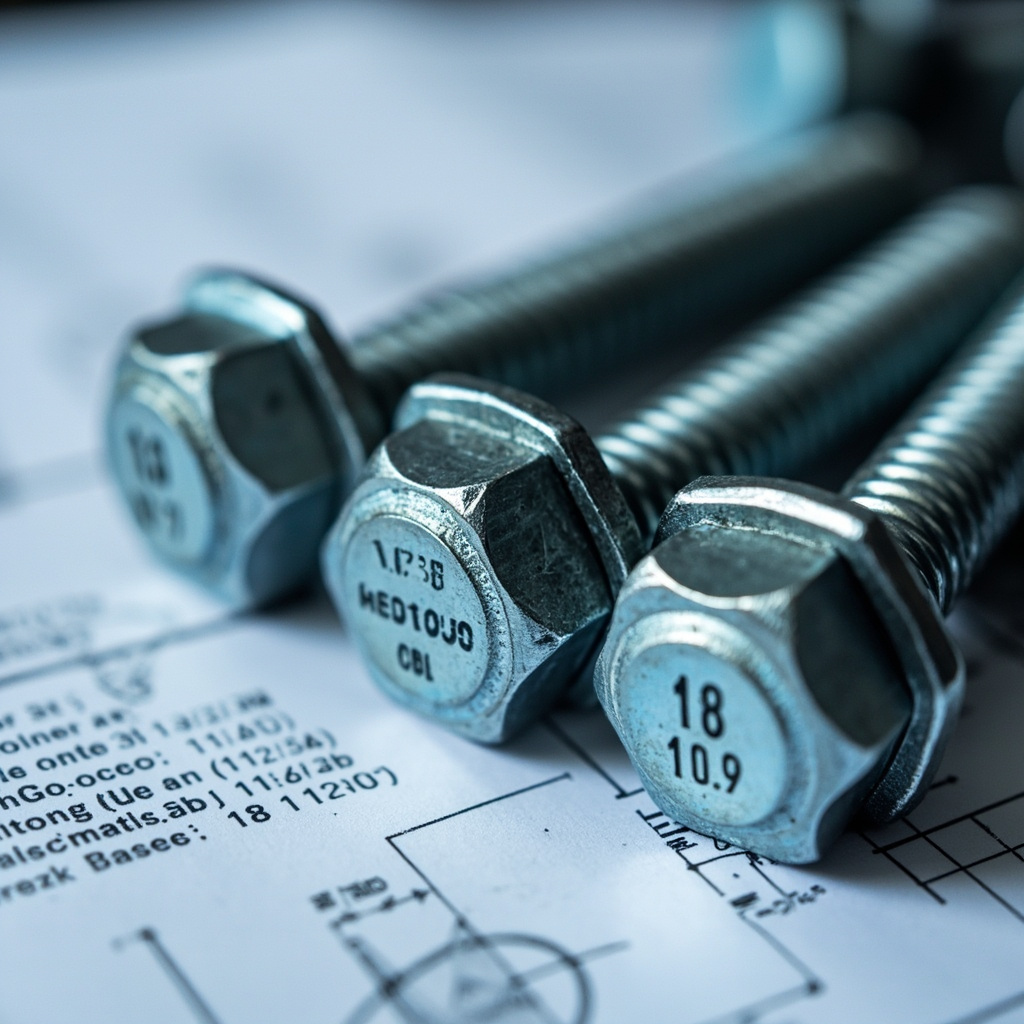
Learn to read bolt grade markings and select the right <a href="/products" class="text-primary-600 hover:text-primary-800 underline underline-offset-2"><a.
Why Bolt Grades Matter: The Cost of Getting It Wrong
Using the wrong bolt grade has real consequences. A Grade 4.6 bolt used where Grade 8.8 is required will fail at 40% of the design load. In structural applications, this means building collapse. In automotive applications, it means component failure at speed. Conversely, using Grade 12.9 where Grade 8.8 suffices wastes 3-4x cost and introduces hydrogen embrittlement risk. The global fastener failure rate is estimated at 2-5% — and 80% of failures trace back to incorrect grade selection. Related resources: high-tensile bolts anchor bolts stainless steel fasteners hex bolts lock nuts washers self-drilling screws socket screws. This procurement framework applies to fastener sourcing for construction, mining, energy, automotive, and general industrial applications. The decision logic prioritizes quality consistency, supplier reliability, and total cost of ownership over short-term unit price. For B2B buyers in Africa, Latin America, and Southeast Asia, additional considerations include regional customs requirements, container consolidation options, and payment security mechanisms. Standardized specifications that travel across projects reduce training time, RFQ processing time, and supplier onboarding effort. This procurement framework applies to fastener sourcing for construction, mining, energy, automotive, and general industrial applications. The decision logic prioritizes quality consistency, supplier reliability, and total cost of ownership over short-term unit price. For B2B buyers in Africa, Latin America, and Southeast Asia, additional considerations include regional customs requirements, container consolidation options, and payment security mechanisms. Standardized specifications that travel across projects reduce training time, RFQ processing time, and supplier onboarding effort.
How to Read Bolt Head Markings
ISO 898-1 bolt grades are stamped on the bolt head. The marking system uses two numbers separated by a dot. The first number = minimum tensile strength / 100 (in MPa). The second number = yield ratio (yield strength / tensile strength) × 10. So for Grade 8.8: tensile strength = 8 × 100 = 800 MPa, yield strength = 800 × 0.8 = 640 MPa. For imperial bolts (SAE J429), markings use radial lines: 3 lines = Grade 5, 6 lines = Grade 8, no lines = Grade 2. Standards-based procurement requires continuous learning as ISO, ASTM, DIN, and GB standards are revised every 3-5 years. Subscribe to standards update notifications and review specifications annually. The most common standards used in international fastener trade are ISO 898-1 (mechanical properties), ISO 3506-1 (stainless), ISO 3269 (acceptance inspection), ISO 4042 (coatings), and ISO 1502 (thread gauges). For B2B buyers, building a standards reference library with at least the top 20 standards relevant to your product mix is essential. Standards-based procurement requires continuous learning as ISO, ASTM, DIN, and GB standards are revised every 3-5 years. Subscribe to standards update notifications and review specifications annually. The most common standards used in international fastener trade are ISO 898-1 (mechanical properties), ISO 3506-1 (stainless), ISO 3269 (acceptance inspection), ISO 4042 (coatings), and ISO 1502 (thread gauges). For B2B buyers, building a standards reference library with at least the top 20 standards relevant to your product mix is essential.
| Grade | Tensile (MPa) | Yield (MPa) | Proof Load (MPa) | Head Marking |
|---|---|---|---|---|
| 4.6 | 400 | 240 | 225 | 4.6 |
| 5.6 | 500 | 300 | 283 | 5.6 |
| 6.8 | 600 | 480 | 448 | 6.8 |
| 8.8 | 800 | 640 | 580 | 8.8 |
| 10.9 | 1000 | 900 | 830 | 10.9 |
| 12.9 | 1200 | 1080 | 970 | 12.9 |
Grade-by-Grade Selection Guide
Grade 4.6 is the standard general-purpose bolt — made from low-carbon steel, no heat treatment required. Adequate for non-structural connections, furniture, light fixtures, and general hardware. Grade 8.8 is the workhorse of structural bolting — quenched and tempered medium-carbon steel. Required for steel structure connections, machinery mounting, and most construction applications. This is the most commonly specified grade in building codes worldwide. Grade 10.9 is high-strength structural — alloy steel with quench and temper. Used for heavy machinery, automotive suspension, crane connections, and high-stress structural joints. Grade 12.9 is the strongest standard grade — high-alloy steel with careful heat treatment. Reserved for extreme applications: automotive engine mounting, hydraulic systems, and critical structural connections. NOTE: 12.9 is susceptible to hydrogen embrittlement and must never be galvanized. The comparison methodology above uses typical ranges from industry data and TradeGo procurement experience 2018-2024. Actual market prices fluctuate with raw material costs (steel, zinc, nickel), energy costs, labor costs, and currency exchange rates. For accurate comparison, request identical RFQs from 3-5 qualified suppliers and compare landed cost (product + shipping + insurance + duties). The lowest unit price is rarely the lowest total cost of ownership. The comparison methodology above uses typical ranges from industry data and TradeGo procurement experience 2018-2024. Actual market prices fluctuate with raw material costs (steel, zinc, nickel), energy costs, labor costs, and currency exchange rates. For accurate comparison, request identical RFQs from 3-5 qualified suppliers and compare landed cost (product + shipping + insurance + duties). The lowest unit price is rarely the lowest total cost of ownership.
| Grade | Material | Heat Treatment | Typical Application | Relative Cost |
|---|---|---|---|---|
| 4.6 | Low carbon steel | None | General hardware, furniture | 1x |
| 8.8 | Medium carbon steel | Q&T | Structural steel, machinery | 1.8x |
| 10.9 | Alloy steel | Q&T | Heavy machinery, automotive | 2.5x |
| 12.9 | High alloy steel | Q&T | Critical connections, hydraulic | 3.5x |
Matching Nuts and Washers: A System Approach
A bolt is only as strong as its nut. The nut grade must match or exceed the bolt grade. ISO 898-2 defines nut designation by proof load stress. Using a Grade 4 nut with a Grade 8.8 bolt means the nut will strip before the bolt reaches its proof load. Critical rule: nut class ≥ bolt class. For Grade 8.8 bolts, use Class 8 nuts minimum. For Grade 10.9 bolts, use Class 10 nuts. Washers also matter: hard washers (HV 300+) are required for Grade 8.8 and above to prevent embedding into the connected part. The verification checklist applies to both initial supplier qualification and ongoing batch inspection. For high-risk applications (load-bearing structural, pressure vessels, mining, marine), add fatigue testing, salt-spray testing (ASTM B117), torque-tension testing, and post-installation inspection. The cost of additional verification is 0.1-0.3% of order value, while undetected quality failures can be 10-100x the order value in damages. The verification checklist applies to both initial supplier qualification and ongoing batch inspection. For high-risk applications (load-bearing structural, pressure vessels, mining, marine), add fatigue testing, salt-spray testing (ASTM B117), torque-tension testing, and post-installation inspection. The cost of additional verification is 0.1-0.3% of order value, while undetected quality failures can be 10-100x the order value in damages.
| Bolt Grade | Minimum Nut Class | Washer Hardness | Washer Standard |
|---|---|---|---|
| 4.6 | 4 | Soft (100 HV) | ISO 7089 |
| 8.8 | 8 | Hard (300 HV) | ISO 7090 |
| 10.9 | 10 | Hard (300 HV) | ISO 7090 |
| 12.9 | 12 | Hard (390 HV) | ISO 7093 |
Coating Interactions: What You Must Know
Coating choice affects bolt strength. Hot-dip galvanizing heats the bolt to ~450°C, which can alter the heat treatment of Grade 10.9 and 12.9 bolts, reducing their mechanical properties. For Grade 10.9 and above, use mechanical galvanizing or sherardizing instead. Hydrogen embrittlement is a critical risk: electroplating introduces hydrogen into the steel. For Grade 10.9 and 12.9, baking within 4 hours of plating is mandatory (4-24 hours at 190-220°C). Never electroplate Grade 12.9 bolts. Supplier evaluation should be a continuous process, not a one-time exercise. Re-evaluate suppliers annually based on delivery performance, quality metrics, price competitiveness, and responsiveness. Maintain a supplier scorecard with weighted metrics: on-time delivery (25%), quality acceptance rate (30%), price competitiveness (20%), responsiveness (15%), and documentation accuracy (10%). Drop suppliers scoring below 70% over a 6-month period and qualify replacements. Supplier evaluation should be a continuous process, not a one-time exercise. Re-evaluate suppliers annually based on delivery performance, quality metrics, price competitiveness, and responsiveness. Maintain a supplier scorecard with weighted metrics: on-time delivery (25%), quality acceptance rate (30%), price competitiveness (20%), responsiveness (15%), and documentation accuracy (10%). Drop suppliers scoring below 70% over a 6-month period and qualify replacements.
| Grade | Hot-Dip Galv | Electroplate | Mechanical Galv | Sherardizing |
|---|---|---|---|---|
| 4.6 | ✅ Safe | ✅ Safe | ✅ Safe | ✅ Safe |
| 8.8 | ✅ Safe | ⚠️ Bake required | ✅ Safe | ✅ Safe |
| 10.9 | ⚠️ May reduce strength | ⚠️ Bake mandatory | ✅ Recommended | ✅ Recommended |
| 12.9 | ❌ Not recommended | ❌ Never | ✅ Recommended | ✅ Recommended |
5 Common Procurement Mistakes
Mistake 1: Buying on price alone — Grade 4.6 bolts cost 40% less than 8.8, but using them in structural applications creates liability. Mistake 2: Not specifying grade on purchase orders — many suppliers default to Grade 4.6 unless told otherwise. Mistake 3: Mixing grades in same connection — creates uneven load distribution. Mistake 4: Substituting imperial for metric grades — SAE Grade 5 ≈ 8.8 but is not equivalent; SAE Grade 8 ≈ 10.9 but has different proof load values. Mistake 5: Ignoring nut grade — a Grade 4 nut on a Grade 8.8 bolt fails at 50% of bolt capacity. For more information, also see our guides on [hex bolt dimensions](/en/industry/hex-bolt-dimensions-chart), [high-tensile bolts](/en/industry/high-tensile-structural-bolts-guide), [carriage bolts](/en/industry/carriage-bolts-specifications). For B2B buyers operating in multiple countries, harmonize specifications with regional standards and local customs requirements. Common regional frameworks: SABS (South Africa), KEBS (Kenya), TBS (Tanzania), ZIMRA (Zimbabwe), SON (Nigeria), and AfCFTA standards for pan-Africa trade. Local standards compliance is often mandatory for public infrastructure projects, mining operations, and government tenders. For B2B buyers operating in multiple countries, harmonize specifications with regional standards and local customs requirements. Common regional frameworks: SABS (South Africa), KEBS (Kenya), TBS (Tanzania), ZIMRA (Zimbabwe), SON (Nigeria), and AfCFTA standards for pan-Africa trade. Local standards compliance is often mandatory for public infrastructure projects, mining operations, and government tenders.
Frequently Asked Questions
See frequently asked questions below.
Related resources: high-tensile bolts anchor bolts stainless steel fasteners hex bolts lock nuts washers self-drilling screws socket screws.What does the dot in 8.8 mean?
The dot separates the two numbers. First number (8) = tensile strength / 100 = 800 MPa. Second number (8) = yield ratio × 10 = 0.8, so yield strength = 800 × 0.8 = 640 MPa.
Can I use Grade 8.8 instead of 10.9?
Only if the engineering design allows it. Grade 8.8 has 80% of the tensile strength but only 71% of the yield strength of Grade 10.9. Never substitute down without engineer approval.
Are stainless steel bolts as strong as Grade 8.8?
No. Standard A2-70 stainless bolts have a tensile strength of 700 MPa — less than Grade 8.8 (800 MPa). For equivalent strength, use A4-80 or A2-80 grade stainless, but these are specialty items with premium pricing.
How do I verify bolt grade on receipt?
Check the head marking matches the purchase order specification. For critical applications, request mill test certificates (MTC) per EN 10204 Type 3.1. Random hardness testing is also recommended for large orders.
Need certified bolts and nuts in bulk? TradeGo supplies all grades with mill test certificates.
Get Quote