Learn everything about concrete anchors and <a href="/products" class="text-primary-600 hover:text-primary-800 underline underline-offset-2"><a.
Types of Concrete Anchors
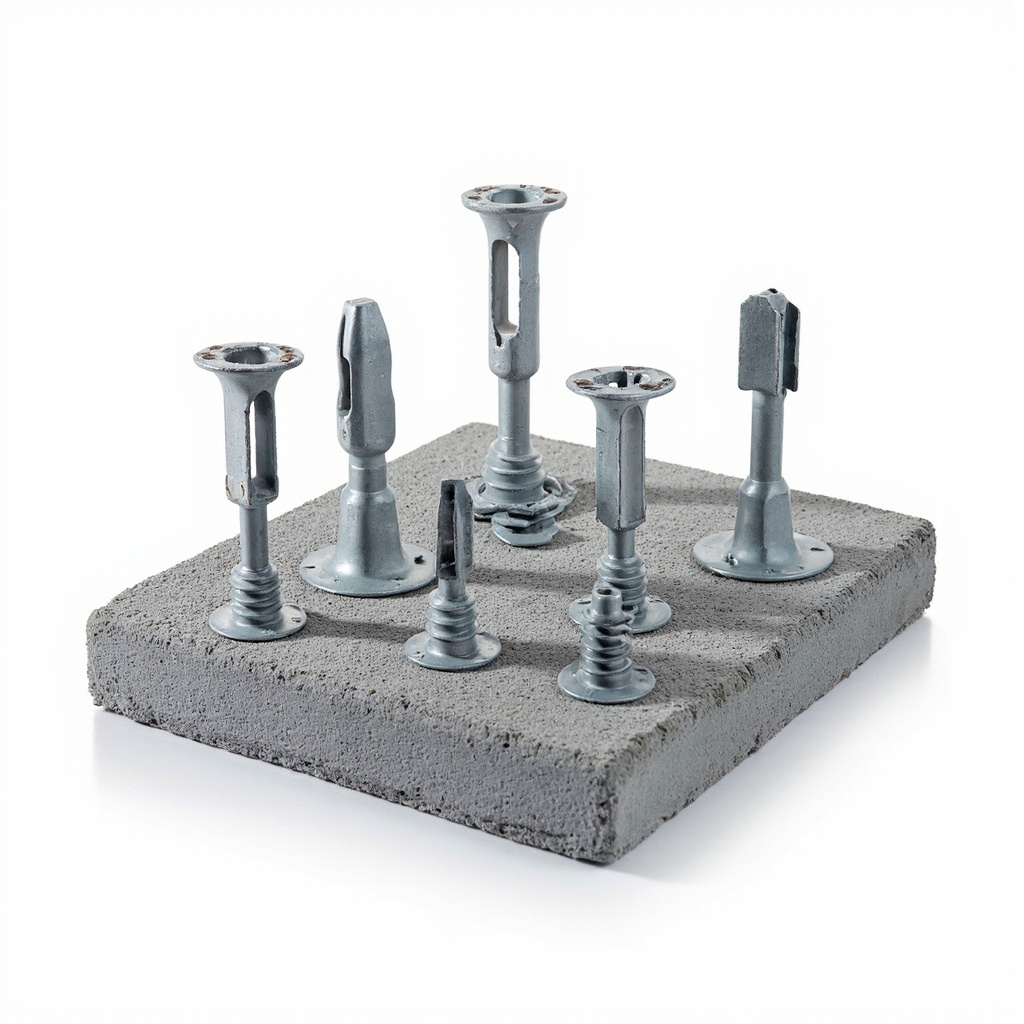
Concrete anchors are mechanical fasteners designed to secure objects to concrete, brick, or masonry surfaces. The most common types include wedge anchors, sleeve anchors, drop-in anchors, and concrete screws. Wedge anchors feature a expansion clip that locks into the concrete when the nut is tightened, making them ideal for heavy-duty applications. Sleeve anchors use a sleeve that expands against the walls of the drilled hole, suitable for medium loads. Drop-in anchors are internally threaded and set with a setting tool, providing a flush surface. Concrete screws (Tapcon-style) cut threads into the base material and can be removed and reinstalled. For construction projects across Africa and the Middle East, selecting the right anchor type depends on the base material condition, load requirements, and whether the application is temporary or permanent. Always consider the concrete's compressive strength — anchors perform differently in cracked versus uncracked concrete. Related resources: high-tensile bolts anchor bolts stainless steel fasteners hex bolts lock nuts washers self-drilling screws socket screws. This procurement framework applies to fastener sourcing for construction, mining, energy, automotive, and general industrial applications. The decision logic prioritizes quality consistency, supplier reliability, and total cost of ownership over short-term unit price. For B2B buyers in Africa, Latin America, and Southeast Asia, additional considerations include regional customs requirements, container consolidation options, and payment security mechanisms. Standardized specifications that travel across projects reduce training time, RFQ processing time, and supplier onboarding effort. This procurement framework applies to fastener sourcing for construction, mining, energy, automotive, and general industrial applications. The decision logic prioritizes quality consistency, supplier reliability, and total cost of ownership over short-term unit price. For B2B buyers in Africa, Latin America, and Southeast Asia, additional considerations include regional customs requirements, container consolidation options, and payment security mechanisms. Standardized specifications that travel across projects reduce training time, RFQ processing time, and supplier onboarding effort. This procurement framework applies to fastener sourcing for construction, mining, energy, automotive, and general industrial applications. The decision logic prioritizes quality consistency, supplier reliability, and total cost of ownership over short-term unit price. For B2B buyers in Africa, Latin America, and Southeast Asia, additional considerations include regional customs requirements, container consolidation options, and payment security mechanisms. Standardized specifications that travel across projects reduce training time, RFQ processing time, and supplier onboarding effort. This procurement framework applies to fastener sourcing for construction, mining, energy, automotive, and general industrial applications. The decision logic prioritizes quality consistency, supplier reliability, and total cost of ownership over short-term unit price. For B2B buyers in Africa, Latin America, and Southeast Asia, additional considerations include regional customs requirements, container consolidation options, and payment security mechanisms. Standardized specifications that travel across projects reduce training time, RFQ processing time, and supplier onboarding effort.
| Anchor Type | Load Rating | Best For | Installation |
|---|---|---|---|
| Wedge Anchor | Heavy Duty | Structural steel, heavy machinery | Through-hole, nut tightened |
| Sleeve Anchor | Medium Duty | Shelving, handrails, brackets | Through-hole, nut tightened |
| Drop-in Anchor | Heavy Duty | Flush-mount, threaded rod | Pre-drill, set with tool |
| Concrete Screw | Light-Medium | Frames, fixtures, electrical | Pre-drill, screw directly |
Load Capacity and Spacing Requirements
Understanding load capacity is critical when specifying concrete anchors. Each anchor type has rated values for tension (pull-out) and shear (lateral) loads. These values depend on anchor diameter, embedment depth, concrete strength, and edge distance. As a general rule, embedment depth should be at least 4 to 6 times the anchor diameter for optimal performance. Minimum edge distance is typically 12 times the anchor diameter, and minimum spacing between anchors should be 10 times the diameter. For projects in regions with seismic activity, such as parts of East Africa, anchors must meet additional requirements for cracked concrete. Always apply a safety factor of 4:1 for static loads and 8:1 for dynamic or shock loads. When ordering anchors in bulk for construction projects, specify the required proof load values and request mill test certificates to verify material compliance. Standards-based procurement requires continuous learning as ISO, ASTM, DIN, and GB standards are revised every 3-5 years. Subscribe to standards update notifications and review specifications annually. The most common standards used in international fastener trade are ISO 898-1 (mechanical properties), ISO 3506-1 (stainless), ISO 3269 (acceptance inspection), ISO 4042 (coatings), and ISO 1502 (thread gauges). For B2B buyers, building a standards reference library with at least the top 20 standards relevant to your product mix is essential. Standards-based procurement requires continuous learning as ISO, ASTM, DIN, and GB standards are revised every 3-5 years. Subscribe to standards update notifications and review specifications annually. The most common standards used in international fastener trade are ISO 898-1 (mechanical properties), ISO 3506-1 (stainless), ISO 3269 (acceptance inspection), ISO 4042 (coatings), and ISO 1502 (thread gauges). For B2B buyers, building a standards reference library with at least the top 20 standards relevant to your product mix is essential. Standards-based procurement requires continuous learning as ISO, ASTM, DIN, and GB standards are revised every 3-5 years. Subscribe to standards update notifications and review specifications annually. The most common standards used in international fastener trade are ISO 898-1 (mechanical properties), ISO 3506-1 (stainless), ISO 3269 (acceptance inspection), ISO 4042 (coatings), and ISO 1502 (thread gauges). For B2B buyers, building a standards reference library with at least the top 20 standards relevant to your product mix is essential. Standards-based procurement requires continuous learning as ISO, ASTM, DIN, and GB standards are revised every 3-5 years. Subscribe to standards update notifications and review specifications annually. The most common standards used in international fastener trade are ISO 898-1 (mechanical properties), ISO 3506-1 (stainless), ISO 3269 (acceptance inspection), ISO 4042 (coatings), and ISO 1502 (thread gauges). For B2B buyers, building a standards reference library with at least the top 20 standards relevant to your product mix is essential.
| Anchor Diameter (mm) | Min Embedment (mm) | Min Edge Distance (mm) | Typical Tension Load (kN) |
|---|---|---|---|
| 8 | 40 | 80 | 5-8 |
| 10 | 50 | 100 | 8-14 |
| 12 | 60 | 120 | 14-22 |
| 16 | 80 | 160 | 22-35 |
| 20 | 100 | 200 | 35-55 |
Installation Best Practices
Proper installation is the most important factor in anchor performance. Begin by selecting the correct drill bit — for mechanical anchors, use a carbide-tipped masonry bit matching the anchor diameter exactly. For concrete screws, use the manufacturer-recommended bit size, which is typically slightly smaller. Drill the hole to the required depth plus 10mm for dust clearance. Clean the hole thoroughly using a wire brush and compressed air or a blow-out bulb — dust residue can reduce anchor capacity by up to 50%. For wedge anchors, insert the anchor through the fixture, then tighten the nut to the specified torque. For sleeve anchors, the same through-hole method applies. Drop-in anchors require setting the anchor first, then threading the bolt. In hot climates common in Africa and the Middle East, concrete temperatures can exceed 60°C during curing, which may affect anchor performance. Schedule anchor installation after the concrete has cured for at least 28 days and has cooled to ambient temperature. For more information, also see our guides on [anchor bolts](/en/industry/anchor-bolts-foundation-guide), [concrete screws](/en/industry/concrete-screws-anchors-guide), [quality standards](/en/industry/fastener-quality-control-iso9001). The comparison methodology above uses typical ranges from industry data and TradeGo procurement experience 2018-2024. Actual market prices fluctuate with raw material costs (steel, zinc, nickel), energy costs, labor costs, and currency exchange rates. For accurate comparison, request identical RFQs from 3-5 qualified suppliers and compare landed cost (product + shipping + insurance + duties). The lowest unit price is rarely the lowest total cost of ownership. The comparison methodology above uses typical ranges from industry data and TradeGo procurement experience 2018-2024. Actual market prices fluctuate with raw material costs (steel, zinc, nickel), energy costs, labor costs, and currency exchange rates. For accurate comparison, request identical RFQs from 3-5 qualified suppliers and compare landed cost (product + shipping + insurance + duties). The lowest unit price is rarely the lowest total cost of ownership. The comparison methodology above uses typical ranges from industry data and TradeGo procurement experience 2018-2024. Actual market prices fluctuate with raw material costs (steel, zinc, nickel), energy costs, labor costs, and currency exchange rates. For accurate comparison, request identical RFQs from 3-5 qualified suppliers and compare landed cost (product + shipping + insurance + duties). The lowest unit price is rarely the lowest total cost of ownership. The comparison methodology above uses typical ranges from industry data and TradeGo procurement experience 2018-2024. Actual market prices fluctuate with raw material costs (steel, zinc, nickel), energy costs, labor costs, and currency exchange rates. For accurate comparison, request identical RFQs from 3-5 qualified suppliers and compare landed cost (product + shipping + insurance + duties). The lowest unit price is rarely the lowest total cost of ownership.
Can I install anchors in wet concrete?
No. Mechanical anchors must be installed in fully cured concrete (minimum 28 days). Wet or green concrete does not provide adequate compressive strength for reliable anchor performance.
What if the anchor spins when I tighten the nut?
This usually means the hole is oversized or the anchor is not properly expanded. Remove the anchor, redrill with the correct bit size if needed, and reinstall. Never overtighten as this can damage the expansion mechanism.
Frequently Asked Questions
See frequently asked questions below.
Related resources: high-tensile bolts anchor bolts stainless steel fasteners hex bolts lock nuts washers self-drilling screws socket screws. The verification checklist applies to both initial supplier qualification and ongoing batch inspection. For high-risk applications (load-bearing structural, pressure vessels, mining, marine), add fatigue testing, salt-spray testing (ASTM B117), torque-tension testing, and post-installation inspection. The cost of additional verification is 0.1-0.3% of order value, while undetected quality failures can be 10-100x the order value in damages. The verification checklist applies to both initial supplier qualification and ongoing batch inspection. For high-risk applications (load-bearing structural, pressure vessels, mining, marine), add fatigue testing, salt-spray testing (ASTM B117), torque-tension testing, and post-installation inspection. The cost of additional verification is 0.1-0.3% of order value, while undetected quality failures can be 10-100x the order value in damages. The verification checklist applies to both initial supplier qualification and ongoing batch inspection. For high-risk applications (load-bearing structural, pressure vessels, mining, marine), add fatigue testing, salt-spray testing (ASTM B117), torque-tension testing, and post-installation inspection. The cost of additional verification is 0.1-0.3% of order value, while undetected quality failures can be 10-100x the order value in damages. The verification checklist applies to both initial supplier qualification and ongoing batch inspection. For high-risk applications (load-bearing structural, pressure vessels, mining, marine), add fatigue testing, salt-spray testing (ASTM B117), torque-tension testing, and post-installation inspection. The cost of additional verification is 0.1-0.3% of order value, while undetected quality failures can be 10-100x the order value in damages.What are Technical Guide and how are they used?
Technical Guide are essential components in construction and manufacturing. Proper selection depends on load requirements, environmental conditions, and material compatibility.
How do I choose the right fastener for my project?
Consider the material being fastened, load requirements, environmental exposure, and applicable standards. Consult with a professional if unsure about specifications.
What materials are available for these fasteners?
Common materials include carbon steel, stainless steel, alloy steel, and specialty alloys. Each offers different strength, corrosion resistance, and cost characteristics.
Do you offer custom manufacturing?
Yes, we offer custom fastener manufacturing to spec. Contact our sales team with your requirements for pricing and lead times.
Need concrete anchors for your next project? Get competitive pricing and bulk quotes from TradeGo Fasteners.
Get Quote