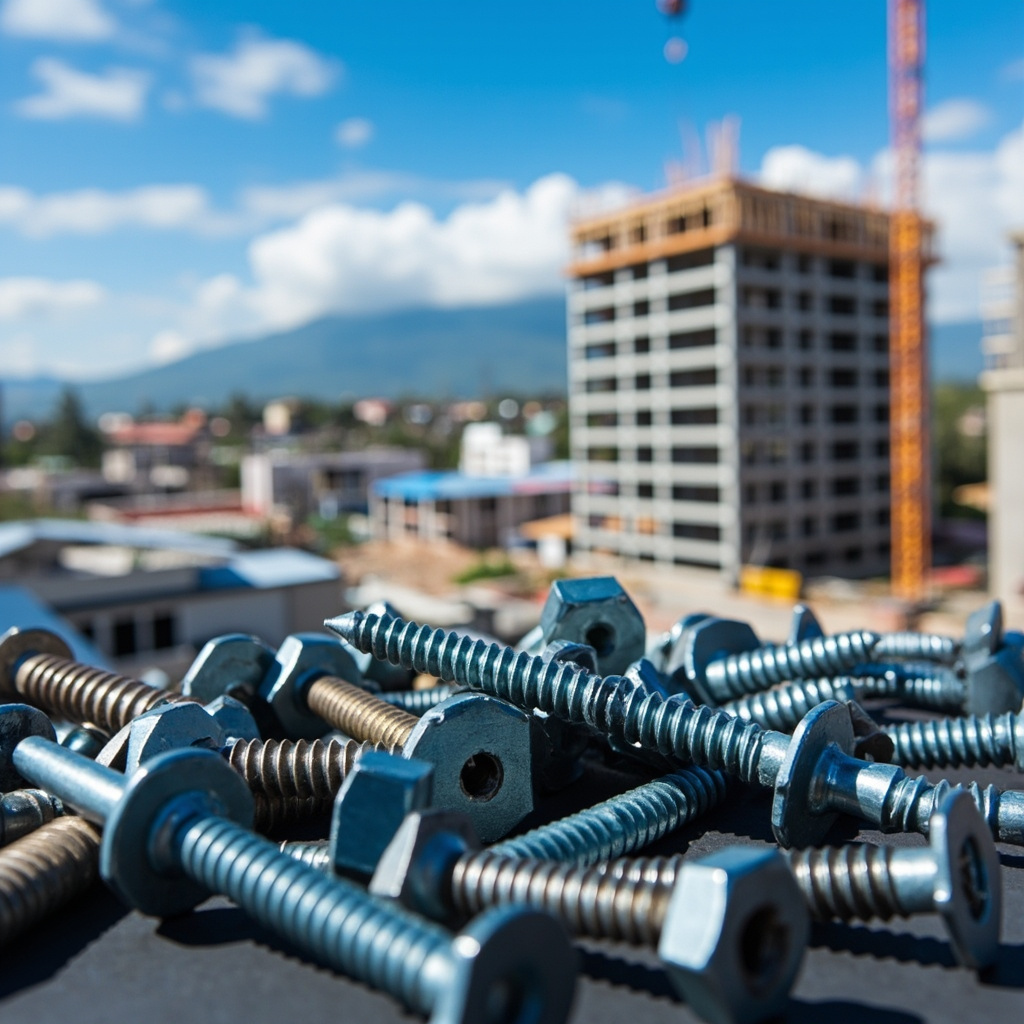
Rwanda construction fastener standards: ISO 898-1, EN 14399, RSB, MININFRA, EAC requirements for B2B fastener sourcing in Kigali and major projects.
Overview of Rwanda Construction Fastener Standards
Construction fasteners used in Rwanda are regulated through a combination of national legislation, technical standards published by the Rwanda Standards Board (RSB), building regulations administered by the Ministry of Infrastructure (MININFRA), and regional harmonization efforts under the East African Community (EAC).[1][2][3]
The Rwanda Standards Board serves as the national standards authority responsible for developing, adopting, and enforcing technical specifications for industrial products, including construction materials.[1] Many mechanical fastener requirements are aligned with internationally recognized ISO and EN standards rather than unique domestic specifications, simplifying sourcing for international EPC contractors.
Major public infrastructure projects—including roads, bridges, industrial facilities, hospitals, schools, and affordable housing developments—typically specify internationally accepted structural fastener standards such as:
ISO 898-1 for mechanical properties of carbon steel bolts
ISO 898-2 for nuts
ISO 4014 and ISO 4017 for hex bolts
ISO 4032 for hex nuts
ISO 7089 and ISO 7090 for washers
ISO 3506 for stainless steel fasteners
EN 14399 for high-strength structural bolting
ASTM A325/A490 (legacy projects)
ASTM F3125 structural bolts
Using recognized international standards simplifies quality verification because inspectors can compare manufacturer certificates directly against globally accepted performance criteria.
For procurement managers, compliance matters throughout the supply chain. Non-compliant fasteners may pass visual inspection but fail tensile testing, hardness verification, or coating thickness measurements during project acceptance. Such failures can delay commissioning and create significant replacement costs.
Rwanda's construction sector has expanded alongside national development programs emphasizing resilient infrastructure and urbanization. Government projects increasingly require documented quality assurance, mill certificates, traceability, and factory inspection reports.[2]
From a purchasing perspective, buyers should verify:
ISO 9001-certified manufacturing
Material certificates (EN 10204 3.1 where specified)
Mechanical test reports
Coating test records
Dimensional inspection reports
Batch traceability
Packing suitable for East African transport conditions
These documents significantly reduce inspection risks during customs clearance and project delivery.[1][4]
Key Certified Materials for Rwanda Construction Fastener Standards
Material selection is one of the most critical aspects of Rwanda construction fastener standards because environmental conditions vary considerably between urban construction, mountainous regions, agricultural zones, and infrastructure exposed to seasonal rainfall.
The most common approved materials include:
Carbon steel
Medium carbon alloy steel
Boron steel
Stainless steel A2 (304)
Stainless steel A4 (316)
Carbon steel remains the dominant choice for general structural construction because it provides excellent strength-to-cost performance. Typical property classes include:
Class 4.8
Class 5.8
Class 8.8
Class 10.9
Class 12.9
For structural steel connections, Grade 8.8 remains the preferred commercial solution because it balances strength, availability, and installation reliability.
Corrosion protection is equally important.
Procurement managers often compare zinc-plated fasteners with hot-dip galvanized (HDG) alternatives.
Electro-zinc plating offers:
Lower cost
Better appearance
Suitable indoor applications
Thin coating (typically 5–25 μm)
Hot-dip galvanizing provides:
Coating thickness commonly exceeding 50 μm
Superior corrosion resistance
Longer outdoor service life
Better protection for bridges and utility infrastructure
Although HDG fasteners cost more initially, lifecycle maintenance costs are substantially lower in exposed environments. For government-funded infrastructure expected to operate for decades, HDG is generally preferred over electroplated products.
Where chloride exposure or aggressive industrial environments exist, stainless steel A4 fasteners outperform galvanized carbon steel despite higher procurement costs.
Material verification generally includes:
Chemical composition analysis
Tensile testing
Yield strength testing
Hardness testing
Impact testing where specified
Coating adhesion verification
Salt spray corrosion testing
Manufacturers exporting to Rwanda should maintain complete production records for every manufacturing batch. Batch traceability enables rapid investigation should any field performance issues arise.
International buyers increasingly request EN 10204 inspection certificates, especially for infrastructure financed by multilateral development agencies. Such documentation demonstrates that raw materials and finished products meet specified mechanical and chemical requirements before shipment.[1][3][5]
Dimensional & Performance Specs for Rwanda Construction Fasteners
Dimensional accuracy is fundamental to structural safety because improperly manufactured fasteners may create uneven load distribution, insufficient preload, or installation difficulties.
Construction projects in Rwanda commonly specify metric fasteners including:
M6
M8
M10
M12
M16
M20
M24
M30
M36
Thread tolerances generally follow ISO metric standards to ensure compatibility between imported bolts, nuts, washers, and structural steel components.
Performance requirements typically include:
Tensile Strength
Typical bolt property classes include:
Property ClassMinimum Tensile Strength4.8400 MPa5.8500 MPa8.8800 MPa10.91040 MPa12.91220 MPa
Selecting an unnecessarily high-strength fastener can actually increase project costs without improving performance. Procurement managers should purchase according to engineering calculations rather than assuming higher grades are always superior.
Preload consistency is another critical requirement.
High-strength friction-grip connections rely on proper bolt tension rather than simple bearing. Therefore, dimensional tolerances on thread pitch, shank diameter, and nut engagement directly influence structural reliability.
Anchor bolts deserve particular attention.
Rather than selecting generic anchor bolts, engineers often specify:
ASTM F1554 Grade 36
ASTM F1554 Grade 55
ASTM F1554 Grade 105
Compared with fabricated low-grade alternatives, ASTM F1554 provides certified mechanical properties and predictable performance for concrete foundations.
Weather resistance is equally important.
Exterior fasteners should maintain coating integrity under prolonged UV exposure, seasonal rainfall, and varying humidity conditions. Coating thickness measurements, adhesion testing, and corrosion resistance evaluations therefore form part of many quality inspection procedures.
Factory quality control should include:
Thread gauge inspection
Torque testing
Proof load testing
Dimensional sampling
Surface finish inspection
Coating thickness measurement
Packing verification
These inspections reduce installation problems on construction sites and minimize costly project delays caused by rejected shipments.[1][3]
Compliance Certification for Rwandan Construction Fastener Imports
Construction fastener imports entering Rwanda should be accompanied by complete technical documentation demonstrating conformity with applicable standards.
Typical documentation includes:
Commercial invoice
Packing list
Bill of lading
Certificate of origin
Material certificates
Mill test reports
Mechanical testing reports
Inspection certificates
Product specifications
The Rwanda Revenue Authority oversees customs procedures while technical conformity may involve verification under applicable import requirements.[4]
Many government and donor-funded projects also require independent third-party inspection before shipment.
Pre-shipment inspection may include:
Quantity verification
Product identification
Mechanical testing review
Packaging inspection
Container loading supervision
Procurement managers should request digital copies of all certificates before production is completed rather than waiting until shipment.
This allows sufficient time to resolve documentation inconsistencies without delaying export schedules.
Traceability has become increasingly important.
Each production batch should be traceable through:
Heat number
Production date
Batch code
Inspection record
Packing identification
This information simplifies warranty investigations and supports quality management systems.
Failure to provide compliant documentation can result in:
Customs delays
Additional inspections
Project rejection
Increased storage costs
Replacement procurement
Contract penalties
For large infrastructure contracts, delayed fastener deliveries can affect structural steel erection schedules, creating substantial downstream costs far exceeding the value of the fasteners themselves.
Experienced exporters therefore integrate compliance management into production planning instead of treating certification as a final administrative task.
Working with manufacturers familiar with African export documentation significantly reduces logistics risks and improves project execution reliability.[1][4][6]
Common Fastener Types Meeting Rwanda Construction Standards
Construction projects across Rwanda utilize different fastener categories depending on structural requirements.
Typical approved products include:
Structural Bolts
Used for:
Steel buildings
Warehouses
Industrial plants
Transmission towers
Bridges
Common grades include Property Class 8.8 and 10.9 with HDG coatings for outdoor applications.
Anchor Bolts
Widely used in:
Concrete foundations
Equipment installation
Power substations
Industrial machinery
Water treatment plants
ASTM F1554 certified anchor bolts provide predictable strength compared with fabricated non-certified alternatives.
Threaded Rods
Suitable for:
HVAC systems
Pipe supports
Suspended ceilings
Industrial installations
Property Class 4.8, 5.8, and 8.8 are commonly specified.
Self-Drilling Screws
Used for:
Roofing
Steel cladding
Sandwich panels
Commercial buildings
EPDM sealing washers improve weather resistance and reduce leakage.
Stainless Steel Fasteners
Preferred for:
Food processing facilities
Water infrastructure
Chemical plants
Coastal or corrosive environments
Although procurement costs are higher, maintenance costs remain significantly lower over the service life.
Procurement managers should avoid purchasing products lacking:
Grade markings
Mechanical certificates
Coating verification
Traceability
Standardized dimensions
Unmarked fasteners frequently cannot be verified during project inspections, creating unnecessary compliance risks.
For public infrastructure funded by government agencies or international organizations, certified products from audited manufacturers consistently outperform low-cost uncertified alternatives in lifecycle value and project acceptance.[2][5][6]
How Tradego Meets Rwanda Construction Fastener Standards
Tradego manufactures export-oriented fasteners designed to satisfy the quality expectations of African construction markets, including Rwanda.
Production begins with carefully controlled raw material procurement from qualified steel suppliers. Incoming materials undergo chemical composition verification before entering manufacturing.
Throughout production, quality control includes:
Wire inspection
Cold forming inspection
Heat treatment monitoring
Thread rolling verification
Surface treatment inspection
Final dimensional inspection
Mechanical performance testing
Testing capabilities include:
Tensile strength
Hardness
Torque
Proof load
Coating thickness
Salt spray corrosion resistance
For Rwanda construction projects, Tradego can manufacture products conforming to:
ISO standards
EN standards
ASTM specifications
DIN standards
Available export products include:
Hex bolts
Heavy hex bolts
Structural bolts
Anchor bolts
Threaded rods
Hex nuts
Flat washers
Spring washers
Self-drilling screws
Roofing screws
For infrastructure buyers, complete documentation packages can include:
Mill test certificates
Material certificates
Mechanical test reports
Inspection reports
Packing verification
Batch traceability
Certificate of origin
Packaging is optimized for long-distance ocean transport to East Africa, reducing corrosion risk during shipping and inland logistics.
Tradego also supports custom manufacturing for EPC contractors requiring:
Non-standard dimensions
Special coatings
Project-specific packaging
OEM branding
Mixed container loading
This integrated manufacturing and documentation approach helps procurement managers reduce inspection delays, improve project compliance, and ensure reliable installation performance throughout Rwanda's expanding construction sector.
Frequently Asked Questions
P: ¿Cuáles son los principales requisitos regulatorios para los sujetadores de construcción en Ruanda?\n\nR: Los sujetadores de construcción en Ruanda están regulados por la Oficina de Normas de Ruanda (RSB). Todos los sujetadores de construcción deben cumplir con las normas ISO o las normas nacionales ruandesas equivalentes. La normativa principal de referencia es RSB/Z 001-2018, "Requisitos técnicos generales para sujetadores metálicos utilizados en construcción" [1]. Los sujetadores importados también deben obtener un certificado de certificación de producto de la RSB y cumplir con las regulaciones pertinentes de la Ley de Facilitación del Comercio y la Inversión.\n\nP: ¿Cuáles son los requisitos especiales para los materiales de pernos utilizados en entornos con H2S?\n\nR: En entornos corrosivos con H2S, se deben seleccionar materiales resistentes al agrietamiento por tensión de sulfuros. Los pernos ASTM A193 Grado B7 son una opción común, su material es acero aleado de cromo-molibdeno templado. Para entornos más exigentes, se recomienda usar ASTM A193 Grado B7M o grados de acero inoxidable (como 304/316). Todos los materiales deben proporcionar informes de prueba de compatibilidad con H2S que cumplan con los requisitos de la norma NACE MR0175 [2].\n\nP: ¿Cómo seleccionar el grado de pernos estructurales de alta resistencia?\n\nR: Los pernos estructurales de alta resistencia se clasifican en grados 8.8, 10.9 y 12.9 según la norma ISO 898-1. El grado 8.8 es aplicable a estructuras de construcción general; el grado 10.9 se recomienda para edificios de gran altura y puentes; el grado 12.9 se utiliza para aplicaciones especiales de carga pesada. En la selección se deben considerar la carga de diseño, el coeficiente de seguridad y el grosor de la placa de conexión. La resistencia a la tracción de los pernos de grado 10.9 no es inferior a 1040 MPa, y la resistencia a la fluencia no es inferior a 940 MPa [3].\n\nP: ¿Cómo se regulan los códigos HS y los aranceles para los sujetadores de construcción en Ruanda?\n\nR: Los códigos HS para sujetadores de construcción se clasifican principalmente en la categoría 7318. Las subdivisiones específicas incluyen: pernos y tuercas comunes de acero al carbono (7318.12), tornillos y espárragos (7318.14), arandelas (7318.21) y remaches (7318.23). Los aranceles de importación varían según el tipo de producto y el país de origen, con tasas impositivas aplicables entre 10% y 25%. Los productos chinos pueden beneficiarse de tratamiento arancelario preferencial bajo la Ley Africana de Crecimiento y Oportunidades (AGOA).\n\nP: ¿Cuáles son los requisitos especiales para los sujetadores utilizados en equipos de cabeza de pozo de campos petroleros y gasíferos?\n\nR: Los sujetadores utilizados en equipos de cabeza de pozo deben cumplir con las normas API 6A o API 6D. Los anillos de sellado de la serie BX son componentes clave del sellado de la cabeza del pozo, fabricados con materiales de aleación especial según lo establecido en el Anexo B de API 6A. Los pernos de conexión de bridas deben usar pernos de alta resistencia que cumplan con los requisitos de API 6A PSP. Los materiales deben someterse a pruebas estrictas de tenacidad al impacto, con un rango de temperatura de trabajo通常 de -29°C a +121°C. Cuando la presión parcial de H2S supere 0.05 psi, se deben utilizar materiales de aleación especial resistentes a la corrosión.\n\nP: ¿Qué documentos de calidad se deben revisar al adquirir sujetadores de construcción?\n\nR: Los documentos de calidad obligatorios para revisión incluyen: certificados de trazabilidad de materiales (MTC) que muestren la composición química y las propiedades mecánicas; informes de tratamiento térmico; informes de pruebas de dureza; informes de inspección dimensional; y certificados de cualificación para acabados superficiales (como galvanizado, Dacrotizado). Para productos certificados por API, también se deben proporcionar certificados API 6A e informes de verificación de diseño. Todos los documentos deben ser trazables hasta números de lote específicos y fechas de producción.
Tradego manufactures export-oriented fasteners designed to satisfy the quality expectations of African construction markets, including Rwanda.
Production begins with carefully controlled raw material procurement from qualified steel suppliers. Incoming materials undergo chemical composition verification before entering manufacturing. Throughout production, quality control includes: Wire inspection Cold forming inspection Heat treatment monitoring Thread rolling verification Surface treatment inspection Final dimensional inspection Mechanical performance testing Testing capabilities include: Tensile strength Hardness Torque Proof load Coating thickness Salt spray corrosion resistance For Rwanda construction projects, Tradego can manufacture products conforming to: ISO standards EN standards ASTM specifications DIN standards Available export products include: Hex bolts Heavy hex bolts Structural bolts Anchor bolts Threaded rods Hex nuts Flat washers Spring washers Self-drilling screws Roofing screws For infrastructure buyers, complete documentation packages can include: Mill test certificates Material certificates Mechanical test reports Inspection reports Packing verification Batch traceability Certificate of origin Packaging is optimized for long-distance ocean transport to East Africa, reducing corrosion risk during shipping and inland logistics. Tradego also supports custom manufacturing for EPC contractors requiring: Non-standard dimensions Special coatings Project-specific packaging OEM branding Mixed container loading This integrated manufacturing and documentation approach helps procurement managers reduce inspection delays, improve project compliance, and ensure reliable installation performance throughout Rwanda's expanding construction sector.
What are the mandatory standards for construction fasteners in Rwanda?
Rwanda enforces national construction requirements through the Rwanda Standards Board while aligning many specifications with internationally recognized ISO and East African Community standards. Certified mechanical properties, corrosion resistance, material quality, and traceable manufacturing documentation are expected for structural construction applications.[1][3]
Do imported construction fasteners need certification for Rwanda?
Yes. Imported construction fasteners should include appropriate compliance documentation, such as material certificates, inspection reports, and relevant quality records. Customs and project owners may require verification before products are accepted for distribution or construction use.[1][4]
Which fastener materials are approved for Rwandan construction?
High-quality carbon steel, alloy steel, and stainless steel are commonly accepted for construction projects. Material selection depends on structural loading, environmental exposure, corrosion resistance requirements, and applicable engineering specifications.[1][3]
Are there size specifications for Rwanda building fasteners?
Yes. Rwanda commonly uses standardized metric fasteners following ISO dimensional standards. Standard bolt sizes from M6 to M36 are widely specified for residential, commercial, industrial, and infrastructure projects, ensuring compatibility across construction systems.[1][3] How can buyers ensure fasteners comply with Rwanda construction standards? Procurement managers should source from manufacturers operating certified quality management systems, verify mechanical testing reports, request complete inspection documentation, confirm batch traceability, and perform pre-shipment quality inspections before export. This significantly reduces customs delays and project compliance risks.[1][4]
Need {topic} for your B2B project? TradeGo supplies ISO/EN/ASTM certified fasteners with full documentation and factory-direct pricing.
Request Quote