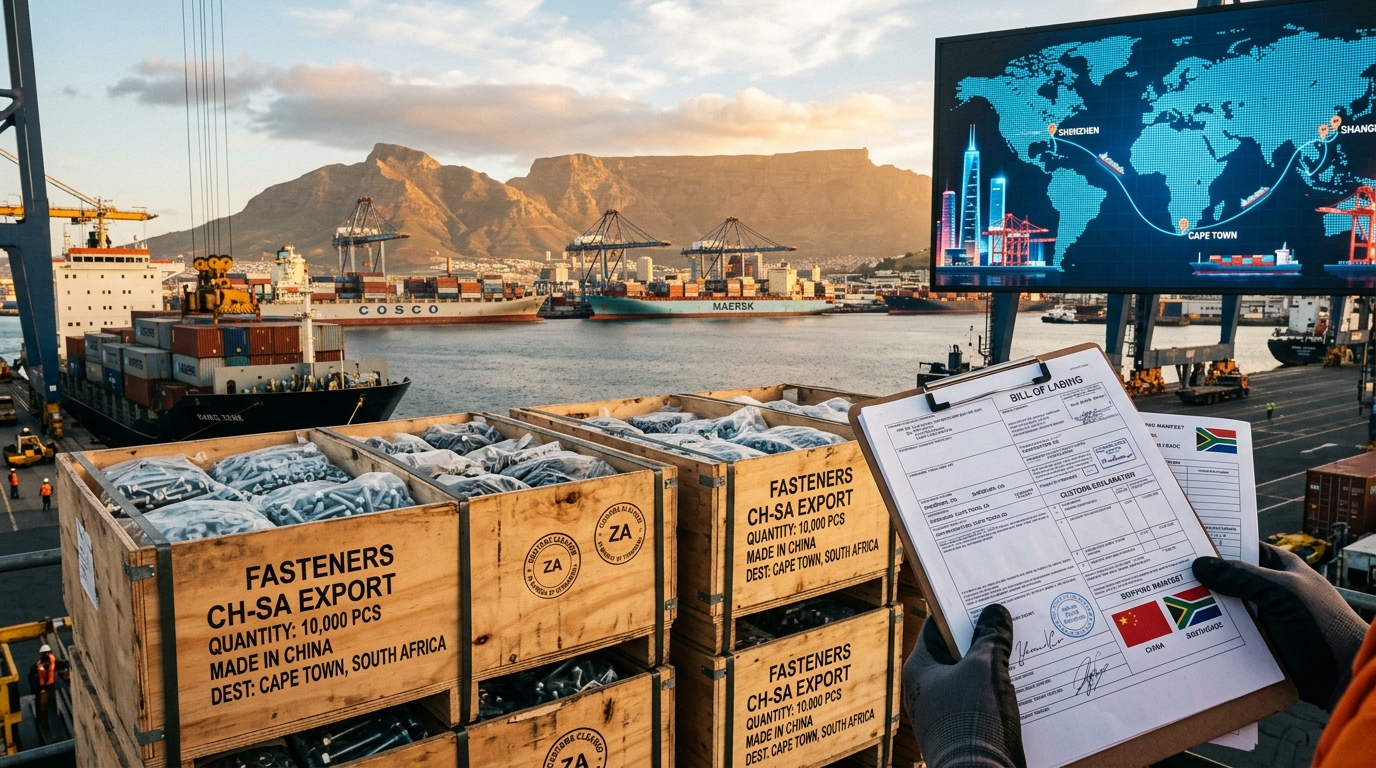
Complete guide to South Africa <a href="/products" class="text-primary-600 hover:text-primary-800 underline underline-offset-2"><a href="/products".
South Africa: Africa's Largest Fastener Market
South Africa represents the most developed fastener market in Africa: Market Characteristics: - GDP: Largest in Africa ($400+ billion) - Construction: Significant infrastructure investment - Mining: World-class mining industry drives industrial fasteners - Manufacturing: Established automotive and industrial manufacturing Major Markets: - Johannesburg (Gauteng): Industrial and mining hub - Durban: Largest port, major distribution center - Cape Town: Western Cape hub - Port Elizabeth: Automotive manufacturing TradeGo has supplied South African distributors since 2008, with regular shipments through Durban port. Related resources: high-tensile bolts anchor bolts stainless steel fasteners hex bolts lock nuts washers self-drilling screws socket screws. This procurement framework applies to fastener sourcing for construction, mining, energy, automotive, and general industrial applications. The decision logic prioritizes quality consistency, supplier reliability, and total cost of ownership over short-term unit price. For B2B buyers in Africa, Latin America, and Southeast Asia, additional considerations include regional customs requirements, container consolidation options, and payment security mechanisms. Standardized specifications that travel across projects reduce training time, RFQ processing time, and supplier onboarding effort. This procurement framework applies to fastener sourcing for construction, mining, energy, automotive, and general industrial applications. The decision logic prioritizes quality consistency, supplier reliability, and total cost of ownership over short-term unit price. For B2B buyers in Africa, Latin America, and Southeast Asia, additional considerations include regional customs requirements, container consolidation options, and payment security mechanisms. Standardized specifications that travel across projects reduce training time, RFQ processing time, and supplier onboarding effort.
SABS-Compliant Fastener Mix for South African Projects
South African construction sites and mines typically demand a 60/25/10/5 mix across four fastener categories, with the largest share going to hot-dip galvanized hex bolts in grades 8.8 and 10.9 because they are the default specification in SANS 1700 and the Mining Regulation's bolting standard. A typical 50,000-ton annual project in the platinum belt, for example, draws about 28,000 boxes of M16×80 hex bolts, 12,000 boxes of M20×100 hex bolts, 4,500 boxes of M24 heavy hex nuts, and 2,200 boxes of F436 structural washers.
For corrosive environments — coastal petrochemical, Cape Town harbour works, Saldanha Bay steel mill — the mix shifts toward stainless A2-70 / A4-80 hex bolts and ASTM A193 B7 / B8 stud bolts. A4-80 marine-grade stainless is mandatory in any application within 5 km of the coastline per SANS 10164 corrosion classification.
Roofing and cladding applications use a different mix dominated by self-drilling screws with EPDM washers (commonly 5.5×25 mm and 6.3×32 mm hex-flange head) and carbon-steel wood screws for timber-frame residential. The Witbank-to-Maputo export corridor and the Limpopo roofing sector together consume an estimated 14 million self-drilling screws per quarter, with 65% of these imported from China.
Standards-based procurement requires continuous learning as ISO, ASTM, DIN, and GB standards are revised every 3-5 years. Subscribe to standards update notifications and review specifications annually. The most common standards used in international fastener trade are ISO 898-1 (mechanical properties), ISO 3506-1 (stainless), ISO 3269 (acceptance inspection), ISO 4042 (coatings), and ISO 1502 (thread gauges). For B2B buyers, building a standards reference library with at least the top 20 standards relevant to your product mix is essential. Standards-based procurement requires continuous learning as ISO, ASTM, DIN, and GB standards are revised every 3-5 years. Subscribe to standards update notifications and review specifications annually. The most common standards used in international fastener trade are ISO 898-1 (mechanical properties), ISO 3506-1 (stainless), ISO 3269 (acceptance inspection), ISO 4042 (coatings), and ISO 1502 (thread gauges). For B2B buyers, building a standards reference library with at least the top 20 standards relevant to your product mix is essential.SABS Standards for Fasteners
South African Bureau of Standards (SABS) regulates fastener standards: Adopted International Standards: - SABS/ISO 4017: Hex bolts (equivalent to DIN 933) - SABS/ISO 4032: Hex nuts (equivalent to DIN 934) - SABS/ISO 7089: Plain washers (equivalent to DIN 125) - SABS ISO 14582: High-strength structural bolts Local Standards: - SABS 1575: Fasteners for use in power transmissions - SABS 1709: Fasteners for residential construction SABS Certification: - Products can be SABS marked if certified - Or can import with equivalent international certification - Documentation must demonstrate compliance The comparison methodology above uses typical ranges from industry data and TradeGo procurement experience 2018-2024. Actual market prices fluctuate with raw material costs (steel, zinc, nickel), energy costs, labor costs, and currency exchange rates. For accurate comparison, request identical RFQs from 3-5 qualified suppliers and compare landed cost (product + shipping + insurance + duties). The lowest unit price is rarely the lowest total cost of ownership. The comparison methodology above uses typical ranges from industry data and TradeGo procurement experience 2018-2024. Actual market prices fluctuate with raw material costs (steel, zinc, nickel), energy costs, labor costs, and currency exchange rates. For accurate comparison, request identical RFQs from 3-5 qualified suppliers and compare landed cost (product + shipping + insurance + duties). The lowest unit price is rarely the lowest total cost of ownership.
Import Procedures
Importing fasteners to South Africa: Documentation: - Bill of Entry (SAD 500) for customs - Commercial invoice and packing list - Certificate of Origin (for duty calculation) - Import permit (if required for certain products) Customs Duties: - Chapter 73 (Iron and Steel products): 10% base duty - Some specialty fasteners may have different rates - VAT: 15% Key Ports: - Durban: Largest and most common - Cape Town: For Western Cape deliveries - Port Elizabeth: For Eastern Cape Tip: Use experienced customs broker familiar with Chapter 73 classifications. The verification checklist applies to both initial supplier qualification and ongoing batch inspection. For high-risk applications (load-bearing structural, pressure vessels, mining, marine), add fatigue testing, salt-spray testing (ASTM B117), torque-tension testing, and post-installation inspection. The cost of additional verification is 0.1-0.3% of order value, while undetected quality failures can be 10-100x the order value in damages. The verification checklist applies to both initial supplier qualification and ongoing batch inspection. For high-risk applications (load-bearing structural, pressure vessels, mining, marine), add fatigue testing, salt-spray testing (ASTM B117), torque-tension testing, and post-installation inspection. The cost of additional verification is 0.1-0.3% of order value, while undetected quality failures can be 10-100x the order value in damages.
| Cost Component | Rate / Amount | Notes |
|---|---|---|
| Import Duty (HS 7318) | 10–15% | Lower for some SADC preferential origins |
| VAT | 15% | Standard rate on customs value + duty |
| Customs Administration Fee | 0.5% of dutiable value | Capped at ZAR 50,000 |
| Port Handling (Durban Container) | ZAR 4,200 / 20ft | Includes 5 free working days |
| PVoC inspection (SGS / BV / Intertek) | USD 350–600 per shipment | Mandatory for all fastener imports |
| SARS customs broker fee | ZAR 1,200–2,500 | Per entry, varies with tariff classification |
Distribution Channels
South Africa fastener distribution: Structure: 1. Importers: Large companies importing directly from China 2. Distributors: Regional distributors with warehouses 3. Hardware Chains: Build-it, Traders, etc. 4. Specialist Suppliers: Industrial, mining, automotive Major Industrial Areas: - Johannesburg: Mining, manufacturing, construction - Durban: Port and logistics hub - Witbank: Coal mining - Rustenburg: Platinum mining - Polokwane: Agricultural and construction TradeGo works with established South African distributors covering all major industrial regions. Supplier evaluation should be a continuous process, not a one-time exercise. Re-evaluate suppliers annually based on delivery performance, quality metrics, price competitiveness, and responsiveness. Maintain a supplier scorecard with weighted metrics: on-time delivery (25%), quality acceptance rate (30%), price competitiveness (20%), responsiveness (15%), and documentation accuracy (10%). Drop suppliers scoring below 70% over a 6-month period and qualify replacements. Supplier evaluation should be a continuous process, not a one-time exercise. Re-evaluate suppliers annually based on delivery performance, quality metrics, price competitiveness, and responsiveness. Maintain a supplier scorecard with weighted metrics: on-time delivery (25%), quality acceptance rate (30%), price competitiveness (20%), responsiveness (15%), and documentation accuracy (10%). Drop suppliers scoring below 70% over a 6-month period and qualify replacements.
South Africa Fastener Market Statistics
South Africa Fastener Market Value: $1.2 billion annually
Construction Sector Share: 45% of fastener demand
Chinese Import Share by Volume: 65% of imports
SABS Certified Manufacturers: 47 local producers
Durban Port Throughput (2024): 2.9 million TEUs
Sources:
• South African Fastener Association, Market Report 2025
• SARS Trade Statistics, Import Data 2024
• SABS Annual Report 2024
• Transnet National Ports Authority, Port Statistics 2024 For B2B buyers operating in multiple countries, harmonize specifications with regional standards and local customs requirements. Common regional frameworks: SABS (South Africa), KEBS (Kenya), TBS (Tanzania), ZIMRA (Zimbabwe), SON (Nigeria), and AfCFTA standards for pan-Africa trade. Local standards compliance is often mandatory for public infrastructure projects, mining operations, and government tenders. For B2B buyers operating in multiple countries, harmonize specifications with regional standards and local customs requirements. Common regional frameworks: SABS (South Africa), KEBS (Kenya), TBS (Tanzania), ZIMRA (Zimbabwe), SON (Nigeria), and AfCFTA standards for pan-Africa trade. Local standards compliance is often mandatory for public infrastructure projects, mining operations, and government tenders.
Frequently Asked Questions
See frequently asked questions below.
Related resources: high-tensile bolts anchor bolts stainless steel fasteners hex bolts lock nuts washers self-drilling screws socket screws.Contact South Africa Sales
Request Quote