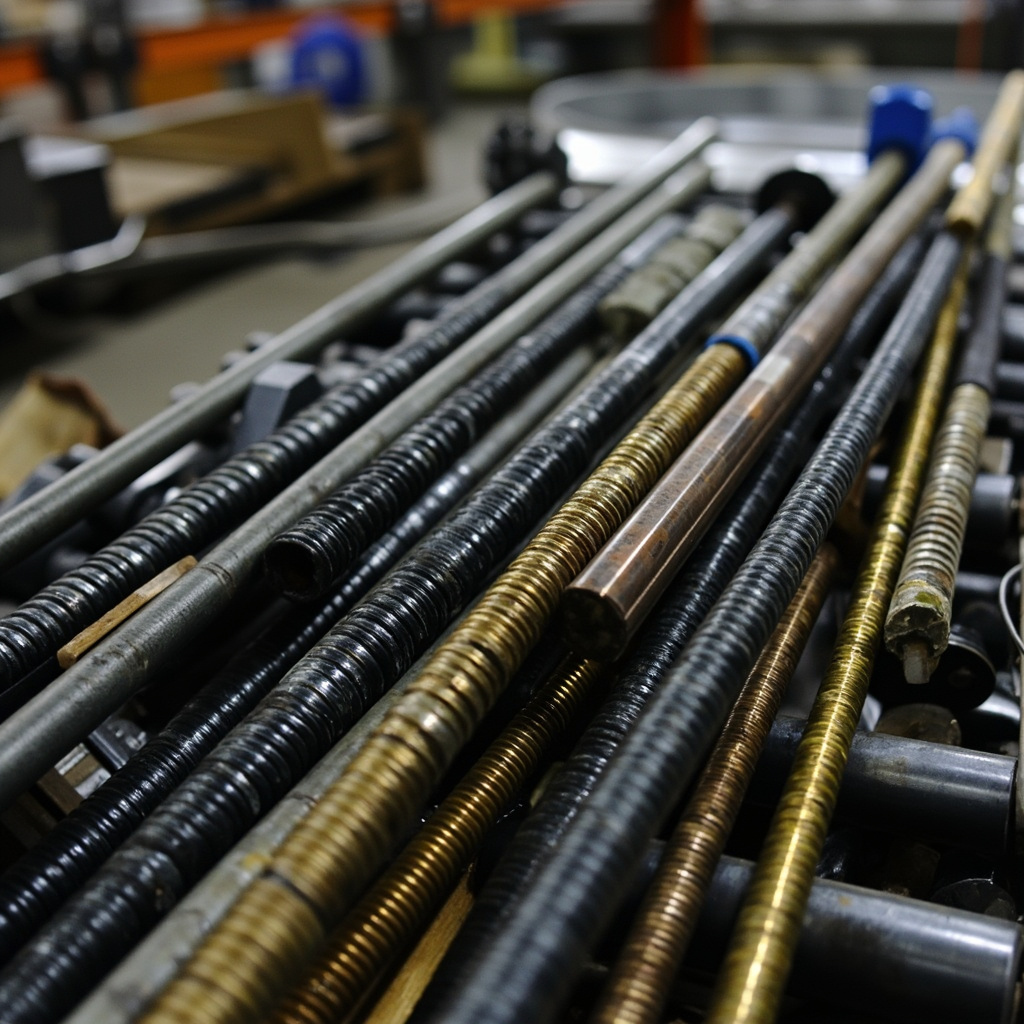
Threaded rod selection guide: materials, coatings, load ratings, and applications. Complete reference for choosing the right threaded rod for.
Understanding Threaded Rod
Threaded rod (also called all-thread or stud bolt) is a fastener with continuous threads along its entire length. This versatile product serves countless applications in construction, mining, manufacturing, and maintenance. Threaded rod is available in various materials, diameters, lengths, and thread specifications to meet diverse application requirements. Common specifications: Metric: M6, M8, M10, M12, M16, M20, M24, M30, M36 Inch: 1/4" through 2" and larger Lengths: Typically 1m to 3m, custom lengths available Grades: 4.6, 8.8, 10.9 for carbon steel; A2, A4 for stainless Threaded rod is typically cut to length from longer stock, but TradeGo offers standard lengths ready for immediate use. TradeGo supplies threaded rod in various materials and coatings for African construction, mining, and industrial applications. Related resources: high-tensile bolts anchor bolts stainless steel fasteners hex bolts lock nuts washers self-drilling screws socket screws. This procurement framework applies to fastener sourcing for construction, mining, energy, automotive, and general industrial applications. The decision logic prioritizes quality consistency, supplier reliability, and total cost of ownership over short-term unit price. For B2B buyers in Africa, Latin America, and Southeast Asia, additional considerations include regional customs requirements, container consolidation options, and payment security mechanisms. Standardized specifications that travel across projects reduce training time, RFQ processing time, and supplier onboarding effort. This procurement framework applies to fastener sourcing for construction, mining, energy, automotive, and general industrial applications. The decision logic prioritizes quality consistency, supplier reliability, and total cost of ownership over short-term unit price. For B2B buyers in Africa, Latin America, and Southeast Asia, additional considerations include regional customs requirements, container consolidation options, and payment security mechanisms. Standardized specifications that travel across projects reduce training time, RFQ processing time, and supplier onboarding effort. This procurement framework applies to fastener sourcing for construction, mining, energy, automotive, and general industrial applications. The decision logic prioritizes quality consistency, supplier reliability, and total cost of ownership over short-term unit price. For B2B buyers in Africa, Latin America, and Southeast Asia, additional considerations include regional customs requirements, container consolidation options, and payment security mechanisms. Standardized specifications that travel across projects reduce training time, RFQ processing time, and supplier onboarding effort.
Materials and Coatings
Threaded rod materials must be selected based on strength requirements and environmental conditions: Carbon Steel: Most common choice for general applications. Zinc-plated for indoor use, hot-dip galvanized for outdoor and corrosive environments. Stainless Steel A2 (304): Excellent corrosion resistance for indoor and outdoor applications. Suitable for most environments not involving chlorides. Stainless Steel A4 (316): Superior chloride corrosion resistance for coastal and marine applications. Recommended for beachfront construction and offshore installations. Alloy Steel (ASTM A193 B7): High-strength option for demanding applications including pressure vessels, high-temperature piping, and heavy machinery. Coatings for carbon steel threaded rod: Zinc Plating: Standard indoor corrosion protection. Cost-effective for controlled environments. Hot-Dip Galvanizing: 40-60 micrometer zinc coating provides excellent outdoor durability. Essential for outdoor construction in African climates. Dacromet: High corrosion resistance with good temperature performance. Suitable for demanding environments. Black Oxide: Cosmetic finish with minimal protection. Indoor use only. For African applications, hot-dip galvanized threaded rod is recommended for outdoor construction due to humid tropical conditions and salt exposure in coastal areas. Standards-based procurement requires continuous learning as ISO, ASTM, DIN, and GB standards are revised every 3-5 years. Subscribe to standards update notifications and review specifications annually. The most common standards used in international fastener trade are ISO 898-1 (mechanical properties), ISO 3506-1 (stainless), ISO 3269 (acceptance inspection), ISO 4042 (coatings), and ISO 1502 (thread gauges). For B2B buyers, building a standards reference library with at least the top 20 standards relevant to your product mix is essential. Standards-based procurement requires continuous learning as ISO, ASTM, DIN, and GB standards are revised every 3-5 years. Subscribe to standards update notifications and review specifications annually. The most common standards used in international fastener trade are ISO 898-1 (mechanical properties), ISO 3506-1 (stainless), ISO 3269 (acceptance inspection), ISO 4042 (coatings), and ISO 1502 (thread gauges). For B2B buyers, building a standards reference library with at least the top 20 standards relevant to your product mix is essential. Standards-based procurement requires continuous learning as ISO, ASTM, DIN, and GB standards are revised every 3-5 years. Subscribe to standards update notifications and review specifications annually. The most common standards used in international fastener trade are ISO 898-1 (mechanical properties), ISO 3506-1 (stainless), ISO 3269 (acceptance inspection), ISO 4042 (coatings), and ISO 1502 (thread gauges). For B2B buyers, building a standards reference library with at least the top 20 standards relevant to your product mix is essential.
Common Applications
Threaded rod serves many construction and industrial applications: Structural Connections: - Anchor rod for concrete foundations - Boundary rods for structural steel connections - Hanger rods for suspended ceilings and mechanical systems - Bracing rods for structural stability Mechanical Installations: - Pump and motor mounting - Conveyor support structures - HVAC equipment mounting - Generator and transformer foundations Plumbing and Pipe Support: - Pipe hangers and supports - Sprinkler system mounting - Plumbing fixture installation - DWV (drain, waste, vent) system supports Mining Applications: - Ground support reinforcement - Equipment anchoring in processing plants - Conveyor structure connections - Tunnel and shaft construction Marine and Coastal: - Dock and pier construction - Seawall and breakwater installations - Marina infrastructure - Offshore platform mounting Threaded rod is often used with nuts and washers on both ends to create adjustable connections or anchor points. This adjustability makes threaded rod ideal for applications where precise length cannot be determined in advance. The comparison methodology above uses typical ranges from industry data and TradeGo procurement experience 2018-2024. Actual market prices fluctuate with raw material costs (steel, zinc, nickel), energy costs, labor costs, and currency exchange rates. For accurate comparison, request identical RFQs from 3-5 qualified suppliers and compare landed cost (product + shipping + insurance + duties). The lowest unit price is rarely the lowest total cost of ownership. The comparison methodology above uses typical ranges from industry data and TradeGo procurement experience 2018-2024. Actual market prices fluctuate with raw material costs (steel, zinc, nickel), energy costs, labor costs, and currency exchange rates. For accurate comparison, request identical RFQs from 3-5 qualified suppliers and compare landed cost (product + shipping + insurance + duties). The lowest unit price is rarely the lowest total cost of ownership. The comparison methodology above uses typical ranges from industry data and TradeGo procurement experience 2018-2024. Actual market prices fluctuate with raw material costs (steel, zinc, nickel), energy costs, labor costs, and currency exchange rates. For accurate comparison, request identical RFQs from 3-5 qualified suppliers and compare landed cost (product + shipping + insurance + duties). The lowest unit price is rarely the lowest total cost of ownership.
Load Ratings and Engineering
Understanding threaded rod load capacity is essential for safe applications: tensile strength ratings by grade: M10 Grade 4.6: 23.2 kN ultimate, 15.5 kN working (3:1 safety factor) M12 Grade 4.6: 33.7 kN ultimate, 22.5 kN working M16 Grade 4.6: 62.3 kN ultimate, 41.5 kN working M20 Grade 8.8: 122 kN ultimate, 81 kN working M24 Grade 8.8: 176 kN ultimate, 117 kN working Critical engineering considerations: Thread engagement: Minimum thread engagement of 1 diameter for full strength (ISO 898). For anchor applications, 2-3 diameters into concrete is recommended. Connection design: Threaded rod in tension requires nut and washer on both ends for proper load distribution. Shear loading: Threaded rod has lower shear strength than tensile strength. Design connections to avoid shear loading where possible. Combined loading: Analyze both tensile and shear forces. Use interaction formulas for combined loading conditions. Fatigue: Dynamic loading requires consideration of fatigue life. Consider using fine thread for better fatigue resistance. For critical structural applications, consult a licensed structural engineer. TradeGo provides technical data but engineering responsibility rests with the designer. The verification checklist applies to both initial supplier qualification and ongoing batch inspection. For high-risk applications (load-bearing structural, pressure vessels, mining, marine), add fatigue testing, salt-spray testing (ASTM B117), torque-tension testing, and post-installation inspection. The cost of additional verification is 0.1-0.3% of order value, while undetected quality failures can be 10-100x the order value in damages. The verification checklist applies to both initial supplier qualification and ongoing batch inspection. For high-risk applications (load-bearing structural, pressure vessels, mining, marine), add fatigue testing, salt-spray testing (ASTM B117), torque-tension testing, and post-installation inspection. The cost of additional verification is 0.1-0.3% of order value, while undetected quality failures can be 10-100x the order value in damages. The verification checklist applies to both initial supplier qualification and ongoing batch inspection. For high-risk applications (load-bearing structural, pressure vessels, mining, marine), add fatigue testing, salt-spray testing (ASTM B117), torque-tension testing, and post-installation inspection. The cost of additional verification is 0.1-0.3% of order value, while undetected quality failures can be 10-100x the order value in damages.
Frequently Asked Questions
See frequently asked questions below.
Related resources: high-tensile bolts anchor bolts stainless steel fasteners hex bolts lock nuts washers self-drilling screws socket screws. Supplier evaluation should be a continuous process, not a one-time exercise. Re-evaluate suppliers annually based on delivery performance, quality metrics, price competitiveness, and responsiveness. Maintain a supplier scorecard with weighted metrics: on-time delivery (25%), quality acceptance rate (30%), price competitiveness (20%), responsiveness (15%), and documentation accuracy (10%). Drop suppliers scoring below 70% over a 6-month period and qualify replacements. Supplier evaluation should be a continuous process, not a one-time exercise. Re-evaluate suppliers annually based on delivery performance, quality metrics, price competitiveness, and responsiveness. Maintain a supplier scorecard with weighted metrics: on-time delivery (25%), quality acceptance rate (30%), price competitiveness (20%), responsiveness (15%), and documentation accuracy (10%). Drop suppliers scoring below 70% over a 6-month period and qualify replacements. Supplier evaluation should be a continuous process, not a one-time exercise. Re-evaluate suppliers annually based on delivery performance, quality metrics, price competitiveness, and responsiveness. Maintain a supplier scorecard with weighted metrics: on-time delivery (25%), quality acceptance rate (30%), price competitiveness (20%), responsiveness (15%), and documentation accuracy (10%). Drop suppliers scoring below 70% over a 6-month period and qualify replacements.What length threaded rod should I order?
Order slightly longer than needed, then cut to exact length on-site. Standard lengths of 1m, 2m, and 3m cover most requirements. For custom lengths, contact TradeGo for availability.
Can threaded rod be used for underground mining support?
Yes, but use appropriate material for the environment. Hot-dip galvanized or stainless steel for humid underground conditions. Some mining applications require specialized corrosion-resistant coatings.
What's the difference between fine thread and coarse thread?
Coarse thread (standard metric) is easier to assemble and provides better fatigue resistance. Fine thread offers better adjustment precision and higher load capacity in the same diameter.
How do I cut threaded rod on site?
Use a hacksaw with fine-tooth blade, angle grinder with cutting disc, or pipe cutter for smaller diameters. Wear safety glasses and protect threads from debris.
Can I weld threaded rod?
Carbon steel threaded rod can be welded using appropriate procedures. Remove any plating or coating before welding. Stainless rod requires specialized welding techniques.
Contact TradeGo for threaded rod and fastening solutions. Email: sales@tradego-fasteners.com
Request Quote