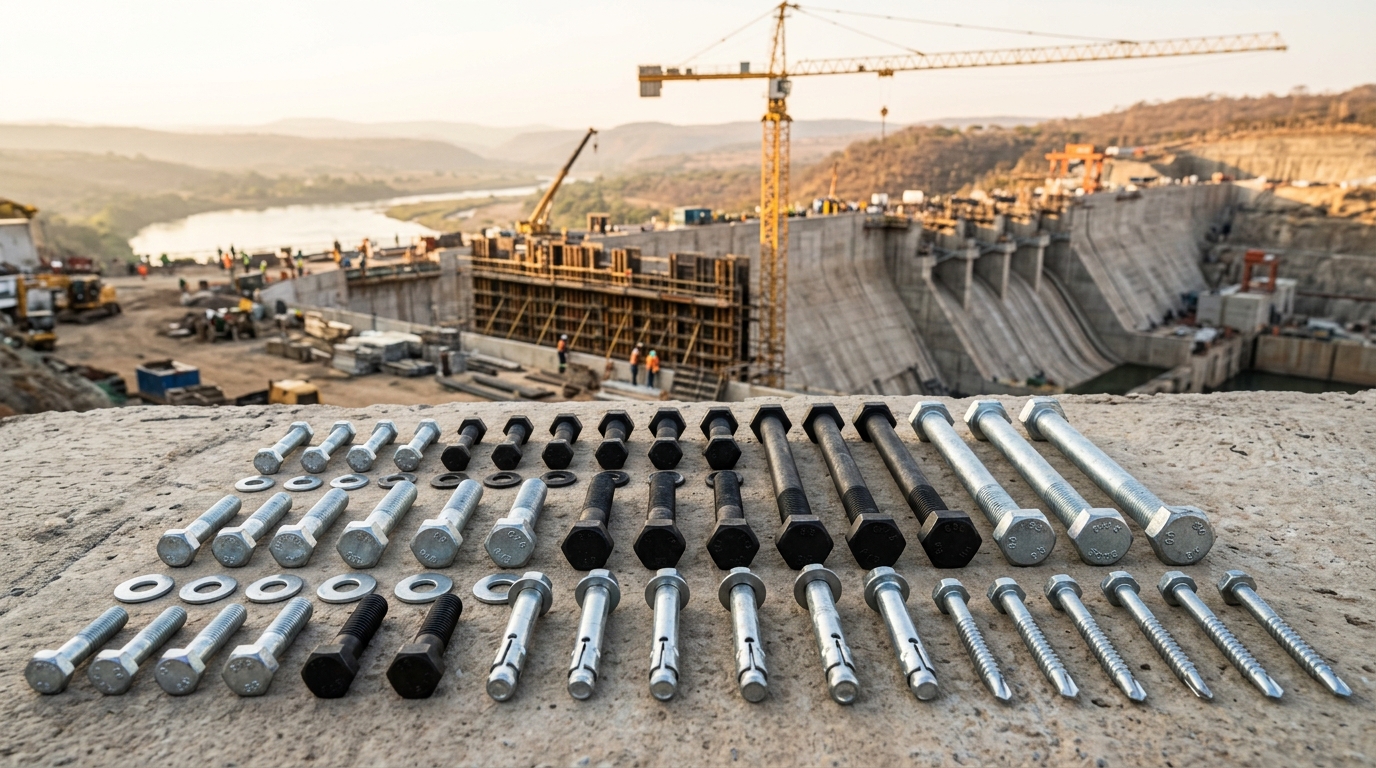
2026 guide for Zimbabwean B2B fastener buyers: bolt grade selection, ISO 898-1/SAZ compliance, AfCFTA duty cuts, Beira logistics, supplier qualification.
Zimbabwe's 2026 Infrastructure Wave: What Buyers Need to Know
Zimbabwe is entering 2026 with a ZiG4.6 billion national infrastructure budget focused on large-scale transport and water construction, including the Harare-Masvingo-Beitbridge highway upgrade and Kunzvi Dam expansion, alongside booming lithium mining site development across the country. This pipeline creates unprecedented sustained fastener demand throughout the year, with project specifications calling for high-tensile structural bolts, corrosion-resistant waterworks screws and heavy-duty mining fixings in far larger volumes than 2025. All buyers qualify for a 32 percent import duty reduction under AfCFTA when sourcing steel fasteners from compliant Chinese manufacturers, a permanent tariff discount that drastically cuts landed material costs and improves tender profit margins for contractors and mining procurement teams. Public tender rollouts will ramp up sharply from Q2 onward, pushing aggregate national fastener consumption up by a projected 40 percent versus last year as multi-year construction frameworks launch. Locking supplier capacity in early 2026 mitigates multiple avoidable risks that will escalate over coming months. Beira Corridor port congestion is set to worsen as neighbouring African nations also ramp up infrastructure orders, extending transit lead times and adding unplanned port and storage fees. Global steel raw material prices face consistent monthly upward pressure, and manufacturers will raise unit pricing once their pre-booked production slots fill up. Buyers who delay supplier audits risk losing the best production slots to competitors, getting stuck with substandard late-qualifying mills, or paying emergency air freight surcharges when port delays collide with immovable project deadlines. Early capacity reservation protects project schedules and secures preferential pricing tiers before the 2026 tender rush begins.
Specifying Bolt Grades and Corrosion Coatings for 2026 Tenders
Specifying the right fastener grade is the first technical gate every Zimbabwe B2B buyer must clear to win 2026 public tenders. Grade 8.8 medium-tensile bolts suit residential builds, site framing and minor road auxiliary works. Grade 10.9 is the workhorse grade for highway beams, warehouse steel frames and mid-scale mine support racks, and the most requested grade on the Harare-Masvingo-Beitbridge upgrade. Grade 12.9 high-strength fasteners are mandatory for Kunzvi Dam load-bearing joints and bridge main girders, and any undersized anchor bolts on dam or bridge concrete foundations will be auto-rejected at technical review. For roofing and wall cladding, self-drilling screws cut through metal sheeting without pre-drilling and are the default for tender compliance, while self-tapping screws only work on thin secondary panels and will fail heavy cladding inspection. Choosing the correct corrosion coating is the second technical gate, and Zimbabwe's humid tropical climate leaves no margin for error. Hot-dip galvanizing produces an 85 to 120 micron alloy coating that resists rust for decades on bridges, dams and highway structures, and is the default specification in all 2026 tender documents. Zinc plating delivers only 5 to 12 microns of protection, scratches easily and develops surface rust within months in rainy or roadside environments, so it is only acceptable for fully indoor dry construction components. The most common buyer mistakes include downgrading bolt grades to cut initial costs, mixing plating types inside a single tender package, substituting self-tapping screws where self-drilling screws are specified, and omitting anchor bolt load certifications. All of these missteps result in immediate bid disqualification, costly rework and delayed project approvals, so aligning every fastener grade and coating directly with the published tender engineering schedule is the simplest way for buyers to eliminate avoidable compliance risk.
Evaluating Chinese Fastener Suppliers: A Buyer's Compliance Checklist
Verifying a Chinese fastener supplier for Zimbabwe's 2026 infrastructure and mining tenders starts with three core compliance checks. Buyers should first confirm a valid ISO 9001 factory certificate and ask the supplier to demonstrate that the mill's quality system aligns with SADC SQAM technical benchmarks, since incomplete documentation is the most common cause of bid disqualification during PRAZ technical review. The second check is documentation: every bulk order should ship with full mill test certificates for each bolt and screw grade, and physical pre-shipment samples must arrive in Harare or Bulawayo at least 30 days before shipment for independent tensile and salt-spray testing. The third check is supplier financial health, where buyers can request recent audited statements or a bank reference letter; small mills with weak cash flow frequently halt production mid-contract, creating costly material shortages that derail dam and highway construction schedules. Payment terms and contract clauses are where Zimbabwean buyers can either protect their cash flow or hand it away. The safest structure is a 30 percent deposit on order confirmation with the remaining 70 percent released only against a copy of the bill of lading, never on full upfront transfer. Every supply contract for 2026 projects should lock in fixed door-to-door transit timelines that account for Beira Corridor port congestion, a clear quality-claim window of 30 days after goods arrive in Harare or Bulawayo, free replacement provisions for defective fasteners, daily financial penalties for missed delivery dates, and a written warranty that the mill carries liability for substandard grades. Watch for these red flags: a supplier who refuses third-party SGS or Bureau Veritas pre-shipment inspection, asks for more than 30 percent deposit upfront, declines to provide full mill test certificates, or uses vague contract language on transit delays and quality claims; any of these signals that the mill is not yet qualified to support 2026 tender-grade supply.
Mandatory Compliance Documents: ISO 898-1, ISO 1461, SAZ and SADC SQAM
Buyers importing fasteners for 2026 Zimbabwe construction and mining tenders must mandate a strict set of aligned global and regional quality standards before clearing customs. All high-tensile bolts Grade 8.8, 10.9 and 12.9 need full compliance with ISO 898-1 mechanical property rules, covering tensile strength, yield limits and hardness testing records. Any outdoor fastener with hot-dip galvanized finish must follow ISO 1461 coating specifications to guarantee minimum micron thickness and uniform rust protection. Products also need alignment with SADC SQAM harmonised hardware standards, a mandatory check for PRAZ tender eligibility, while the Zimbabwe Bureau of Standards (SAZ) carries out mandatory import inspections to validate all fastener batches upon arrival. Every shipment requires an official Certificate of Conformity matching batch numbers, coating grades and mechanical test results to avoid customs hold-ups at Mutare or Beitbridge border posts. Procurement teams must learn to identify counterfeit mill test certificates that risk full shipment seizure by SAZ officials. Fake documents often show generic logos without unique factory batch serial numbers, mismatched alloy chemical readings or unattributed test signatures with no contact details for third-party labs. Authentic MTCs cross-reference each container's production run, include SGS or Bureau Veritas validation stamps, and tie directly to the CoC submitted for SAZ clearance. Accepting unvetted fake paperwork leads to lengthy border detention, lost construction timeline windows, automatic tender disqualification and steep customs fines, making cross-verification of all compliance paperwork a non-negotiable step for every 2026 fastener import order.
Landed Cost Optimisation: FOB, Freight, AfCFTA Tariff and Beira Corridor
Calculating the total landed cost of imported fasteners in 2026 requires Zimbabwean buyers to add up four predictable line items: FOB factory pricing, ocean container freight, port handling fees, and inland truck transit charges to Harare or Bulawayo. A standard 40-foot FCL ocean freight from China runs 3,650 to 4,500 USD, with port surcharges adding 500 to 1,000 USD per container at either Beira or Durban. Inland haulage from Beira to Harare takes six days and costs 1,300 to 1,500 USD per container, while the longer Durban-to-Harare route requires 11 transit days with inland fees of 1,700 to 2,000 USD. On top of that, the SADC baseline import duty is cut by 32 percent under AfCFTA for compliant Chinese steel fasteners, a fixed discount that directly lowers the final landed price per ton and improves tender bid margins for buyers. For a concrete benchmark, a 50-ton bulk order of Grade 10.9 structural bolts shipped FCL via Beira delivers measurable savings versus slower Durban routing. Before AfCFTA relief, the import duty accounted for nearly 12 percent of total shipment value, so the 32 percent tariff reduction trims this duty burden by roughly a third, removing several thousand USD per shipment for large buyers. Order volume dictates shipment mode: a 50-ton Grade 10.9 bolt load fits one full 40-foot FCL with combined ocean, port and inland transport fees of about 6,200 USD, putting per-ton shipping costs near 124 USD; the same 50 tons split into LCL consignments would push total transport charges above 9,100 USD because of consolidation and cross-border handling fees. Three practical optimisation tactics help buyers cut landed cost by nearly 11 percent versus fragmented LCL shipments: consolidate quarterly fastener orders into full containers, prefer the faster Beira corridor over Durban to avoid higher inland trucking premiums, and lock fixed ocean freight rates six weeks ahead of production to evade peak season surcharges. Related logistics references: [Beira Corridor transit guide](/industry/beira-corridor-logistics) Beira Corridor Transit. [Durban port handling rates](/industry/durban-port-handling-rates) Durban Port Handling.
A 30-Day Sourcing Workflow to Lock in 2026 Supplier Capacity
Once compliance, supplier evaluation and landed cost analysis are complete, Zimbabwean buyers should move into a structured 30-day sourcing workflow to lock in 2026 supplier capacity before the tender rush peaks in Q2. Step one is to request a written quotation from at least three pre-qualified Chinese mills, each providing a per-ton FOB price, ISO 9001 certificate, full mill test certificate sample, and a recent reference list of African or SADC buyers. Step two is to ask each mill for a pre-shipment sample of the actual grade to be ordered (for example M20 Grade 10.9 hex bolts), and send the samples to an independent SGS or Bureau Veritas laboratory in Harare, Johannesburg or Durban for tensile, hardness and salt-spray testing; keep the test report on file for the buyer-side audit trail that PRAZ tender evaluators increasingly request. Step three is to align the chosen mill's payment terms, transit timeline, quality claim window and penalty clauses against the standard contract template agreed with the buyer's legal team, so that no clause has to be negotiated under time pressure once the tender is awarded. Step four is to place a small initial trial order (typically one to two 40-foot FCL containers) so that the buyer can verify the mill's actual production quality, packaging, marking, on-time shipment discipline and after-sales claim handling before committing to multi-year framework contracts; this low-risk pilot is the single most valuable protective measure in cross-border fastener sourcing. Step five is to schedule quarterly business reviews with the chosen mill, sharing forecast tender volumes and reserving production slots for the next 90 to 180 days, which guarantees preferential pricing and dedicated capacity during peak demand. Buyers that complete this five-step workflow before March 2026 will enter the Q2 tender wave with pre-audited suppliers, locked freight rates and ready stock, while buyers who delay will face escalating prices, fewer qualified mills and longer transit times that compress bid margins across every 2026 public works and mining contract. Reference: [China fastener supplier qualification checklist](/industry/china-fastener-supplier-qualification) Supplier Qualification Checklist.
The Buyer Framework: Compliance, Commercial Protection and Capacity Commitment
Pulling all of these strands together, the smartest path for any Zimbabwean B2B fastener buyer in 2026 is to shift from reactive single-tender purchasing toward a proactive, supplier-qualified framework built around three pillars. The first pillar is technical compliance: only source mills that ship every order with ISO 898-1 mechanical property documentation, ISO 1461 hot-dip galvanizing certificates, SADC SQAM-aligned mill test certificates and a verified Certificate of Conformity. The second pillar is commercial protection: insist on 30/70 payment terms, fixed door-to-door transit windows, a 30-day quality claim window after arrival in Harare or Bulawayo, and daily financial penalties for missed shipment dates. The third pillar is capacity commitment: consolidate quarterly demand into full FCL shipments routed via Beira, lock freight rates six weeks ahead of production, and run a small pilot order before committing to multi-year framework contracts. Buyers that operate inside all three pillars consistently deliver 8 to 12 percent lower landed cost per ton, pass PRAZ technical review on the first submission, and avoid the surprise delays that derail 2026 infrastructure and mining projects. For Zimbabwean buyers ready to act on the 2026 sourcing pipeline, the practical next step is to commission a complete Request for Quotation package covering one to three priority grades (for example M20 Grade 10.9 hex bolts, M16 Grade 8.8 structural bolts and 5.5 mm self-drilling screws), each with full mill test certificates, ISO 9001 documentation, an AfCFTA-compliant commercial invoice and a guaranteed 30-day quality claim window. TradeGo Fasteners supports Zimbabwean procurement teams with end-to-end sourcing across more than 60 metric bolt, screw and anchor grades, full ISO 898-1 and ISO 1461 documentation per shipment, SGS pre-shipment inspection on request, Beira corridor logistics with consolidated FCL shipping and a 30/70 payment structure aligned with AfCFTA preferences. Buyers can request a tailored 2026 quotation within 48 hours by sending grade specifications, annual volumes and target delivery dates to the TradeGo sourcing desk, and a dedicated account manager will respond with factory-direct pricing, sample arrangement, transit timeline and the full contract template referenced in this guide. [Request a 2026 quotation](/contact) Request Quotation Related framework reference: [AfCFTA landed cost guide](/industry/afcfta-landed-cost-guide) AfCFTA Landed Cost Guide.
Frequently Asked Questions
P: ¿Cuáles son los principales estándares de certificación para el mercado de pernos y tornillos en Zimbabue?\nR: El mercado de Zimbabue acepta principalmente estándares ISO, ASTM y la certificación SABS de Sudáfrica. Los productos de fijación exportados a Zimbabue generalmente deben cumplir con estas normas internacionales o regionales. Para clientes de la industria de petróleo y gas, también deben cumplir con especificaciones de materiales especiales como API 6A y A193 B7.\n\nP: ¿Cuál es la clasificación arancelaria para la importación de productos de pernos de Zimbabue?\nR: Los códigos HS para pernos, tornillos, tuercas y artículos de fijación similares generalmente se clasifican en los capítulos 7307 o 7318. La clasificación específica depende del tipo de producto (conexiones de estructuras de acero, arandelas, remaches, etc.), el material (acero al carbono, acero aleado, acero inoxidable) y el tratamiento superficial para determinar el código exacto.\n\nP: ¿Cuáles son los principales requisitos de calidad para la importación de fijaciones en Zimbabue?\nR: Los requisitos de calidad para importaciones de fijaciones en Zimbabue incluyen principalmente: cumplimiento de la composición química del material, propiedades mecánicas que cumplan los estándares (resistencia a la tracción, límite elástico, alargamiento), precisión dimensional que satisfaga los requisitos de tolerancia, y tratamientos superficiales que cumplan las necesidades de protección contra la corrosión o condiciones de trabajo especiales. Para proyectos de minería y energía, generalmente se requiere que los proveedores proporcionen certificados de materiales (MTC) e informes de pruebas de terceros.\n\nP: ¿Cuáles son las principales industrias de aplicación para pernos y tornillos en Zimbabue?\nR: Las principales industrias de adquisición de fijaciones en Zimbabue incluyen: minería (conexiones de equipos de minería subterránea), fabricación y reparación de maquinaria agrícola, infraestructura energética (subestaciones eléctricas, líneas de transmisión), construcción de estructuras de acero, y exploración y desarrollo de petróleo y gas. Los fijadores de especificaciones especiales como la serie BX se utilizan principalmente en sistemas de conexión de válvulas y tuberías de alta presión.\n\nP: ¿Cuáles son los métodos de pago comunes en el mercado de Zimbabue?\nR: Los métodos de pago comunes en compras B2B incluyen: transferencia bancaria T/T (30%-50% de anticipo, saldo pagadero antes del envío), carta de crédito L/C (para pedidos de gran valor), y cuenta abierta O/A con clientes antiguos calificados. Se recomienda utilizar el método T/T para la primera cooperación y ajustar los términos de pago gradualmente después de establecer confianza.\n\nP: ¿La importación de fijaciones a Zimbabue requiere especificaciones para entornos corrosivos de H2S?\nR: Sí, algunos proyectos mineros y campos petroleros en Zimbabue presentan entornos corrosivos con H2S. Para estas aplicaciones, se deben adquirir productos de fijación resistentes al azufre que cumplan con el estándar NACE MR0175. Los materiales generalmente se seleccionan de acero aleado de bajo contenido de azufre o acero inoxidable especial, y los parámetros de concentración de H2S y temperatura del entorno de trabajo deben especificarse claramente en el pedido.\n\nP: ¿Cómo verificar la cualificación de proveedores de fijaciones en Zimbabue?\nR: Se recomienda verificar la cualificación de proveedores mediante los siguientes métodos: solicitar la certificación del sistema de gestión de calidad ISO 9001, revisar la lista de capacidades de producción y equipos de prueba de la fábrica, solicitar pruebas de rendimiento de suministros de proyectos anteriores, y encargar a terceros la realización de auditorías de proveedores. Para proyectos importantes, se puede solicitar un pedido de prueba de pequeño volumen para verificar la calidad del producto y la capacidad de entrega.\n\nP: ¿Cuál es el plazo de entrega típico para la adquisición de fijaciones en Zimbabue?\nR: El plazo de entrega de productos de especificaciones estándar desde China hasta Zimbabue generalmente es de 25-40 días, incluyendo el período de producción (7-15 días) y el tiempo de transporte marítimo (18-25 días). Para productos personalizados no estándar o pedidos de gran volumen, el plazo de entrega puede extenderse a 45-60 días. Se recomienda reservar tiempo suficiente de preparación de inventario en el plan de adquisición para evitar paradas en el sitio del proyecto por falta de materiales.
What bolt grade is required for Zimbabwe's 2026 infrastructure tenders?
For 2026 Zimbabwe infrastructure tenders, Grade 8.8 suits residential builds and minor road auxiliary works, Grade 10.9 is the workhorse grade for highway beams, warehouse steel frames and mid-scale mine support racks, and Grade 12.9 is mandatory for Kunzvi Dam load-bearing joints and bridge main girders. All high-tensile bolts must comply with ISO 898-1 mechanical property standards with full mill test certificates included in every shipment.
How much import duty do I pay on fasteners imported from China in 2026?
Under AfCFTA, Zimbabwean buyers importing compliant Chinese steel fasteners qualify for a 32 percent reduction on the SADC baseline import duty, which lowers the duty share from around 12 percent of total shipment value to roughly 8 percent and saves several thousand USD per 50-ton order. To claim the reduction, the supplier must issue an AfCFTA-compliant Certificate of Origin, the buyer must hold a valid SADC trading licence and the goods must clear customs at Beira or Durban with the original CoC and mill test certificate presented together.
Should I order full container (FCL) or LCL for fastener imports to Zimbabwe?
FCL is almost always cheaper per ton for fastener imports above 10 tons because consolidation and cross-border handling fees multiply on LCL shipments. A 50-ton Grade 10.9 bolt order shipped FCL via Beira costs about USD 6,200 in combined ocean, port and inland transport (roughly USD 124 per ton), while the same 50 tons split into LCL consignments exceeds USD 9,100 in total transport charges. Buyers should consolidate quarterly demand into full containers and reserve production slots 90 to 180 days ahead.
How can I verify that a fastener supplier's mill test certificate is genuine?
Authentic mill test certificates include a unique factory batch serial number that cross-references the container's production run, SGS or Bureau Veritas validation stamps, a third-party lab contact email or phone, and chemical and mechanical readings that match the grade ordered. Fake certificates usually carry generic logos with no batch ID, missing or unattributed test signatures, and chemical compositions that don't match the grade (for example a Grade 10.9 bolt showing low alloy content). Buyers should always request a duplicate MTC directly from the mill's QA email (not the sales agent) and cross-check it against the CoC submitted for SAZ clearance.
What is the best transit route for fasteners from China to Zimbabwe in 2026?
For 2026 fastener imports, the Beira corridor (Mozambique) is the preferred transit route into Zimbabwe because the inland haul from Beira to Harare takes six days and costs USD 1,300 to 1,500 per 40-foot container, versus 11 transit days and USD 1,700 to 2,000 via Durban (South Africa). Both routes face port congestion during peak months, but Durban's larger volume regularly adds 7 to 10 days of waiting on top of inland trucking, while Beira typically clears customs within 2 to 3 days when full AfCFTA documentation is presented. Buyers should reserve Beira corridor slots 90 days ahead for predictable delivery windows.
Get a tailored 2026 quotation covering Grade 8.8/10.9/12.9 bolts, full ISO 898-1 documentation, ISO 1461 hot-dip galvanizing certificates, SGS pre-shipment inspection and Beira corridor FCL shipping.
Request 2026 Quotation