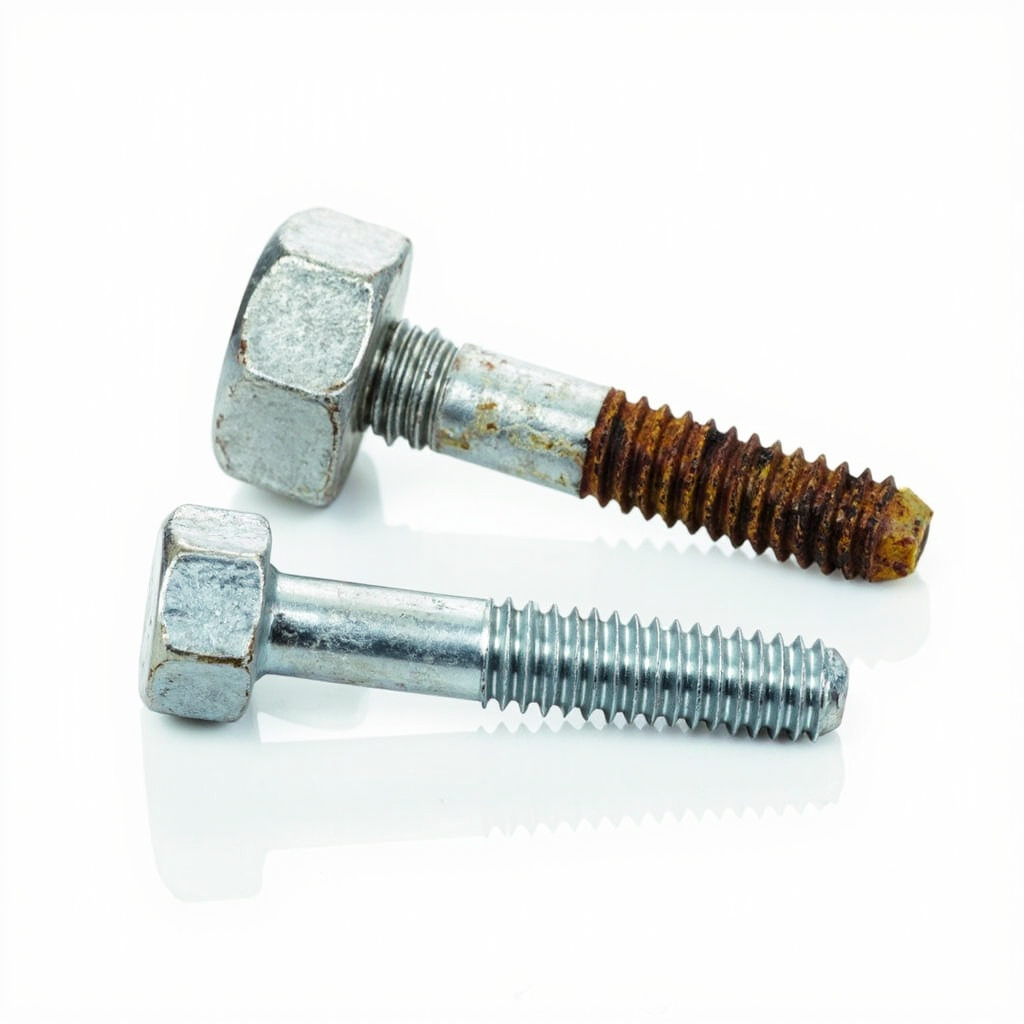
Domine la resistencia a la corrosión de fijaciones: tipos de recubrimiento, grados de material y estrategias de selección.
Tipos de Corrosión que Afectan a los Elementos de Fijación
Comprender los mecanismos de corrosión es esencial para seleccionar elementos de fijación que sobrevivan en su entorno operativo. Los tipos más comunes que afectan a los elementos de fijación de construcción son la corrosión uniforme, la corrosión galvánica, la corrosión en hendiduras y el agrietamiento por corrosión bajo tensión. La corrosión uniforme es la pérdida gradual y uniforme de material de la superficie: es predecible y se puede gestionar mediante la selección del espesor del recubrimiento. La corrosión galvánica ocurre cuando dos metales diferentes están en contacto eléctrico en presencia de un electrolito (humedad). El metal menos noble se corroe de forma preferente; por ejemplo, un perno zincado en contacto con una arandela de acero inoxidable se corroerá mucho más rápido que si ambos fueran del mismo material. La corrosión en hendiduras se desarrolla en espacios confinados donde se agota el oxígeno, como bajo las cabezas de los pernos y las arandelas. El agrietamiento por corrosión bajo tensión (SCC, por sus siglas en inglés) es la forma más peligrosa: provoca una falla frágil y súbita de pernos de alta resistencia bajo tensión de tracción en entornos corrosivos, particularmente con exposición a cloruros. Para proyectos de construcción costera en África Oriental y Occidental, la corrosión galvánica y la corrosión en hendiduras son las amenazas más prevalentes, mientras que el SCC inducido por cloruros es motivo de preocupación para los pernos de Clase 10.9 y 12.9 en entornos marinos. Recursos relacionados: pernos de alta resistencia pernos de anclaje elementos de fijación de acero inoxidable pernos hexagonales tuercas de bloqueo arandelas tornillos autoperforantes tornillos de cabeza Allen. Este marco de adquisiciones se aplica al abastecimiento de elementos de fijación para construcción, minería, energía, automoción y aplicaciones industriales generales. La lógica de decisión prioriza la consistencia de la calidad, la fiabilidad del proveedor y el coste total de propiedad sobre el precio unitario a corto plazo. Para los compradores B2B en África, América Latina y el Sudeste Asiático, las consideraciones adicionales incluyen los requisitos aduaneros regionales, las opciones de consolidación de contenedores y los mecanismos de seguridad de pago. Las especificaciones estandarizadas que se mantienen en los proyectos reducen el tiempo de capacitación, el tiempo de procesamiento de solicitudes de cotización y el esfuerzo de incorporación de proveedores. Este marco de adquisiciones se aplica al abastecimiento de elementos de fijación para construcción, minería, energía, automoción y aplicaciones industriales generales. La lógica de decisión prioriza la consistencia de la calidad, la fiabilidad del proveedor y el coste total de propiedad sobre el precio unitario a corto plazo. Para los compradores B2B en África, América Latina y el Sudeste Asiático, las consideraciones adicionales incluyen los requisitos aduaneros regionales, las opciones de consolidación de contenedores y los mecanismos de seguridad de pago. Las especificaciones estandarizadas que se mantienen en los proyectos reducen el tiempo de capacitación, el tiempo de procesamiento de solicitudes de cotización y el esfuerzo de incorporación de proveedores.
| Corrosion Type | Mechanism | Risk Level | Prevention |
|---|---|---|---|
| Uniform | Surface material loss | Low-Medium | Coating thickness |
| Galvanic | Dissimilar metal contact | High | Same metal or insulation |
| Crevice | Oxygen depletion in gaps | Medium-High | Sealants, proper torque |
| Stress Corrosion | Tension + chlorides | Critical | Avoid high-grade in marine |
| Pitting | Localized anodic attack | Medium | Stainless steel upgrade |
Opciones de Recubrimiento y Material para la Resistencia a la Corrosión
La resistencia a la corrosión de los elementos de fijación se puede lograr mediante recubrimientos superficiales, selección del material base o una combinación de ambos. La jerarquía de protección contra la corrosión, de menor a mayor resistencia, es: fosfato negro (solo en interiores) → zinc electrodepositado (24-72 h en cámara de niebla salina) → zinc amarillo/cromato (48-96 h) → galvanizado mecánico (100-200 h) → galvanizado en caliente (500-1000 h) → aleación de zinc-aluminio (1000-2000 h) → acero inoxidable A2 (más de 3000 h) → acero inoxidable A4 (más de 5000 h). El galvanizado en caliente (HDG, por sus siglas en inglés) es el estándar de oro para los elementos de fijación de acero al carbono en aplicaciones exteriores y costeras. El recubrimiento de zinc tiene un espesor de 45-85 micras y proporciona tanto protección de barrera como de sacrificio. Para pernos estructurales, el HDG conforme a ISO 10684 o ASTM A153 es el estándar. La consideración principal con el HDG es que el recubrimiento grueso afecta el ajuste de la rosca; se requiere un roscado de sobremedida de las tuercas (roscado AZ conforme a ISO 10684). Los elementos de fijación de acero inoxidable (A2-70 para exteriores en general, A4-80 para entornos marinos) proporcionan la mayor resistencia a la corrosión, pero a un coste de 3 a 5 veces superior al del acero al carbono HDG. Los recubrimientos dúplex (HDG + pintura o sherardizado + sellador) ofrecen protección premium para entornos extremos. Las adquisiciones basadas en normas requieren un aprendizaje continuo, ya que las normas ISO, ASTM, DIN y GB se revisan cada 3-5 años. Suscríbase a las notificaciones de actualización de normas y revise las especificaciones anualmente. Las normas más comunes utilizadas en el comercio internacional de elementos de fijación son ISO 898-1 (propiedades mecánicas), ISO 3506-1 (acero inoxidable), ISO 3269 (inspección de aceptación), ISO 4042 (recubrimientos) e ISO 1502 (calibres de rosca). Para los compradores B2B, es esencial crear una biblioteca de referencia de normas con al menos las 20 normas más relevantes para su gama de productos. Las adquisiciones basadas en normas requieren un aprendizaje continuo, ya que las normas ISO, ASTM, DIN y GB se revisan cada 3-5 años. Suscríbase a las notificaciones de actualización de normas y revise las especificaciones anualmente. Las normas más comunes utilizadas en el comercio internacional de elementos de fijación son ISO 898-1 (propiedades mecánicas), ISO 3506-1 (acero inoxidable), ISO 3269 (inspección de aceptación), ISO 4042 (recubrimientos) e ISO 1502 (calibres de rosca). Para los compradores B2B, es esencial crear una biblioteca de referencia de normas con al menos las 20 normas más relevantes para su gama de productos.
| Protection Level | Coating/Material | Salt Spray (hours) | Relative Cost | Best Application |
|---|---|---|---|---|
| 1 - Basic | Zinc Plated | 24-72 | 1.0x | Indoor, mild |
| 2 - Standard | Yellow Zinc | 48-96 | 1.1x | Light outdoor |
| 3 - Heavy | Mechanical Galv | 100-200 | 1.3x | Outdoor, humid |
| 4 - Premium | Hot-Dip Galv | 500-1000 | 1.5x | Coastal, industrial |
| 5 - Superior | Zn-Al Alloy | 1000-2000 | 2.0x | Marine, extreme |
| 6 - Maximum | SS A4-80 | 5000+ | 4-5x | Chemical, subsea |
Estrategia de Selección de Resistencia a la Corrosión según el Entorno
Seleccionar el nivel adecuado de protección contra la corrosión requiere evaluar las condiciones ambientales específicas en el sitio del proyecto. Recomendamos un enfoque de cuatro pasos: (1) Clasifique el entorno de corrosión utilizando las categorías ISO 12944-2: C1 (interiores calefactados), C2 (rural con baja contaminación), C3 (urbano/costero moderado), C4 (industrial/costero), C5 (industrial/marino extremo). (2) Determine la vida útil requerida: 5 años para estructuras temporales, 15-25 años para construcción estándar, más de 50 años para infraestructura. (3) Seleccione el sistema de recubrimiento según el entorno y la vida útil. (4) Especifique protección complementaria para conexiones críticas. Para proyectos en el interior de Zimbabue (C2-C3), los elementos de fijación galvanizados en caliente suelen proporcionar una vida útil de más de 25 años. Para proyectos costeros en Mombasa, Dar es Salaam o Lagos (C4-C5), el HDG es el mínimo; considere acero inoxidable para conexiones críticas o sistemas dúplex para una vida útil prolongada. En el Golfo Arábigo, donde las temperaturas superan regularmente los 45 °C y la humedad fluctúa drásticamente, el ciclado térmico acelera la degradación del recubrimiento; especifique recubrimientos de aleación de Zn-Al o actualice a acero inoxidable para conexiones expuestas sobre el nivel del suelo. La metodología de comparación anterior utiliza rangos típicos de datos de la industria y la experiencia de adquisiciones de TradeGo entre 2018 y 2024. Los precios reales del mercado fluctúan con los costes de las materias primas (acero, zinc, níquel), los costes energéticos, los costes laborales y los tipos de cambio de divisas. Para una comparación precisa, solicite solicitudes de cotización idénticas a 3-5 proveedores cualificados y compare el coste puesto en destino (producto + envío + seguro + aranceles). El precio unitario más bajo rara vez es el coste total de propiedad más bajo. La metodología de comparación anterior utiliza rangos típicos de datos de la industria y la experiencia de adquisiciones de TradeGo entre 2018 y 2024. Los precios reales del mercado fluctúan con los costes de las materias primas (acero, zinc, níquel), los costes energéticos, los costes laborales y los tipos de cambio de divisas. Para una comparación precisa, solicite solicitudes de cotización idénticas a 3-5 proveedores cualificados y compare el coste puesto en destino (producto + envío + seguro + aranceles). El precio unitario más bajo rara vez es el coste total de propiedad más bajo.
| ISO Category | Environment | Recommended Protection | Expected Life |
|---|---|---|---|
| C2 | Rural inland, low humidity | Zinc plated | 10-15 years |
| C3 | Urban, moderate coastal | Hot-dip galvanized | 15-25 years |
| C4 | Industrial, coastal | HDG or Zn-Al alloy | 15-25 years |
| C5 | Extreme marine/industrial | Zn-Al alloy or SS A4 | 25+ years |
Mantenimiento e Inspección de Elementos de Fijación Corroídos
Incluso con una especificación inicial adecuada, la corrosión de los elementos de fijación debe supervisarse mediante programas de inspección regulares. Para proyectos de construcción en entornos corrosivos, establezca un programa de inspección basado en las categorías de mantenimiento de ISO 12944. La inspección visual debe centrarse en la integridad del recubrimiento (ampollas, descamación, manchas de óxido), el estado de la cabeza del perno (redondeo, productos de corrosión) y cualquier signo de movimiento estructural en las conexiones. Las áreas más críticas son las conexiones elevadas, donde la falla por corrosión representa un riesgo para la seguridad, y las conexiones subterráneas, donde la acumulación de humedad acelera la degradación. Cuando se identifiquen elementos de fijación corroídos, el reemplazo debe utilizar el mismo nivel o un nivel superior de protección contra la corrosión; nunca los rebaje. Para reemplazos en estructuras existentes, tenga en cuenta que los elementos de fijación HDG más nuevos pueden tener dimensiones ligeramente diferentes debido al espesor del recubrimiento. Aplique pintura rica en zinc o spray de galvanizado en frío en cualquier área donde el recubrimiento se haya dañado durante la instalación. Para pernos en entornos altamente corrosivos, considere un programa programado de reemplazo preventivo: reemplazar los elementos de fijación al 60-70 % de su vida útil esperada es mucho más económico que las reparaciones de emergencia tras una falla. Documente todos los hallazgos de inspección y reemplazos para fines de garantía y responsabilidad. Para obtener más información, consulte también nuestras guías sobre [galvanizado frente a inoxidable](/en/industry/galvanized-vs-stainless-steel-fasteners), [opciones de recubrimiento](/en/industry/zinc-plated-vs-black-phosphate-screws), [aplicaciones para cubiertas](/en/industry/roofing-screws-epdm-washer-guide). La lista de verificación de verificación se aplica tanto a la calificación inicial del proveedor como a la inspección continua de lotes. Para aplicaciones de alto riesgo (estructural portante, recipientes a presión, minería, marina), añada pruebas de fatiga, pruebas de niebla salina (ASTM B117), pruebas de par-tensión e inspección posterior a la instalación. El coste de la verificación adicional es del 0,1 al 0,3 % del valor del pedido, mientras que las fallas de calidad no detectadas pueden suponer entre 10 y 100 veces el valor del pedido en daños. La lista de verificación de verificación se aplica tanto a la calificación inicial del proveedor como a la inspección continua de lotes. Para aplicaciones de alto riesgo (estructural portante, recipientes a presión, minería, marina), añada pruebas de fatiga, pruebas de niebla salina (ASTM B117), pruebas de par-tensión e inspección posterior a la instalación. El coste de la verificación adicional es del 0,1 al 0,3 % del valor del pedido, mientras que las fallas de calidad no detectadas pueden suponer entre 10 y 100 veces el valor del pedido en daños.
How can I tell if a galvanized bolt needs replacement?
Replace when: (1) more than 25% of the surface shows red rust (not white zinc oxidation), (2) the bolt head shows significant material loss or rounding, (3) the zinc coating has blistered or flaked off in large areas, or (4) the bolt fails a torque verification test.
Is it okay to mix galvanized and stainless steel fasteners?
Not recommended. The galvanic couple between zinc and stainless steel will accelerate zinc corrosion. If mixing is unavoidable, use insulating washers (nylon or EPDM) between the dissimilar metals to break the electrical circuit.
Preguntas Frecuentes
Consulte las preguntas frecuentes a continuación.
Recursos relacionados: pernos de alta resistencia pernos de anclaje elementos de fijación de acero inoxidable pernos hexagonales tuercas de bloqueo arandelas tornillos autoperforantes tornillos de cabeza Allen. La evaluación de proveedores debe ser un proceso continuo, no un ejercicio puntual. Reevalúe a los proveedores anualmente según el rendimiento de entrega, las métricas de calidad, la competitividad de precios y la capacidad de respuesta. Mantenga una ficha de puntuación de proveedores con métricas ponderadas: entrega puntual (25 %), tasa de aceptación de calidad (30 %), competitividad de precios (20 %), capacidad de respuesta (15 %) y precisión de la documentación (10 %). Descarte a los proveedores que obtengan una puntuación inferior al 70 % durante un periodo de 6 meses y califique a los reemplazos. La evaluación de proveedores debe ser un proceso continuo, no un ejercicio puntual. Reevalúe a los proveedores anualmente según el rendimiento de entrega, las métricas de calidad, la competitividad de precios y la capacidad de respuesta. Mantenga una ficha de puntuación de proveedores con métricas ponderadas: entrega puntual (25 %), tasa de aceptación de calidad (30 %), competitividad de precios (20 %), capacidad de respuesta (15 %) y precisión de la documentación (10 %). Descarte a los proveedores que obtengan una puntuación inferior al 70 % durante un periodo de 6 meses y califique a los reemplazos.What are Technical Guide and how are they used?
Technical Guide are essential components in construction and manufacturing. Proper selection depends on load requirements, environmental conditions, and material compatibility.
How do I choose the right fastener for my project?
Consider the material being fastened, load requirements, environmental exposure, and applicable standards. Consult with a professional if unsure about specifications.
What materials are available for these fasteners?
Common materials include carbon steel, stainless steel, alloy steel, and specialty alloys. Each offers different strength, corrosion resistance, and cost characteristics.
Do you offer custom manufacturing?
Yes, we offer custom fastener manufacturing to spec. Contact our sales team with your requirements for pricing and lead times.
¿Necesita elementos de fijación resistentes a la corrosión para entornos agresivos? TradeGo Fasteners suministra opciones de HDG, Zn-Al y acero inoxidable.
Get Quote