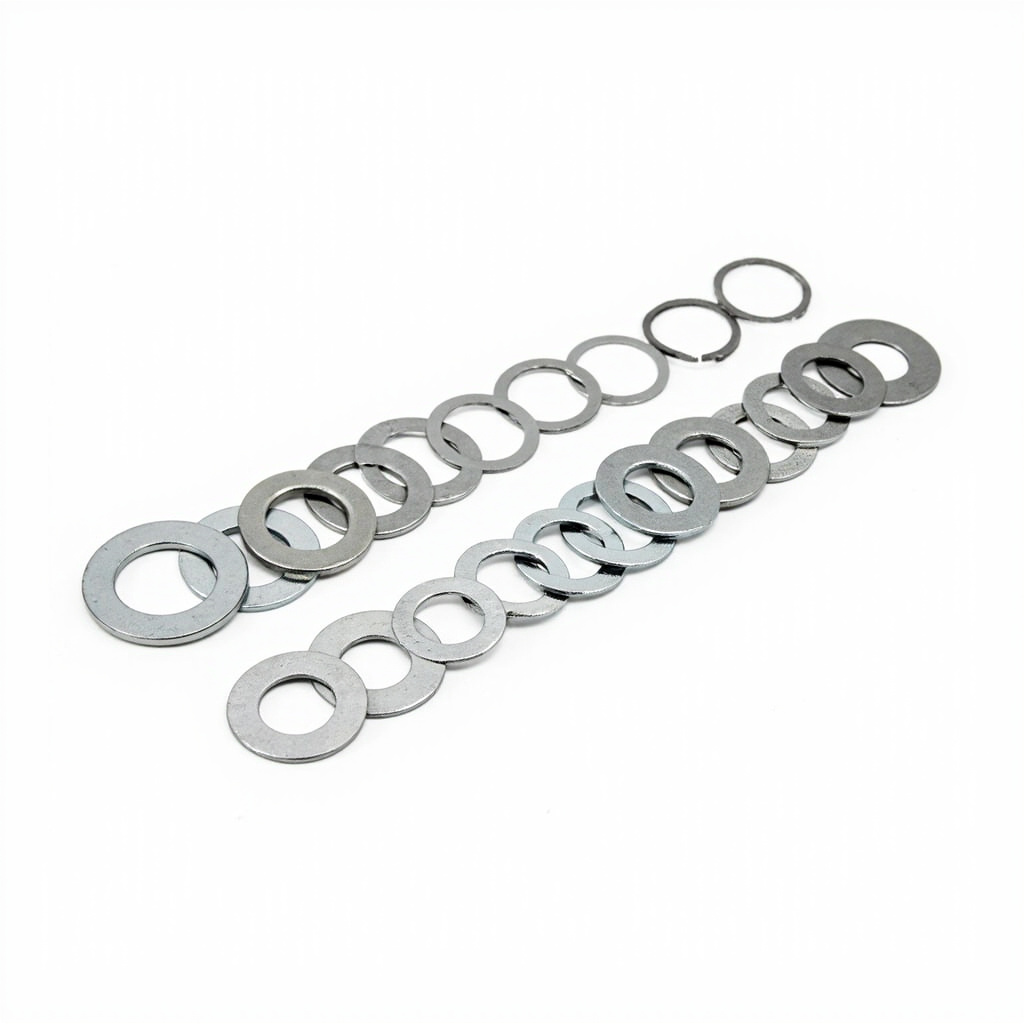
Compare arandelas planas y de resorte: cuándo usar cada tipo, distribución de carga vs antiaflojamiento y criterios de selección.
Funciones de las arandelas planas frente a las arandelas de resorte
Las arandelas planas y las arandelas de resorte cumplen funciones fundamentalmente diferentes en los conjuntos atornillados, aunque con frecuencia se confunden o se aplican de forma incorrecta. Las arandelas planas (DIN 125 / ISO 7089) distribuyen la carga de apriete sobre una superficie mayor, protegiendo el material base contra daños y evitando que la cabeza del perno o la tuerca se hundan en materiales blandos. También proporcionan una superficie de apoyo lisa que ayuda a lograr una fuerza de sujeción uniforme. Las arandelas de resorte (DIN 127 / ISO 7090), también llamadas arandelas de seguridad partidas, actúan como dispositivo antiflojedad. La hendidura crea un efecto elástico que mantiene la tensión sobre el perno incluso si se pierde parte del pretensado. Sin embargo, las arandelas de resorte solo ofrecen una resistencia moderada a la vibración y se están reemplazando cada vez más por métodos de bloqueo más efectivos en aplicaciones críticas. Para proyectos de construcción en África, la práctica habitual es utilizar una arandela plana tanto bajo la cabeza del perno como bajo la tuerca, añadiendo una arandela de resorte en el lado de la tuerca cuando la vibración es motivo de preocupación. Esta combinación proporciona tanto distribución de carga como cierto grado de protección antiflojedad. Recursos relacionados: pernos de alta resistencia pernos de anclaje fijaciones de acero inoxidable pernos hexagonales tuercas de bloqueo arandelas tornillos autoperforantes tornillos Allen. Este marco de adquisiciones se aplica al abastecimiento de elementos de fijación para construcción, minería, energía, automoción y aplicaciones industriales generales. La lógica de decisión prioriza la consistencia de calidad, la fiabilidad del proveedor y el coste total de propiedad sobre el precio unitario a corto plazo. Para los compradores B2B en África, América Latina y el sudeste asiático, las consideraciones adicionales incluyen los requisitos aduaneros regionales, las opciones de consolidación de contenedores y los mecanismos de seguridad de pago. Las especificaciones estandarizadas que se trasladan entre proyectos reducen el tiempo de formación, el tiempo de procesamiento de solicitudes de cotización y el esfuerzo de incorporación de proveedores. Este marco de adquisiciones se aplica al abastecimiento de elementos de fijación para construcción, minería, energía, automoción y aplicaciones industriales generales. La lógica de decisión prioriza la consistencia de calidad, la fiabilidad del proveedor y el coste total de propiedad sobre el precio unitario a corto plazo. Para los compradores B2B en África, América Latina y el sudeste asiático, las consideraciones adicionales incluyen los requisitos aduaneros regionales, las opciones de consolidación de contenedores y los mecanismos de seguridad de pago. Las especificaciones estandarizadas que se trasladan entre proyectos reducen el tiempo de formación, el tiempo de procesamiento de solicitudes de cotización y el esfuerzo de incorporación de proveedores. Este marco de adquisiciones se aplica al abastecimiento de elementos de fijación para construcción, minería, energía, automoción y aplicaciones industriales generales. La lógica de decisión prioriza la consistencia de calidad, la fiabilidad del proveedor y el coste total de propiedad sobre el precio unitario a corto plazo. Para los compradores B2B en África, América Latina y el sudeste asiático, las consideraciones adicionales incluyen los requisitos aduaneros regionales, las opciones de consolidación de contenedores y los mecanismos de seguridad de pago. Las especificaciones estandarizadas que se trasladan entre proyectos reducen el tiempo de formación, el tiempo de procesamiento de solicitudes de cotización y el esfuerzo de incorporación de proveedores.
| Property | Flat Washer | Spring Washer |
|---|---|---|
| Primary Function | Load distribution | Anti-loosening |
| Standard | DIN 125 / ISO 7089 | DIN 127 / ISO 7090 |
| Material | Steel, stainless, nylon | Spring steel, stainless |
| Surface Protection | Yes — prevents gouging | No |
| Vibration Resistance | None | Moderate |
| Reusability | Yes | Limited (fatigue) |
Tipos y especificaciones de arandelas planas
Las arandelas planas se presentan en varias configuraciones adecuadas para distintas aplicaciones. Las arandelas planas estándar (DIN 125 Forma A) tienen un diámetro exterior normal y se utilizan con fines generales. Las arandelas Forma B tienen un diámetro exterior mayor para materiales blandos o agujeros sobredimensionados. Las arandelas planas endurecidas (DIN 6917) se utilizan con pernos estructurales (Grado 8.8 y superior) y presentan mayor dureza para evitar deformaciones bajo altas fuerzas de apriete. Las arandelas planas de servicio pesado (DIN 433) tienen un diámetro exterior menor y se utilizan en espacios reducidos. Las opciones de material incluyen acero suave (estándar), acero inoxidable (A2/A4 para resistencia a la corrosión), latón (aplicaciones eléctricas) y nailon (no conductor, ligero). Para la construcción en regiones costeras africanas, las arandelas planas de acero inoxidable combinadas con pernos y tuercas de acero inoxidable proporcionan el conjunto más durable. Al solicitar arandelas planas a granel, especifique la norma, el material, el diámetro interior, el diámetro exterior, el espesor y el acabado superficial. La adquisición basada en normas requiere un aprendizaje continuo, ya que las normas ISO, ASTM, DIN y GB se revisan cada 3-5 años. Suscríbase a las notificaciones de actualización de normas y revise las especificaciones anualmente. Las normas más utilizadas en el comercio internacional de elementos de fijación son ISO 898-1 (propiedades mecánicas), ISO 3506-1 (inoxidables), ISO 3269 (inspección de aceptación), ISO 4042 (recubrimientos) e ISO 1502 (calibres de rosca). Para los compradores B2B, es esencial contar con una biblioteca de referencia de normas que incluya al menos las 20 normas principales relevantes para su mezcla de productos. La adquisición basada en normas requiere un aprendizaje continuo, ya que las normas ISO, ASTM, DIN y GB se revisan cada 3-5 años. Suscríbase a las notificaciones de actualización de normas y revise las especificaciones anualmente. Las normas más utilizadas en el comercio internacional de elementos de fijación son ISO 898-1 (propiedades mecánicas), ISO 3506-1 (inoxidables), ISO 3269 (inspección de aceptación), ISO 4042 (recubrimientos) e ISO 1502 (calibres de rosca). Para los compradores B2B, es esencial contar con una biblioteca de referencia de normas que incluya al menos las 20 normas principales relevantes para su mezcla de productos. La adquisición basada en normas requiere un aprendizaje continuo, ya que las normas ISO, ASTM, DIN y GB se revisan cada 3-5 años. Suscríbase a las notificaciones de actualización de normas y revise las especificaciones anualmente. Las normas más utilizadas en el comercio internacional de elementos de fijación son ISO 898-1 (propiedades mecánicas), ISO 3506-1 (inoxidables), ISO 3269 (inspección de aceptación), ISO 4042 (recubrimientos) e ISO 1502 (calibres de rosca). Para los compradores B2B, es esencial contar con una biblioteca de referencia de normas que incluya al menos las 20 normas principales relevantes para su mezcla de productos.
| Bolt Size | ID (mm) | OD (mm) Form A | Thickness (mm) | Hardness (HV) |
|---|---|---|---|---|
| M6 | 6.4 | 12 | 1.6 | 140-200 |
| M8 | 8.4 | 16 | 1.6 | 140-200 |
| M10 | 10.5 | 20 | 2.0 | 140-200 |
| M12 | 13.0 | 24 | 2.5 | 140-200 |
| M16 | 17.0 | 30 | 3.0 | 140-200 |
Eficacia de las arandelas de resorte y alternativas
La eficacia de las arandelas de resorte como dispositivos antiflojedad es un tema de debate continuo en la comunidad de ingeniería. Las investigaciones han demostrado que las arandelas de resorte helicoidales partidas estándar ofrecen una resistencia limitada a la vibración bajo condiciones de carga dinámica. La fuerza elástica generada por una arandela partida comprimida suele ser solo del 5-10% del pretensado del perno, lo que puede ser insuficiente para evitar el aflojamiento en entornos de alta vibración. Para aplicaciones que requieren un sistema antiflojedad fiable, varias alternativas superan a las arandelas de resorte. Las arandelas de bloqueo de cuña Nord-Lock utilizan un mecanismo de leva que aumenta la tensión bajo vibración. Las tuercas de par predominante (con inserción de nailon o rosca deformada) proporcionan una fuerza de bloqueo constante. Los adhesivos de bloqueo de roscas (Loctite) crean una unión química. Para construcción estructural en zonas sísmicas como partes del África oriental, se especifican disposiciones de doble tuerca o tuercas almenadas con pasadores. Cuando se utilizan arandelas de resorte, deben instalarse entre la tuerca y la arandela plana, nunca directamente contra el material base. Reemplace las arandelas de resorte después de cada desmontaje, ya que pierden elasticidad con los ciclos repetidos de compresión. Para más información, consulte también nuestras guías sobre [arandelas de guardabarros](/en/industry/fender-washers-simplate-washers), [tuercas y arandelas](/en/industry/nylon-nuts-bolts-guide), [pernos](/en/industry/hex-bolt-dimensions-chart). La metodología de comparación anterior utiliza rangos típicos de datos del sector y de la experiencia de adquisiciones de TradeGo entre 2018 y 2024. Los precios reales del mercado fluctúan con los costes de las materias primas (acero, zinc, níquel), los costes energéticos, los costes laborales y los tipos de cambio. Para una comparación precisa, solicite solicitudes de cotización idénticas a 3-5 proveedores cualificados y compare el coste puesto en destino (producto + envío + seguro + aranceles). El precio unitario más bajo rara vez es el menor coste total de propiedad. La metodología de comparación anterior utiliza rangos típicos de datos del sector y de la experiencia de adquisiciones de TradeGo entre 2018 y 2024. Los precios reales del mercado fluctúan con los costes de las materias primas (acero, zinc, níquel), los costes energéticos, los costes laborales y los tipos de cambio. Para una comparación precisa, solicite solicitudes de cotización idénticas a 3-5 proveedores cualificados y compare el coste puesto en destino (producto + envío + seguro + aranceles). El precio unitario más bajo rara vez es el menor coste total de propiedad. La metodología de comparación anterior utiliza rangos típicos de datos del sector y de la experiencia de adquisiciones de TradeGo entre 2018 y 2024. Los precios reales del mercado fluctúan con los costes de las materias primas (acero, zinc, níquel), los costes energéticos, los costes laborales y los tipos de cambio. Para una comparación precisa, solicite solicitudes de cotización idénticas a 3-5 proveedores cualificados y compare el coste puesto en destino (producto + envío + seguro + aranceles). El precio unitario más bajo rara vez es el menor coste total de propiedad.
Should I always use a spring washer with a nut?
No. For static loads with no vibration, a flat washer alone is sufficient. Spring washers are only needed when vibration or dynamic loading is expected. Overuse of spring washers adds cost without benefit.
Can I stack multiple spring washers for more locking force?
Stacking spring washers is not recommended. It does not proportionally increase locking force and can create uneven bearing surfaces. Instead, use a more effective locking method such as a Nord-Lock washer or prevailing torque nut.
Preguntas frecuentes
Consulte las preguntas frecuentes a continuación.
Recursos relacionados: pernos de alta resistencia pernos de anclaje fijaciones de acero inoxidable pernos hexagonales tuercas de bloqueo arandelas tornillos autoperforantes tornillos Allen. La lista de verificación de verificación se aplica tanto a la cualificación inicial del proveedor como a la inspección continua de lotes. Para aplicaciones de alto riesgo (estructurales portantes, recipientes a presión, minería, marina), añada pruebas de fatiga, pruebas de niebla salina (ASTM B117), pruebas de par-tensión e inspección posterior a la instalación. El coste de la verificación adicional es del 0,1-0,3% del valor del pedido, mientras que los fallos de calidad no detectados pueden suponer 10-100 veces el valor del pedido en daños. La lista de verificación de verificación se aplica tanto a la cualificación inicial del proveedor como a la inspección continua de lotes. Para aplicaciones de alto riesgo (estructurales portantes, recipientes a presión, minería, marina), añada pruebas de fatiga, pruebas de niebla salina (ASTM B117), pruebas de par-tensión e inspección posterior a la instalación. El coste de la verificación adicional es del 0,1-0,3% del valor del pedido, mientras que los fallos de calidad no detectados pueden suponer 10-100 veces el valor del pedido en daños. La lista de verificación de verificación se aplica tanto a la cualificación inicial del proveedor como a la inspección continua de lotes. Para aplicaciones de alto riesgo (estructurales portantes, recipientes a presión, minería, marina), añada pruebas de fatiga, pruebas de niebla salina (ASTM B117), pruebas de par-tensión e inspección posterior a la instalación. El coste de la verificación adicional es del 0,1-0,3% del valor del pedido, mientras que los fallos de calidad no detectados pueden suponer 10-100 veces el valor del pedido en daños.What are Product Comparison and how are they used?
Product Comparison are essential components in construction and manufacturing. Proper selection depends on load requirements, environmental conditions, and material compatibility.
How do I choose the right fastener for my project?
Consider the material being fastened, load requirements, environmental exposure, and applicable standards. Consult with a professional if unsure about specifications.
What materials are available for these fasteners?
Common materials include carbon steel, stainless steel, alloy steel, and specialty alloys. Each offers different strength, corrosion resistance, and cost characteristics.
Do you offer custom manufacturing?
Yes, we offer custom fastener manufacturing to spec. Contact our sales team with your requirements for pricing and lead times.
¿Necesita arandelas para sus conjuntos de fijación? Obtenga precios al por mayor de TradeGo Fasteners.
Get Quote