津巴布韦 B2B 紧固件买家实用 2026 指南,涵盖螺栓等级选择、防腐涂层、供应商评估、ISO 898-1 与 SAZ 合规、AfCFTA 到岸成本优化、贝拉走廊物流与结构化供应商资质审核。
津巴布韦 2026 基础设施浪潮:买家需要了解的关键信息
Zimbabwe is entering 2026 with a ZiG4.6 billion national infrastructure budget focused on large-scale transport and water construction, including the Harare-Masvingo-Beitbridge highway upgrade and Kunzvi Dam expansion, alongside booming lithium mining site development across the country. This pipeline creates unprecedented sustained fastener demand throughout the year, with project specifications calling for high-tensile structural bolts, corrosion-resistant waterworks screws and heavy-duty mining fixings in far larger volumes than 2025. All buyers qualify for a 32 percent import duty reduction under AfCFTA when sourcing steel fasteners from compliant Chinese manufacturers, a permanent tariff discount that drastically cuts landed material costs and improves tender profit margins for contractors and mining procurement teams. Public tender rollouts will ramp up sharply from Q2 onward, pushing aggregate national fastener consumption up by a projected 40 percent versus last year as multi-year construction frameworks launch. Locking supplier capacity in early 2026 mitigates multiple avoidable risks that will escalate over coming months. Beira Corridor port congestion is set to worsen as neighbouring African nations also ramp up infrastructure orders, extending transit lead times and adding unplanned port and storage fees. Global steel raw material prices face consistent monthly upward pressure, and manufacturers will raise unit pricing once their pre-booked production slots fill up. Buyers who delay supplier audits risk losing the best production slots to competitors, getting stuck with substandard late-qualifying mills, or paying emergency air freight surcharges when port delays collide with immovable project deadlines. Early capacity reservation protects project schedules and secures preferential pricing tiers before the 2026 tender rush begins.
为 2026 投标指定螺栓等级和防腐涂层
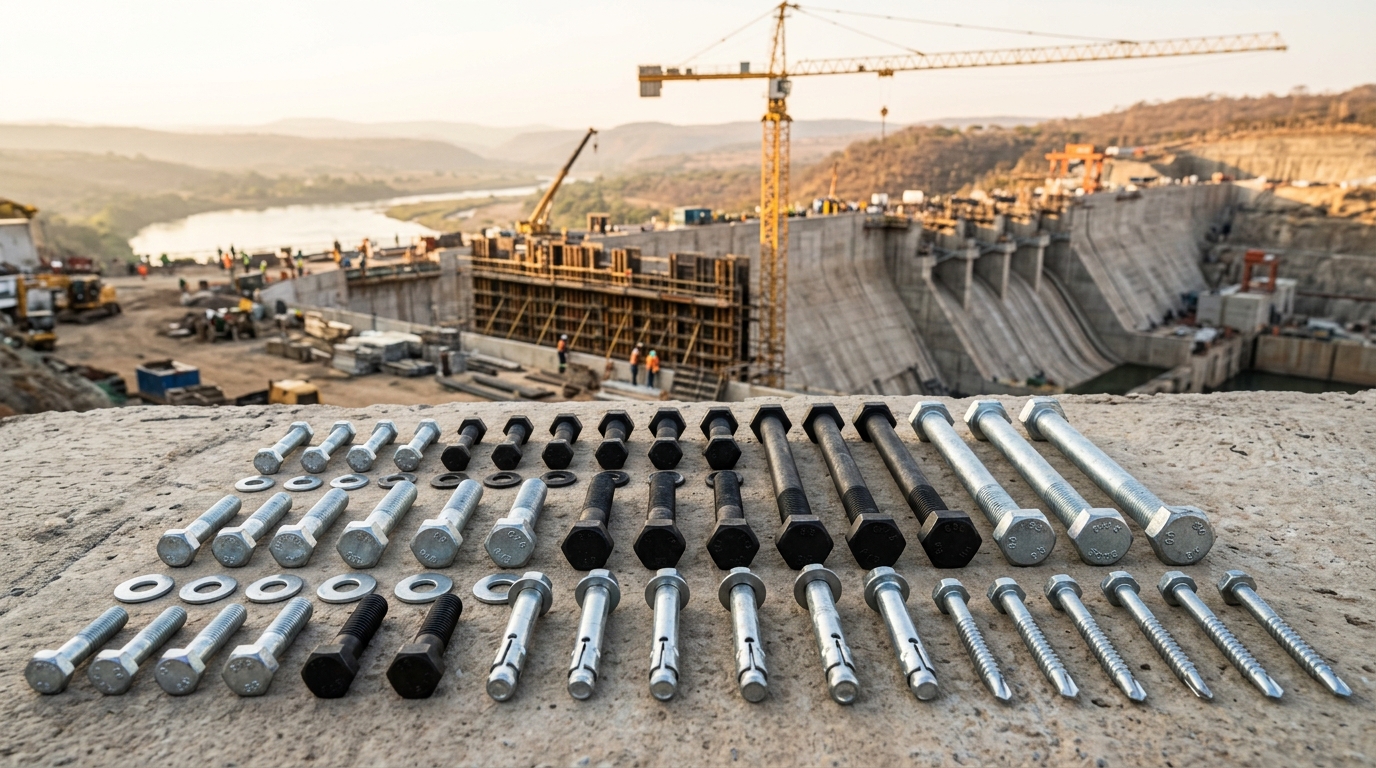
Specifying the right fastener grade is the first technical gate every Zimbabwe B2B buyer must clear to win 2026 public tenders. Grade 8.8 medium-tensile bolts suit residential builds, site framing and minor road auxiliary works. Grade 10.9 is the workhorse grade for highway beams, warehouse steel frames and mid-scale mine support racks, and the most requested grade on the Harare-Masvingo-Beitbridge upgrade. Grade 12.9 high-strength fasteners are mandatory for Kunzvi Dam load-bearing joints and bridge main girders, and any undersized anchor bolts on dam or bridge concrete foundations will be auto-rejected at technical review. For roofing and wall cladding, self-drilling screws cut through metal sheeting without pre-drilling and are the default for tender compliance, while self-tapping screws only work on thin secondary panels and will fail heavy cladding inspection. Choosing the correct corrosion coating is the second technical gate, and Zimbabwe's humid tropical climate leaves no margin for error. Hot-dip galvanizing produces an 85 to 120 micron alloy coating that resists rust for decades on bridges, dams and highway structures, and is the default specification in all 2026 tender documents. Zinc plating delivers only 5 to 12 microns of protection, scratches easily and develops surface rust within months in rainy or roadside environments, so it is only acceptable for fully indoor dry construction components. The most common buyer mistakes include downgrading bolt grades to cut initial costs, mixing plating types inside a single tender package, substituting self-tapping screws where self-drilling screws are specified, and omitting anchor bolt load certifications. All of these missteps result in immediate bid disqualification, costly rework and delayed project approvals, so aligning every fastener grade and coating directly with the published tender engineering schedule is the simplest way for buyers to eliminate avoidable compliance risk.
评估中国紧固件供应商:买家合规检查清单
Verifying a Chinese fastener supplier for Zimbabwe's 2026 infrastructure and mining tenders starts with three core compliance checks. Buyers should first confirm a valid ISO 9001 factory certificate and ask the supplier to demonstrate that the mill's quality system aligns with SADC SQAM technical benchmarks, since incomplete documentation is the most common cause of bid disqualification during PRAZ technical review. The second check is documentation: every bulk order should ship with full mill test certificates for each bolt and screw grade, and physical pre-shipment samples must arrive in Harare or Bulawayo at least 30 days before shipment for independent tensile and salt-spray testing. The third check is supplier financial health, where buyers can request recent audited statements or a bank reference letter; small mills with weak cash flow frequently halt production mid-contract, creating costly material shortages that derail dam and highway construction schedules. Payment terms and contract clauses are where Zimbabwean buyers can either protect their cash flow or hand it away. The safest structure is a 30 percent deposit on order confirmation with the remaining 70 percent released only against a copy of the bill of lading, never on full upfront transfer. Every supply contract for 2026 projects should lock in fixed door-to-door transit timelines that account for Beira Corridor port congestion, a clear quality-claim window of 30 days after goods arrive in Harare or Bulawayo, free replacement provisions for defective fasteners, daily financial penalties for missed delivery dates, and a written warranty that the mill carries liability for substandard grades. Watch for these red flags: a supplier who refuses third-party SGS or Bureau Veritas pre-shipment inspection, asks for more than 30 percent deposit upfront, declines to provide full mill test certificates, or uses vague contract language on transit delays and quality claims; any of these signals that the mill is not yet qualified to support 2026 tender-grade supply.
强制合规文件:ISO 898-1、ISO 1461、SAZ 与 SADC SQAM
Buyers importing fasteners for 2026 Zimbabwe construction and mining tenders must mandate a strict set of aligned global and regional quality standards before clearing customs. All high-tensile bolts Grade 8.8, 10.9 and 12.9 need full compliance with ISO 898-1 mechanical property rules, covering tensile strength, yield limits and hardness testing records. Any outdoor fastener with hot-dip galvanized finish must follow ISO 1461 coating specifications to guarantee minimum micron thickness and uniform rust protection. Products also need alignment with SADC SQAM harmonised hardware standards, a mandatory check for PRAZ tender eligibility, while the Zimbabwe Bureau of Standards (SAZ) carries out mandatory import inspections to validate all fastener batches upon arrival. Every shipment requires an official Certificate of Conformity matching batch numbers, coating grades and mechanical test results to avoid customs hold-ups at Mutare or Beitbridge border posts. Procurement teams must learn to identify counterfeit mill test certificates that risk full shipment seizure by SAZ officials. Fake documents often show generic logos without unique factory batch serial numbers, mismatched alloy chemical readings or unattributed test signatures with no contact details for third-party labs. Authentic MTCs cross-reference each container's production run, include SGS or Bureau Veritas validation stamps, and tie directly to the CoC submitted for SAZ clearance. Accepting unvetted fake paperwork leads to lengthy border detention, lost construction timeline windows, automatic tender disqualification and steep customs fines, making cross-verification of all compliance paperwork a non-negotiable step for every 2026 fastener import order.
到岸成本优化:FOB、海运、AfCFTA 关税与贝拉走廊
Calculating the total landed cost of imported fasteners in 2026 requires Zimbabwean buyers to add up four predictable line items: FOB factory pricing, ocean container freight, port handling fees, and inland truck transit charges to Harare or Bulawayo. A standard 40-foot FCL ocean freight from China runs 3,650 to 4,500 USD, with port surcharges adding 500 to 1,000 USD per container at either Beira or Durban. Inland haulage from Beira to Harare takes six days and costs 1,300 to 1,500 USD per container, while the longer Durban-to-Harare route requires 11 transit days with inland fees of 1,700 to 2,000 USD. On top of that, the SADC baseline import duty is cut by 32 percent under AfCFTA for compliant Chinese steel fasteners, a fixed discount that directly lowers the final landed price per ton and improves tender bid margins for buyers. For a concrete benchmark, a 50-ton bulk order of Grade 10.9 structural bolts shipped FCL via Beira delivers measurable savings versus slower Durban routing. Before AfCFTA relief, the import duty accounted for nearly 12 percent of total shipment value, so the 32 percent tariff reduction trims this duty burden by roughly a third, removing several thousand USD per shipment for large buyers. Order volume dictates shipment mode: a 50-ton Grade 10.9 bolt load fits one full 40-foot FCL with combined ocean, port and inland transport fees of about 6,200 USD, putting per-ton shipping costs near 124 USD; the same 50 tons split into LCL consignments would push total transport charges above 9,100 USD because of consolidation and cross-border handling fees. Three practical optimisation tactics help buyers cut landed cost by nearly 11 percent versus fragmented LCL shipments: consolidate quarterly fastener orders into full containers, prefer the faster Beira corridor over Durban to avoid higher inland trucking premiums, and lock fixed ocean freight rates six weeks ahead of production to evade peak season surcharges. Related logistics references: [Beira Corridor transit guide](/industry/beira-corridor-logistics) Beira Corridor Transit. [Durban port handling rates](/industry/durban-port-handling-rates) Durban Port Handling.
锁定 2026 供应商产能的 30 天采购工作流
Once compliance, supplier evaluation and landed cost analysis are complete, Zimbabwean buyers should move into a structured 30-day sourcing workflow to lock in 2026 supplier capacity before the tender rush peaks in Q2. Step one is to request a written quotation from at least three pre-qualified Chinese mills, each providing a per-ton FOB price, ISO 9001 certificate, full mill test certificate sample, and a recent reference list of African or SADC buyers. Step two is to ask each mill for a pre-shipment sample of the actual grade to be ordered (for example M20 Grade 10.9 hex bolts), and send the samples to an independent SGS or Bureau Veritas laboratory in Harare, Johannesburg or Durban for tensile, hardness and salt-spray testing; keep the test report on file for the buyer-side audit trail that PRAZ tender evaluators increasingly request. Step three is to align the chosen mill's payment terms, transit timeline, quality claim window and penalty clauses against the standard contract template agreed with the buyer's legal team, so that no clause has to be negotiated under time pressure once the tender is awarded. Step four is to place a small initial trial order (typically one to two 40-foot FCL containers) so that the buyer can verify the mill's actual production quality, packaging, marking, on-time shipment discipline and after-sales claim handling before committing to multi-year framework contracts; this low-risk pilot is the single most valuable protective measure in cross-border fastener sourcing. Step five is to schedule quarterly business reviews with the chosen mill, sharing forecast tender volumes and reserving production slots for the next 90 to 180 days, which guarantees preferential pricing and dedicated capacity during peak demand. Buyers that complete this five-step workflow before March 2026 will enter the Q2 tender wave with pre-audited suppliers, locked freight rates and ready stock, while buyers who delay will face escalating prices, fewer qualified mills and longer transit times that compress bid margins across every 2026 public works and mining contract. Reference: [China fastener supplier qualification checklist](/industry/china-fastener-supplier-qualification) Supplier Qualification Checklist.
买家框架:合规、商务保护与产能承诺
Pulling all of these strands together, the smartest path for any Zimbabwean B2B fastener buyer in 2026 is to shift from reactive single-tender purchasing toward a proactive, supplier-qualified framework built around three pillars. The first pillar is technical compliance: only source mills that ship every order with ISO 898-1 mechanical property documentation, ISO 1461 hot-dip galvanizing certificates, SADC SQAM-aligned mill test certificates and a verified Certificate of Conformity. The second pillar is commercial protection: insist on 30/70 payment terms, fixed door-to-door transit windows, a 30-day quality claim window after arrival in Harare or Bulawayo, and daily financial penalties for missed shipment dates. The third pillar is capacity commitment: consolidate quarterly demand into full FCL shipments routed via Beira, lock freight rates six weeks ahead of production, and run a small pilot order before committing to multi-year framework contracts. Buyers that operate inside all three pillars consistently deliver 8 to 12 percent lower landed cost per ton, pass PRAZ technical review on the first submission, and avoid the surprise delays that derail 2026 infrastructure and mining projects. For Zimbabwean buyers ready to act on the 2026 sourcing pipeline, the practical next step is to commission a complete Request for Quotation package covering one to three priority grades (for example M20 Grade 10.9 hex bolts, M16 Grade 8.8 structural bolts and 5.5 mm self-drilling screws), each with full mill test certificates, ISO 9001 documentation, an AfCFTA-compliant commercial invoice and a guaranteed 30-day quality claim window. TradeGo Fasteners supports Zimbabwean procurement teams with end-to-end sourcing across more than 60 metric bolt, screw and anchor grades, full ISO 898-1 and ISO 1461 documentation per shipment, SGS pre-shipment inspection on request, Beira corridor logistics with consolidated FCL shipping and a 30/70 payment structure aligned with AfCFTA preferences. Buyers can request a tailored 2026 quotation within 48 hours by sending grade specifications, annual volumes and target delivery dates to the TradeGo sourcing desk, and a dedicated account manager will respond with factory-direct pricing, sample arrangement, transit timeline and the full contract template referenced in this guide. [Request a 2026 quotation](/contact) Request Quotation Related framework reference: [AfCFTA landed cost guide](/industry/afcfta-landed-cost-guide) AfCFTA Landed Cost Guide.
常见问题解答
以下是针对津巴布韦螺栓与螺钉B2B采购的常见问题解答。\n\n问:津巴布韦螺栓与螺钉市场的主要认证标准是什么?\n答:津巴布韦市场主要接受ISO、ASTM以及南非SABS认证标准。出口至津巴布韦的紧固件产品通常需要符合这些国际或区域标准。对于石油天然气行业客户,还需满足API 6A和A193 B7等特殊材料规范要求。\n\n问:采购津巴布韦螺栓产品的税则分类是什么?\n答:螺栓、螺钉、螺母及类似紧固件的HS编码通常归类在7307或7318章节下。具体分类需根据产品类型(钢结构连接件、垫圈、铆钉等)、材质(碳钢、合金钢、不锈钢)及表面处理情况确定准确编码。\n\n问:津巴布韦对进口紧固件的主要质量要求有哪些?\n答:津巴布韦对进口紧固件的质量要求主要包括:材料化学成分符合规定、力学性能达标(抗拉强度、屈服强度、延伸率)、尺寸精度满足公差要求、表面处理符合防腐或特殊工况需求。对于矿业和能源项目,通常要求供应商提供材质证明书(MTC)和第三方检测报告。\n\n问:津巴布韦螺栓与螺钉的主要应用行业有哪些?\n答:津巴布韦紧固件的主要采购行业包括:矿业开采(地下采矿设备连接件)、农业机械制造与维修、能源基础设施(变电站、输电线路)、建筑钢结构施工、以及石油天然气勘探开发。BX-series等特殊规格紧固件主要用于高压阀门和管道连接系统。\n\n问:津巴布韦市场的付款方式通常是什么?\n答:B2B采购中常见的付款方式包括:T/T电汇(30%-50%预付款,余额发货前付清)、L/C信用证(对于大额订单)、以及与资质良好的老客户采用O/A赊账方式。建议首次合作采用T/T方式,逐步建立信任后调整付款条款。\n\n问:津巴布韦进口紧固件是否涉及H2S腐蚀环境要求?\n答:是的,津巴布韦部分矿业项目和油气田存在H2S腐蚀环境。对于此类应用,需采购符合NACE MR0175标准的抗硫紧固件产品。材料通常选用低硫含量的合金钢或特殊不锈钢,并需在订单中明确标注工作环境的H2S浓度和温度参数。\n\n问:如何验证津巴布韦紧固件供应商的资质?\n答:建议通过以下方式验证供应商资质:要求提供ISO 9001质量管理体系认证、查看工厂生产能力与检测设备清单、要求提供以往项目供货业绩证明、委托第三方机构进行供应商审计。对于重要项目,可要求进行小批量试订单以验证产品质量和交付能力。\n\n问:津巴布韦紧固件采购的典型交货期是多少?\n答:标准规格产品从中国发运至津巴布韦的交货期通常为25-40天,包括生产周期(7-15天)和海运时间(18-25天)。对于非标准定制产品或大批量订单,交货期可能延长至45-60天。建议在采购计划中预留充足的备货时间,避免项目现场停工待料。
津巴布韦 2026 基础设施项目需要什么等级的螺栓?
2026 年津巴布韦基础设施项目投标中,8.8 级适用于住宅建筑和小型道路辅助工程,10.9 级是公路梁、仓库钢结构和中等规模矿山支架的主力等级,12.9 级是库恩兹维大坝承重节点和桥梁主梁的强制要求。所有高强度螺栓必须符合 ISO 898-1 机械性能标准,每批货物必须附带完整的工厂测试证书。
2026 年从中国进口紧固件需要缴纳多少进口关税?
根据 AfCFTA,津巴布韦买家进口合规的中国紧固件可享受 SADC 基准进口关税 32% 的减免,使关税占货值比例从约 12% 降至约 8%,每个 50 吨订单可节省数千美元。要享受该减免,供应商必须出具 AfCFTA 合规的原产地证书,买家必须持有有效的 SADC 贸易许可证,并且货物必须在贝拉或德班海关清关时同时出示 CoC 原件和工厂测试证书。
向津巴布韦进口紧固件应该订整柜还是拼箱?
对于 10 吨以上的紧固件进口,整柜(FCL)的每吨成本几乎总是更低,因为拼箱(LCL)的合并和跨境操作费用会成倍增加。一个 50 吨 10.9 级螺栓订单通过贝拉港整柜运输,海运、港口和内陆运输综合费用约 6,200 美元(每吨约 124 美元),而同样 50 吨分成拼箱运输总费用超过 9,100 美元。建议买家将季度需求合并为整柜订单,并提前 90-180 天预订生产档期。
如何验证紧固件供应商的工厂测试证书是真的?
真实的工厂测试证书包含与集装箱生产批次对应的唯一工厂批次编号、SGS 或 Bureau Veritas 验证印章、第三方实验室的联系邮箱或电话,以及与所订等级相符的化学和机械数据。假证书通常只有通用标识而没有批次 ID,缺少或未署名的测试签名,以及与等级不符的化学成分(例如 10.9 级螺栓显示低合金含量)。买家应始终直接从工厂质量部邮箱(而非销售代理)索取 MTC 副本,并与提交给 SAZ 清关的 CoC 交叉核对。
2026 年从中国到津巴布韦紧固件的最佳运输路线是什么?
2026 年紧固件进口,贝拉走廊(莫桑比克)是进入津巴布韦的首选运输路线,因为贝拉到哈拉雷的内陆运输仅需 6 天,每个 40 英尺集装箱费用 1,300-1,500 美元,而经德班(南非)则需 11 天,费用 1,700-2,000 美元。两条路线在高峰月份都面临港口拥堵,但德班由于吞吐量较大通常在陆运基础上额外增加 7-10 天的等待时间,而贝拉在提交完整 AfCFTA 文件后通常在 2-3 天内完成清关。建议买家提前 90 天预订贝拉走廊舱位以获得可预测的交付窗口。
获取 2026 年定制报价,涵盖 8.8/10.9/12.9 级螺栓、完整 ISO 898-1 文件、ISO 1461 热浸镀锌证书、SGS 装运前检验以及贝拉走廊整柜运输。
索取 2026 报价