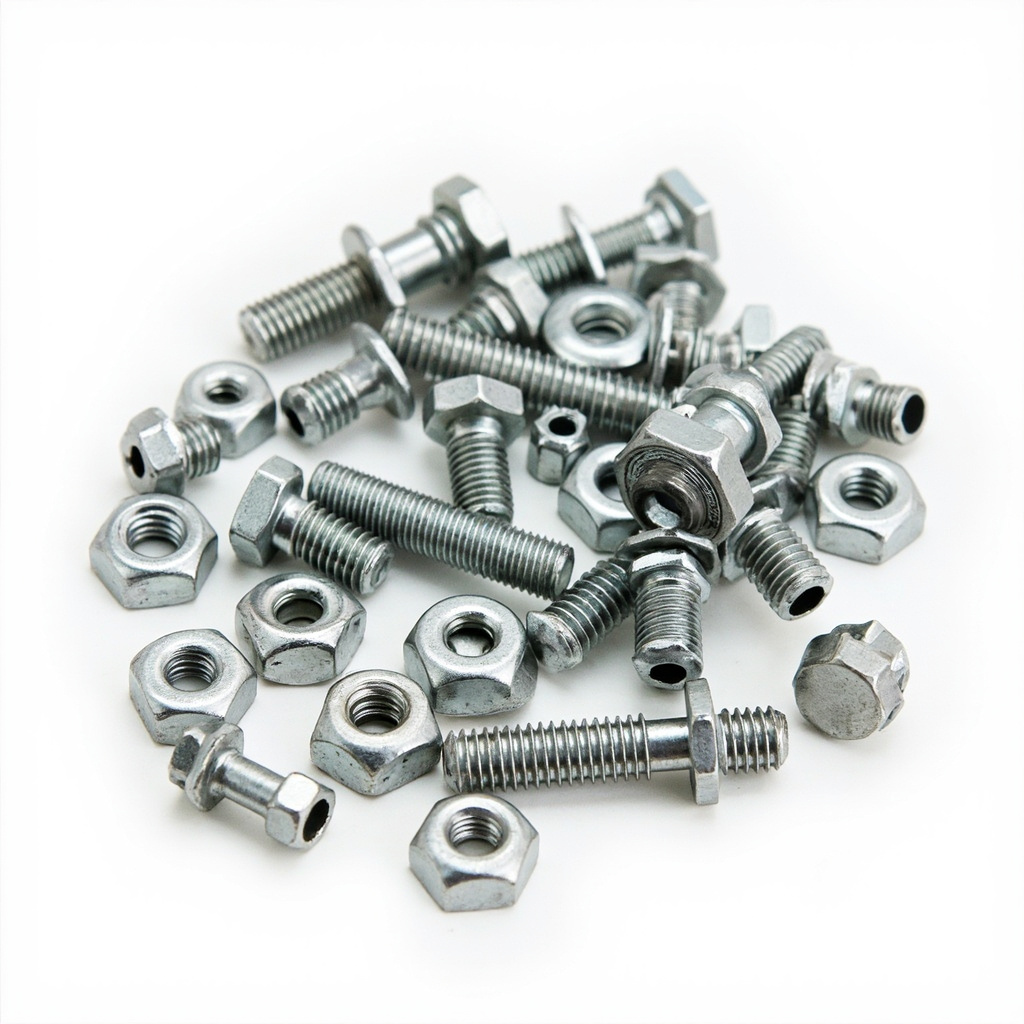
Wesentliches Glossar zur Befestigungsterminologie für Einkaufsprofis.
Begriffe zu Schrauben und Bolzen
Axial — entlang der Achse des Bolzens (Zugbelastung). Auflagefläche — die Oberfläche der Unterlegscheibe, die das Verbindungsmaterial kontaktiert. Bolzen — außen mit Gewinde versehene Verbindungselement, die durch Bohrungen in den montierten Teilen geführt wird und in eine Mutter greift; besitzt einen Kopf zum Anziehen. Cam-out — die Tendenz eines Phillips/Sq-Bits, unter Drehmoment aus dem Kopf zu rutschen; wird durch Robertson (Sq) oder Innensechskant-Antriebe reduziert. Klemmkraft — die Druckkraft, die beim Anziehen eines Verbindungselements erzeugt wird; die Hauptquelle für Reibung und Dichtheit der Verbindung. Kritischer Bolzen — jeder Bolzen, dessen Versagen einen Kollaps, Verletzungen oder erhebliche wirtschaftliche Verluste verursachen könnte. Bezeichnung — die Standard-Identifikation eines Verbindungselements (z. B. ‚M10×50 10.9 Sechskantbolzen‘). Einbettung — plastische Verformung der Verbindungsflächen unter Klemmkraft, die zu Verlust der Vorspannung führt. Verwandte Ressourcen: Hochfeste Bolzen Ankerbolzen Verbindungselemente aus Edelstahl Sechskantbolzen Kontermuttern Unterlegscheiben Selbstbohrschrauben Zylinderschrauben. Dieser Beschaffungsrahmen gilt für die Sourcing von Verbindungselementen im Bauwesen, Bergbau, Energiesektor, in der Automobilindustrie und allgemeinen industriellen Anwendungen. Die Entscheidungslogik priorisiert Qualitätskonstanz, Lieferantenzuverlässigkeit und Gesamtbetriebskosten gegenüber kurzfristigen Stückpreisen. Für B2B-Einkäufer in Afrika, Lateinamerika und Südostasien sind zusätzliche Überlegungen zu regionalen Zollanforderungen, Container-Konsolidierungsoptionen und Zahlungssicherheitsmechanismen erforderlich. Standardisierte Spezifikationen, die projektübergreifend anwendbar sind, reduzieren Schulungszeit, RFQ-Bearbeitungszeit und Lieferanten-Onboarding-Aufwand. Dieser Beschaffungsrahmen gilt für die Sourcing von Verbindungselementen im Bauwesen, Bergbau, Energiesektor, in der Automobilindustrie und allgemeinen industriellen Anwendungen. Die Entscheidungslogik priorisiert Qualitätskonstanz, Lieferantenzuverlässigkeit und Gesamtbetriebskosten gegenüber kurzfristigen Stückpreisen. Für B2B-Einkäufer in Afrika, Lateinamerika und Südostasien sind zusätzliche Überlegungen zu regionalen Zollanforderungen, Container-Konsolidierungsoptionen und Zahlungssicherheitsmechanismen erforderlich. Standardisierte Spezifikationen, die projektübergreifend anwendbar sind, reduzieren Schulungszeit, RFQ-Bearbeitungszeit und Lieferanten-Onboarding-Aufwand.
| Term | Definition |
|---|---|
| Shank | Unthreaded portion of a bolt between the head and the threads |
| Thread root | Bottom of the thread groove (smallest diameter) |
| Thread crest | Top of the thread ridge (largest diameter) |
| Pitch | Distance between adjacent thread crests |
| Major diameter | Thread crest to crest diameter (nominal size) |
| Minor diameter | Thread root to thread root diameter |
| Pitch diameter | Effective diameter where thread width equals gap width |
| Grip length | Total thickness of materials being clamped (excluding fasteners) |
Begriffe zu Muttern und Gewinden
Mutter — innen mit Gewinde versehenes Bauteil, das mit einem Bolzen oder einer Gewindestange in Eingriff kommt. Teilkreisdurchmesser (Gewinde) — der effektive Durchmesser des Gewindes, an dem die Messung erfolgt; gleiches Konzept wie für Bolzen. Losbrechmoment — das Drehmoment, das erforderlich ist, um eine Kontermutter in Rotation zu versetzen, bevor das eigentliche Anzugsdrehmoment aufgebracht wird. Prüflast — die maximale Belastung, die ein Verbindungselement ohne dauerhafte Verformung aushalten kann. Gewindeeingriff — die Länge, über die sich Innen- und Außengewinde überlappen. Streckgrenze — die Spannung, bei der ein Material beginnt, sich dauerhaft zu verformen. Die normenbasierte Beschaffung erfordert kontinuierliches Lernen, da ISO-, ASTM-, DIN- und GB-Normen alle 3–5 Jahre überarbeitet werden. Abonnieren Sie Benachrichtigungen zu Normenaktualisierungen und überprüfen Sie Spezifikationen jährlich. Die im internationalen Verbindungselementehandel am häufigsten verwendeten Normen sind ISO 898-1 (mechanische Eigenschaften), ISO 3506-1 (Edelstahl), ISO 3269 (Abnahmeprüfung), ISO 4042 (Beschichtungen) und ISO 1502 (Gewindelehren). Für B2B-Einkäufer ist der Aufbau einer Normen-Referenzbibliothek mit mindestens den 20 wichtigsten Normen für Ihr Produktsortiment unerlässlich. Die normenbasierte Beschaffung erfordert kontinuierliches Lernen, da ISO-, ASTM-, DIN- und GB-Normen alle 3–5 Jahre überarbeitet werden. Abonnieren Sie Benachrichtigungen zu Normenaktualisierungen und überprüfen Sie Spezifikationen jährlich. Die im internationalen Verbindungselementehandel am häufigsten verwendeten Normen sind ISO 898-1 (mechanische Eigenschaften), ISO 3506-1 (Edelstahl), ISO 3269 (Abnahmeprüfung), ISO 4042 (Beschichtungen) und ISO 1502 (Gewindelehren). Für B2B-Einkäufer ist der Aufbau einer Normen-Referenzbibliothek mit mindestens den 20 wichtigsten Normen für Ihr Produktsortiment unerlässlich.
| Term | Definition |
|---|---|
| Hex nut | Standard six-sided nut; most common nut type |
| Jam nut | Thin nut used to lock another nut in place (double nut) |
| Lock nut | Nut with a built-in locking mechanism (Nyloc, all-metal) |
| Wing nut | Nut with wing-like projections for hand tightening |
| Coupling nut | Long nut for joining two threaded rods end-to-end |
| Castle nut | Nut with slots for a cotter pin (e.g., on axle shafts) |
| Flange nut | Nut with an integrated washer-like flange |
Begriffe zu Festigkeit und Qualität
Festigkeitsklasse — die Güteklasse eines Verbindungselements (z. B. 8.8, 10.9); gibt die mechanischen Eigenschaften an (Zugfestigkeit, Streckgrenze). Prüflast — die maximale Zugbelastung, die ein Verbindungselement ohne dauerhafte Verformung aushalten kann; dient zur Qualitätsüberprüfung. Prüfspannung — Prüflast geteilt durch Spannungsquerschnitt. Drehmomentkoeffizient (K-Faktor) — das Verhältnis von Drehmoment zu Klemmkraft; variiert je nach Schmierung, Oberflächenzustand und Material. Typischerweise K=0,20 für blanken Stahl, K=0,15 für leicht geölt, K=0,12 für gewachst. Klemmkraftberechnung: T = K × D × F, wobei T=Drehmoment, K=Koeffizient, D=Nenndurchmesser, F=Klemmkraft. Die oben dargestellte Vergleichsmethodik verwendet typische Bereiche aus Branchendaten und TradeGo-Beschaffungserfahrung 2018–2024. Die tatsächlichen Marktpreise schwanken mit den Rohstoffkosten (Stahl, Zink, Nickel), Energiekosten, Arbeitskosten und Wechselkursen. Für einen genauen Vergleich fordern Sie identische RFQs von 3–5 qualifizierten Lieferanten an und vergleichen Sie die Landed Cost (Produkt + Versand + Versicherung + Zölle). Der niedrigste Stückpreis ist selten die niedrigste Gesamtbetriebskosten. Die oben dargestellte Vergleichsmethodik verwendet typische Bereiche aus Branchendaten und TradeGo-Beschaffungserfahrung 2018–2024. Die tatsächlichen Marktpreise schwanken mit den Rohstoffkosten (Stahl, Zink, Nickel), Energiekosten, Arbeitskosten und Wechselkursen. Für einen genauen Vergleich fordern Sie identische RFQs von 3–5 qualifizierten Lieferanten an und vergleichen Sie die Landed Cost (Produkt + Versand + Versicherung + Zölle). Der niedrigste Stückpreis ist selten die niedrigste Gesamtbetriebskosten.
| Term | Definition |
|---|---|
| 8.8 Grade (metric) | 800 MPa tensile, 640 MPa yield; most common structural bolt |
| 10.9 Grade (metric) | 1000 MPa tensile, 900 MPa yield; high-strength structural |
| 12.9 Grade (metric) | 1200 MPa tensile, 1100 MPa yield; highest strength for machinery |
| A325 (ASTM) | High-strength structural bolt, 825 MPa tensile; US standard |
| A490 (ASTM) | Alloy structural bolt, 1035 MPa tensile; stronger than A325 |
| Proof stress | Minimum stress a fastener can withstand without plastic deformation |
| Yield stress | Stress at which material begins to deform permanently |
Begriffe zu Beschichtung und Oberflächenbehandlung
Verzinkung (galvanisch) — dünne Zinkbeschichtung durch Elektrolyse; 5–15 μm; guter Innenschutz; silberweißes Erscheinungsbild. Feuerverzinkung (HDG) — dicke Zinkbeschichtung durch Zinkbad; 40–85 μm; ausgezeichneter Außen-/Korrosionsschutz. Zink-Nickel — fortschrittliche Galvanisierung; 8–15 μm; überlegen gegenüber Standardzink; über 1000 Stunden Salzsprühnebeltest. Dacromet/Geomet — wasserbasierte Zinklamellenbeschichtungen; 8–15 μm; ausgezeichnete Korrosionsbeständigkeit, keine Wasserstoffversprödung. Sherardisieren — Zinkdampf-Diffusionsbeschichtung; 15–30 μm; gleichmäßige Abdeckung auch bei komplexen Formen. Parkerisierung — Mangan-/Eisenphosphatbeschichtung; 5–15 μm; gute Schmiermittelretention; militärische Oberfläche. Brünierung — chemische Konversionsbeschichtung; 1–2 μm; dekorativ/rosthemmend im Innenbereich; kein primärer Korrosionsschutz. Die Verifizierungs-Checkliste gilt sowohl für die erstmalige Lieferantenqualifikation als auch für die laufende Chargeninspektion. Für Hochrisikoanwendungen (tragende Strukturen, Druckbehälter, Bergbau, Marine) ergänzen Sie Ermüdungsprüfungen, Salzsprühnebelprüfungen (ASTM B117), Drehmoment-Zug-Prüfungen und Installations-Endkontrollen. Die Kosten zusätzlicher Verifizierung betragen 0,1–0,3 % des Bestellwerts, während unentdeckte Qualitätsmängel das 10- bis 100-fache des Bestellwerts an Schäden verursachen können. Die Verifizierungs-Checkliste gilt sowohl für die erstmalige Lieferantenqualifikation als auch für die laufende Chargeninspektion. Für Hochrisikoanwendungen (tragende Strukturen, Druckbehälter, Bergbau, Marine) ergänzen Sie Ermüdungsprüfungen, Salzsprühnebelprüfungen (ASTM B117), Drehmoment-Zug-Prüfungen und Installations-Endkontrollen. Die Kosten zusätzlicher Verifizierung betragen 0,1–0,3 % des Bestellwerts, während unentdeckte Qualitätsmängel das 10- bis 100-fache des Bestellwerts an Schäden verursachen können.
Referenz der Normungsorganisationen
ISO (International) — ISO 261 (Gewindeprofil), ISO 965 (metrische Gewindetoleranzen), ISO 4014/4017 (Sechskantbolzen); weltweit anerkannt. DIN (Deutschland) — historische Grundlage vieler ISO-Normen; DIN 931, DIN 933 werden weiterhin häufig referenziert. ANSI/ASME (USA) — Amerikanische Nationalnormen; B1.1 (UN/UNF Zollgewinde), B18.2.1 (Sechskantbolzen), B18.2.2 (Muttern). ASTM (USA) — Material- und mechanische Eigenschaftsnormen; F1554 (Ankerbolzen), A307 (kohlenstoffarme Bolzen). SABS/SANS (Südafrika) — South African Bureau of Standards; SANS 135 (Sechskantbolzen), SANS 1431 (hochfeste Struktur-bolzen); häufig als Grundlage für andere afrikanische nationale Normen verwendet. Die Lieferantenbewertung sollte ein kontinuierlicher Prozess sein, keine einmalige Übung. Bewerten Sie Lieferanten jährlich neu auf Basis von Lieferleistung, Qualitätskennzahlen, Preiswettbewerbsfähigkeit und Reaktionsfähigkeit. Pflegen Sie eine Lieferanten-Scorecard mit gewichteten Metriken: termingerechte Lieferung (25 %), Qualitätsakzeptanzrate (30 %), Preiswettbewerbsfähigkeit (20 %), Reaktionsfähigkeit (15 %) und Dokumentationsgenauigkeit (10 %). Lieferanten mit weniger als 70 % über einen Zeitraum von 6 Monaten sollten aussortiert und Ersatz qualifiziert werden. Die Lieferantenbewertung sollte ein kontinuierlicher Prozess sein, keine einmalige Übung. Bewerten Sie Lieferanten jährlich neu auf Basis von Lieferleistung, Qualitätskennzahlen, Preiswettbewerbsfähigkeit und Reaktionsfähigkeit. Pflegen Sie eine Lieferanten-Scorecard mit gewichteten Metriken: termingerechte Lieferung (25 %), Qualitätsakzeptanzrate (30 %), Preiswettbewerbsfähigkeit (20 %), Reaktionsfähigkeit (15 %) und Dokumentationsgenauigkeit (10 %). Lieferanten mit weniger als 70 % über einen Zeitraum von 6 Monaten sollten aussortiert und Ersatz qualifiziert werden.
Häufig gestellte Fragen
Siehe häufig gestellte Fragen unten.
Verwandte Ressourcen: Hochfeste Bolzen Ankerbolzen Verbindungselemente aus Edelstahl Sechskantbolzen Kontermuttern Unterlegscheiben Selbstbohrschrauben Zylinderschrauben. Für B2B-Einkäufer, die in mehreren Ländern tätig sind, harmonisieren Sie Spezifikationen mit regionalen Normen und lokalen Zollanforderungen. Häufige regionale Rahmenwerke: SABS (Südafrika), KEBS (Kenia), TBS (Tansania), ZIMRA (Simbabwe), SON (Nigeria) und AfCFTA-Normen für den panafrikanischen Handel. Die Einhaltung lokaler Normen ist häufig obligatorisch für öffentliche Infrastrukturprojekte, Bergbaubetriebe und staatliche Ausschreibungen. Für B2B-Einkäufer, die in mehreren Ländern tätig sind, harmonisieren Sie Spezifikationen mit regionalen Normen und lokalen Zollanforderungen. Häufige regionale Rahmenwerke: SABS (Südafrika), KEBS (Kenia), TBS (Tansania), ZIMRA (Simbabwe), SON (Nigeria) und AfCFTA-Normen für den panafrikanischen Handel. Die Einhaltung lokaler Normen ist häufig obligatorisch für öffentliche Infrastrukturprojekte, Bergbaubetriebe und staatliche Ausschreibungen.What does 'K-factor' or 'torque coefficient' mean?
The K-factor (torque coefficient) is the constant that relates applied torque to clamp force. It accounts for friction in the threads and under the bearing surface. T = K × D × F, where T=torque (N·m), D=bolt diameter (m), F=clamp load (N). For bare steel threads with no lubrication, K≈0.20. For lightly oiled, K≈0.15. For wax or anti-seize, K≈0.12. Always use the correct K-factor for your coating/lubricant when calculating torque specifications.
What is the difference between proof load and yield strength?
Proof load is a test requirement — the load a fastener must withstand without permanent set when tested. Yield strength is a material property — the stress at which plastic deformation begins. For fasteners, proof load corresponds to approximately 85-90% of the yield strength. Proof load is what manufacturers must demonstrate in testing; yield strength is a design parameter.
Why do some standards have 'revoked' or 'withdrawn' status?
Standards are sometimes revoked when they are superseded by an international standard. For example, many DIN standards for fasteners were officially withdrawn when ISO adopted equivalent standards. In practice, DIN and ISO fastener dimensions are nearly identical, so DIN designations (DIN 931, DIN 933) are still widely used in industry even though the standards are technically withdrawn. Always check if the current project specification references ISO or DIN standards.
Benötigen Sie Verbindungselemente für Ihr Projekt? Fordern Sie ein Werksangebot von TradeGo an — wir liefern nach Spezifikation.
Get Quote