Master <a href="/products" class="text-primary-600 hover:text-primary-800 underline underline-offset-2"><a href="/products" class="text-primary-600.
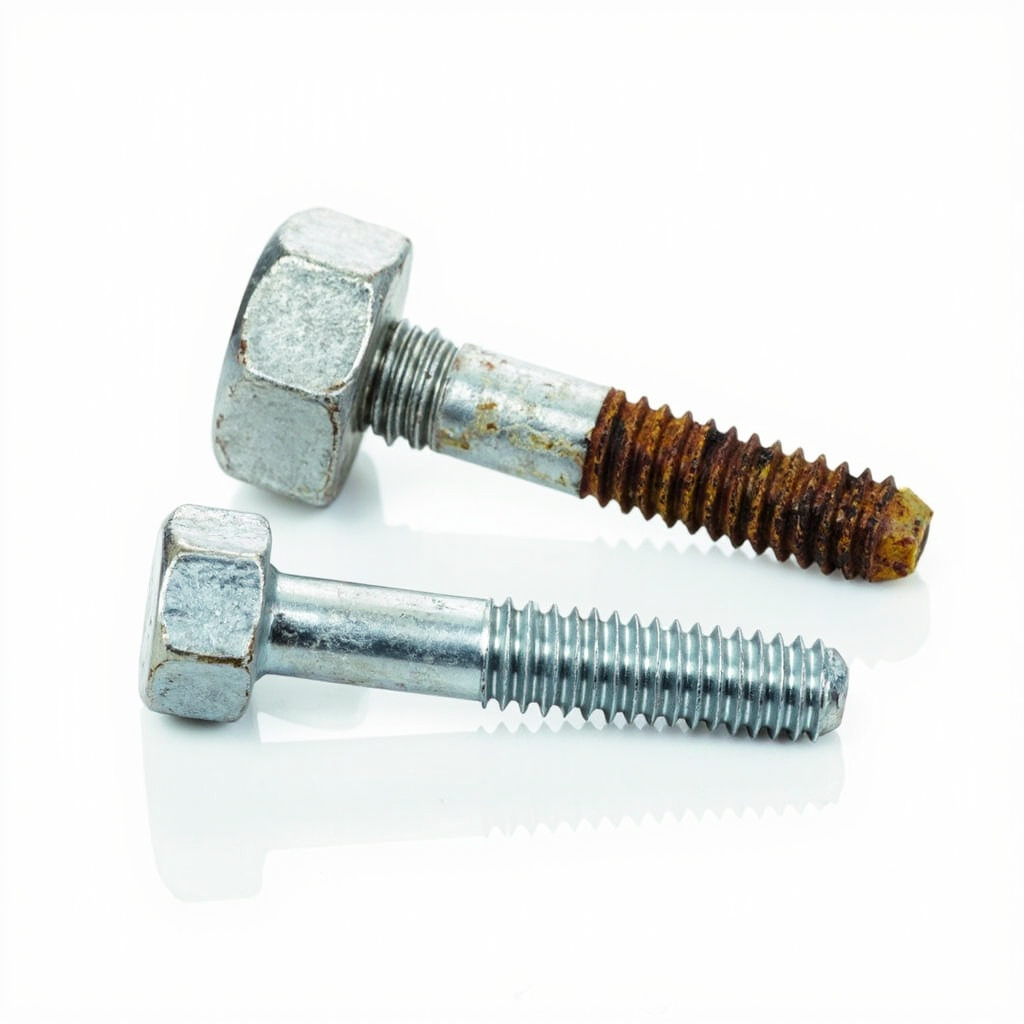
Types of Corrosion Affecting Fasteners
Understanding corrosion mechanisms is essential for selecting fasteners that will survive in their operating environment. The most common types affecting construction fasteners are uniform corrosion, galvanic corrosion, crevice corrosion, and stress corrosion cracking. Uniform corrosion is the gradual, even loss of material from the surface — it is predictable and can be managed through coating thickness selection. Galvanic corrosion occurs when two dissimilar metals are in electrical contact in the presence of an electrolyte (moisture). The less noble metal corrodes preferentially — for example, a zinc-plated bolt in contact with a stainless steel washer will corrode much faster than if both were the same material. Crevice corrosion develops in confined spaces where oxygen is depleted, such as under bolt heads and washers. Stress corrosion cracking (SCC) is the most dangerous form — it causes sudden brittle failure of high-strength bolts under tensile stress in corrosive environments, particularly with chloride exposure. For coastal construction projects across East and West Africa, galvanic and crevice corrosion are the most prevalent threats, while chloride-induced SCC is a concern for Grade 10.9 and 12.9 bolts in marine environments. Related resources: high-tensile bolts anchor bolts stainless steel fasteners hex bolts lock nuts washers self-drilling screws socket screws. This procurement framework applies to fastener sourcing for construction, mining, energy, automotive, and general industrial applications. The decision logic prioritizes quality consistency, supplier reliability, and total cost of ownership over short-term unit price. For B2B buyers in Africa, Latin America, and Southeast Asia, additional considerations include regional customs requirements, container consolidation options, and payment security mechanisms. Standardized specifications that travel across projects reduce training time, RFQ processing time, and supplier onboarding effort. This procurement framework applies to fastener sourcing for construction, mining, energy, automotive, and general industrial applications. The decision logic prioritizes quality consistency, supplier reliability, and total cost of ownership over short-term unit price. For B2B buyers in Africa, Latin America, and Southeast Asia, additional considerations include regional customs requirements, container consolidation options, and payment security mechanisms. Standardized specifications that travel across projects reduce training time, RFQ processing time, and supplier onboarding effort.
| Corrosion Type | Mechanism | Risk Level | Prevention |
|---|---|---|---|
| Uniform | Surface material loss | Low-Medium | Coating thickness |
| Galvanic | Dissimilar metal contact | High | Same metal or insulation |
| Crevice | Oxygen depletion in gaps | Medium-High | Sealants, proper torque |
| Stress Corrosion | Tension + chlorides | Critical | Avoid high-grade in marine |
| Pitting | Localized anodic attack | Medium | Stainless steel upgrade |
Coating and Material Options for Corrosion Resistance
Fastener corrosion resistance can be achieved through surface coatings, base material selection, or a combination of both. The hierarchy of corrosion protection, from least to most resistant, is: black phosphate (indoor only) → electroplated zinc (24-72h salt spray) → yellow zinc/chromate (48-96h) → mechanical galvanizing (100-200h) → hot-dip galvanizing (500-1000h) → zinc-aluminum alloy (1000-2000h) → stainless steel A2 (3000h+) → stainless steel A4 (5000h+). Hot-dip galvanizing (HDG) is the gold standard for carbon steel construction fasteners in outdoor and coastal applications. The zinc coating is 45-85 microns thick and provides both barrier and sacrificial protection. For structural bolts, HDG per ISO 10684 or ASTM A153 is standard. The main consideration with HDG is that the thick coating affects thread fit — oversize tapping of nuts is required (AZ tapping per ISO 10684). Stainless steel fasteners (A2-70 for general outdoor, A4-80 for marine) provide the highest corrosion resistance but at 3-5 times the cost of HDG carbon steel. Duplex coatings (HDG + paint or sherardizing + sealer) offer premium protection for extreme environments. Standards-based procurement requires continuous learning as ISO, ASTM, DIN, and GB standards are revised every 3-5 years. Subscribe to standards update notifications and review specifications annually. The most common standards used in international fastener trade are ISO 898-1 (mechanical properties), ISO 3506-1 (stainless), ISO 3269 (acceptance inspection), ISO 4042 (coatings), and ISO 1502 (thread gauges). For B2B buyers, building a standards reference library with at least the top 20 standards relevant to your product mix is essential. Standards-based procurement requires continuous learning as ISO, ASTM, DIN, and GB standards are revised every 3-5 years. Subscribe to standards update notifications and review specifications annually. The most common standards used in international fastener trade are ISO 898-1 (mechanical properties), ISO 3506-1 (stainless), ISO 3269 (acceptance inspection), ISO 4042 (coatings), and ISO 1502 (thread gauges). For B2B buyers, building a standards reference library with at least the top 20 standards relevant to your product mix is essential.
| Protection Level | Coating/Material | Salt Spray (hours) | Relative Cost | Best Application |
|---|---|---|---|---|
| 1 - Basic | Zinc Plated | 24-72 | 1.0x | Indoor, mild |
| 2 - Standard | Yellow Zinc | 48-96 | 1.1x | Light outdoor |
| 3 - Heavy | Mechanical Galv | 100-200 | 1.3x | Outdoor, humid |
| 4 - Premium | Hot-Dip Galv | 500-1000 | 1.5x | Coastal, industrial |
| 5 - Superior | Zn-Al Alloy | 1000-2000 | 2.0x | Marine, extreme |
| 6 - Maximum | SS A4-80 | 5000+ | 4-5x | Chemical, subsea |
Corrosion Resistance Selection Strategy by Environment
Selecting the right level of corrosion protection requires evaluating the specific environmental conditions at the project site. We recommend a four-step approach: (1) Classify the corrosion environment using ISO 12944-2 categories — C1 (heated interiors), C2 (low pollution rural), C3 (moderate urban/coastal), C4 (industrial/coastal), C5 (extreme industrial/marine). (2) Determine the required service life — 5 years for temporary structures, 15-25 years for standard construction, 50+ years for infrastructure. (3) Select the coating system based on environment and service life. (4) Specify supplementary protection for critical connections. For projects in Zimbabwe's interior (C2-C3), hot-dip galvanized fasteners typically provide 25+ year service life. For coastal projects in Mombasa, Dar es Salaam, or Lagos (C4-C5), HDG is the minimum; consider stainless steel for critical connections or duplex systems for extended life. In the Arabian Gulf, where temperatures regularly exceed 45°C and humidity fluctuates dramatically, thermal cycling accelerates coating degradation — specify Zn-Al alloy coatings or upgrade to stainless steel for above-grade exposed connections. The comparison methodology above uses typical ranges from industry data and TradeGo procurement experience 2018-2024. Actual market prices fluctuate with raw material costs (steel, zinc, nickel), energy costs, labor costs, and currency exchange rates. For accurate comparison, request identical RFQs from 3-5 qualified suppliers and compare landed cost (product + shipping + insurance + duties). The lowest unit price is rarely the lowest total cost of ownership. The comparison methodology above uses typical ranges from industry data and TradeGo procurement experience 2018-2024. Actual market prices fluctuate with raw material costs (steel, zinc, nickel), energy costs, labor costs, and currency exchange rates. For accurate comparison, request identical RFQs from 3-5 qualified suppliers and compare landed cost (product + shipping + insurance + duties). The lowest unit price is rarely the lowest total cost of ownership.
| ISO Category | Environment | Recommended Protection | Expected Life |
|---|---|---|---|
| C2 | Rural inland, low humidity | Zinc plated | 10-15 years |
| C3 | Urban, moderate coastal | Hot-dip galvanized | 15-25 years |
| C4 | Industrial, coastal | HDG or Zn-Al alloy | 15-25 years |
| C5 | Extreme marine/industrial | Zn-Al alloy or SS A4 | 25+ years |
Maintenance and Inspection of Corroded Fasteners
Even with proper initial specification, fastener corrosion should be monitored through regular inspection programs. For construction projects in corrosive environments, establish an inspection schedule based on the ISO 12944 maintenance categories. Visual inspection should focus on coating integrity (blistering, flaking, rust staining), bolt head condition (rounding, corrosion products), and any signs of structural movement at connections. The most critical areas are overhead connections where corrosion failure poses a safety risk and below-grade connections where moisture accumulation accelerates degradation. When corroded fasteners are identified, replacement should use the same or higher corrosion protection level — never downgrade. For replacement in existing structures, consider that newer HDG fasteners may have slightly different dimensions due to coating thickness. Apply zinc-rich paint or cold galvanizing spray to any areas where the coating has been damaged during installation. For bolts in highly corrosive environments, consider a scheduled preventive replacement program — replacing fasteners at 60-70% of their expected service life is far cheaper than emergency repairs after failure. Document all inspection findings and replacements for warranty and liability purposes. For more information, also see our guides on [galvanized vs stainless](/en/industry/galvanized-vs-stainless-steel-fasteners), [coating options](/en/industry/zinc-plated-vs-black-phosphate-screws), [roofing applications](/en/industry/roofing-screws-epdm-washer-guide). The verification checklist applies to both initial supplier qualification and ongoing batch inspection. For high-risk applications (load-bearing structural, pressure vessels, mining, marine), add fatigue testing, salt-spray testing (ASTM B117), torque-tension testing, and post-installation inspection. The cost of additional verification is 0.1-0.3% of order value, while undetected quality failures can be 10-100x the order value in damages. The verification checklist applies to both initial supplier qualification and ongoing batch inspection. For high-risk applications (load-bearing structural, pressure vessels, mining, marine), add fatigue testing, salt-spray testing (ASTM B117), torque-tension testing, and post-installation inspection. The cost of additional verification is 0.1-0.3% of order value, while undetected quality failures can be 10-100x the order value in damages.
How can I tell if a galvanized bolt needs replacement?
Replace when: (1) more than 25% of the surface shows red rust (not white zinc oxidation), (2) the bolt head shows significant material loss or rounding, (3) the zinc coating has blistered or flaked off in large areas, or (4) the bolt fails a torque verification test.
Is it okay to mix galvanized and stainless steel fasteners?
Not recommended. The galvanic couple between zinc and stainless steel will accelerate zinc corrosion. If mixing is unavoidable, use insulating washers (nylon or EPDM) between the dissimilar metals to break the electrical circuit.
Frequently Asked Questions
See frequently asked questions below.
Related resources: high-tensile bolts anchor bolts stainless steel fasteners hex bolts lock nuts washers self-drilling screws socket screws. Supplier evaluation should be a continuous process, not a one-time exercise. Re-evaluate suppliers annually based on delivery performance, quality metrics, price competitiveness, and responsiveness. Maintain a supplier scorecard with weighted metrics: on-time delivery (25%), quality acceptance rate (30%), price competitiveness (20%), responsiveness (15%), and documentation accuracy (10%). Drop suppliers scoring below 70% over a 6-month period and qualify replacements. Supplier evaluation should be a continuous process, not a one-time exercise. Re-evaluate suppliers annually based on delivery performance, quality metrics, price competitiveness, and responsiveness. Maintain a supplier scorecard with weighted metrics: on-time delivery (25%), quality acceptance rate (30%), price competitiveness (20%), responsiveness (15%), and documentation accuracy (10%). Drop suppliers scoring below 70% over a 6-month period and qualify replacements.What are Technical Guide and how are they used?
Technical Guide are essential components in construction and manufacturing. Proper selection depends on load requirements, environmental conditions, and material compatibility.
How do I choose the right fastener for my project?
Consider the material being fastened, load requirements, environmental exposure, and applicable standards. Consult with a professional if unsure about specifications.
What materials are available for these fasteners?
Common materials include carbon steel, stainless steel, alloy steel, and specialty alloys. Each offers different strength, corrosion resistance, and cost characteristics.
Do you offer custom manufacturing?
Yes, we offer custom fastener manufacturing to spec. Contact our sales team with your requirements for pricing and lead times.
Need corrosion-resistant fasteners for harsh environments? TradeGo Fasteners supplies HDG, Zn-Al, and stainless steel options.
Get Quote