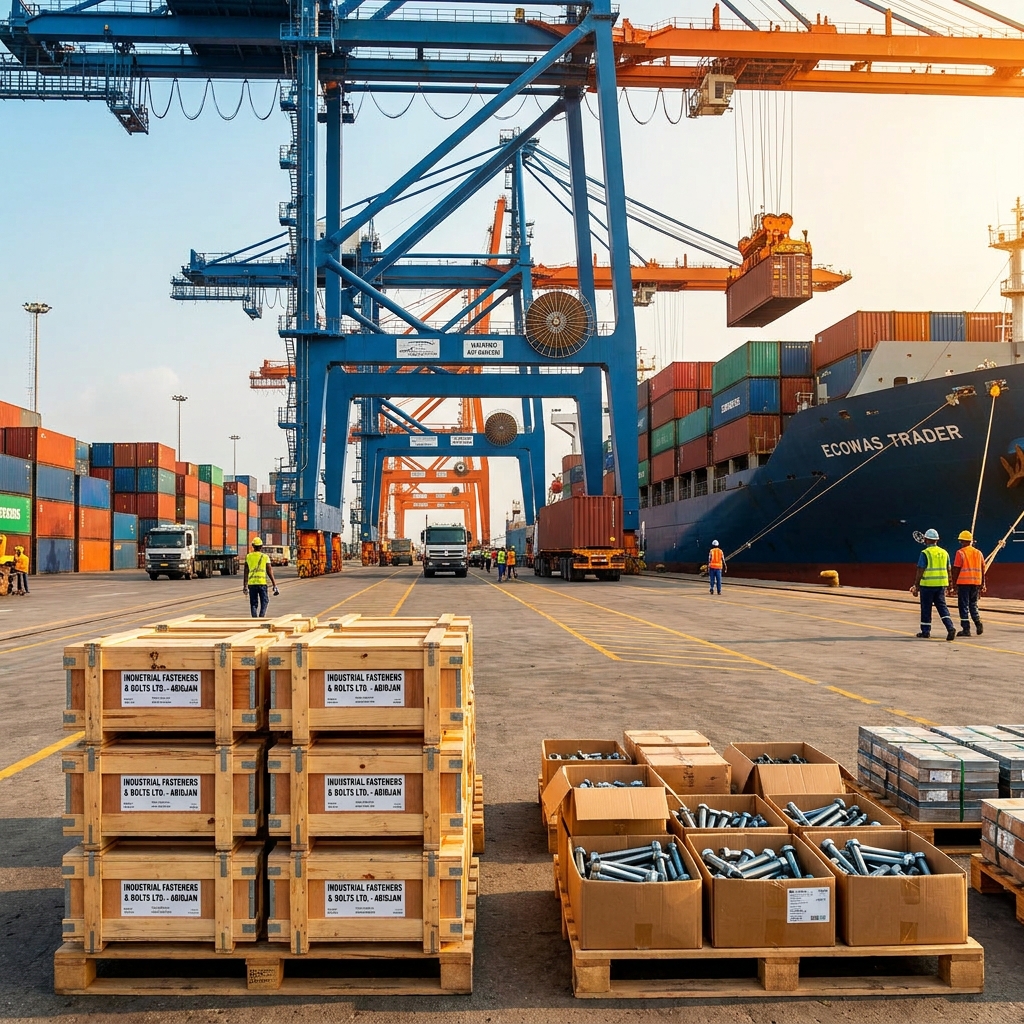
Understand the latest Ivory Coast Abidjan port fastener tariff regulations. Optimize your B2B supply chain to Abidjan today. Read our expert import guide.
Navigating the Ivory Coast Abidjan Port Fastener Tariff
For procurement managers sourcing industrial hardware, mastering the Ivory Coast Abidjan port fastener tariff is the cornerstone of a profitable West African supply chain. As the economic engine of the UEMOA zone, Abidjan processes a significant volume of industrial goods, with the Port Autonome d’Abidjan serving as a critical entry point for fasteners destined for construction, energy, and infrastructure projects across the region [2]. The regulatory framework is defined by the ECOWAS Common External Tariff (CET), a harmonized system designed to standardize import duties across member states. For B2B importers, the primary challenge lies in the exact classification of goods under the Harmonized System (HS). Industrial fasteners, typically categorized under Chapter 73 of the HS nomenclature, are subject to specific tariff bands depending on their material composition—such as steel, stainless steel, or alloy—and their technical application. Accurate classification is not merely a bureaucratic requirement; it is a financial necessity. Mislabeling a shipment of high-tensile bolts as generic screws can trigger incorrect duty assessments, leading to customs disputes, delays, and potential re-valuation of the entire container value by the Douanes de Côte d'Ivoire [1]. To ensure seamless entry, procurement teams must verify that the HS code provided by the manufacturer aligns precisely with the descriptions in the ECOWAS Trade Portal [3]. By understanding how these duties are aggregated, buyers can move beyond raw unit pricing and calculate the true landed cost, which includes the duty, the statistical tax, and the domestic Value Added Tax (VAT) essential for operations in Abidjan.
Understanding Tariff Classifications and Duties
The total financial exposure for a fastener shipment is rarely limited to a single duty percentage. The Ivory Coast Abidjan port fastener tariff is composed of several layers of taxation that accumulate upon the CIF (Cost, Insurance, and Freight) value of the goods. Under the current ECOWAS structure, most industrial fasteners fall into categories attracting customs duties ranging from 5% to 20% [3]. Beyond the base import duty, the Ivorian customs regime enforces several auxiliary charges that procurement managers must include in their budget models. These typically include the Statistical Tax (RS), which is often calculated as a percentage of the CIF value, and the Community Solidarity Levy (PCS). Furthermore, importers must account for the standard VAT, which is applied at the point of clearance. Calculating the "landed cost" requires a granular approach: take the FOB (Free On Board) price from the manufacturer, add the freight and insurance costs to arrive at the CIF value, and then layer on the duties and taxes sequentially. For high-volume B2B importers, differentiating between commodity-grade fasteners and specialized industrial components is key. Stainless steel fasteners, for instance, may attract different duty rates compared to galvanized or black-oxide steel fasteners due to their different end-use classifications in the manufacturing sector. By utilizing tools like the ITC Market Access Map, firms can run simulations to predict the exact tax burden for specific product batches, allowing for more precise contract pricing and margin protection [4]. Ignoring these nuances often leads to cash-flow gaps when the final customs invoice exceeds the initial procurement estimates.
Optimizing Your Ivory Coast Abidjan Port Fastener Tariff Strategy
Strategic duty mitigation requires a proactive approach to documentation and regional trade compliance. The most effective way to optimize the Ivory Coast Abidjan port fastener tariff is through the rigorous application of preferential rules of origin, where applicable. While China-based exports are subject to standard CET rates, importers should evaluate whether their local assembly or distribution partnerships in the West African region can leverage specific industrial incentives offered by the Ivorian government for raw materials or components used in national infrastructure projects [1]. Collaboration with a licensed local customs broker (transitaire) in Abidjan is non-negotiable. An experienced broker understands the "human element" of the port—navigating inspections, managing temporary storage fees, and ensuring that any potential tariff exemptions for government-sponsored projects are applied correctly. Documentation accuracy remains the primary tool for optimization; ensuring that the Commercial Invoice, Packing List, and Certificate of Origin are perfectly aligned prevents the reassessment of goods at higher tariff brackets. Furthermore, procurement managers should choose their shipping terms wisely. Utilizing CIF terms allows the exporter to control the logistics flow, but understanding the breakdown of local charges is essential for the importer. For large-scale projects, importers often find that shifting from a standard Sea Waybill to a negotiable Bill of Lading provides better control over the cargo release process, ensuring that all duties are settled with the customs authorities before the containers are moved to a bonded warehouse. This level of control minimizes the risk of incurring expensive demurrage charges while waiting for administrative clearance.
Essential Documentation for Abidjan Port Customs
Clearance efficiency at the Port of Abidjan hinges entirely on the quality and integrity of the documentation package. For industrial fasteners, the Certificate of Origin is arguably the most critical document, as it validates the source and technical specifications of the material [1]. This is not just about customs; it serves as a proof of quality for the end-user in Abidjan, verifying that the fasteners meet international standards such as ISO or DIN, which are widely accepted in the Ivorian industrial sector. The Commercial Invoice must be hyper-detailed, listing the precise HS code for every individual item. Generalizing descriptions like "steel parts" is a common trap that invites intense scrutiny during pre-shipment inspections. According to World Bank guidelines on West African trade, discrepancies between the shipping manifest and the actual cargo content remain the leading cause of inspection-related delays [6]. To avoid these pitfalls, procurement managers should ensure their manufacturer provides a detailed packing list that maps every box to its corresponding HS code, net weight, and gross weight. Managing Pre-Shipment Inspection (PSI) requirements is another vital step. While the Ivorian customs system has modernized, certain specialized fastener grades may still trigger mandatory quality testing to ensure they meet the structural demands of the local construction environment. By preparing high-resolution product technical data sheets and ensuring all markings on the product packaging match the documentation, exporters can demonstrate transparency and speed up the verification process, keeping the supply chain moving without the need for secondary inspections.
Compliance and Quality Standards for Fastener Exports
Technical compliance is the hidden gatekeeper of the Abidjan port. Fasteners are essential safety-critical components; therefore, Ivorian authorities enforce strict quality standards. Importing inferior-grade fasteners that do not meet tensile strength requirements or plating thickness specifications can lead to more than just customs delays—it can lead to the outright seizure of the goods if they are deemed unfit for structural use [2]. For B2B exporters, providing a Mill Test Report (MTR) with every shipment is highly recommended. This document confirms the chemical composition and mechanical properties of the steel, satisfying local engineering auditors who oversee large construction projects in Abidjan. Packaging also plays a role in compliance; fasteners must be packed in durable, moisture-resistant materials suitable for the tropical West African climate to prevent corrosion during transit and storage at the port. Importers often fail to realize that customs agents have the authority to pull samples for laboratory testing if they suspect the technical specifications do not match the declared HS code. By preemptively sharing technical certificates and ensuring that packaging is clearly labeled with product grades (e.g., 8.8, 10.9), the importer reduces the perceived risk profile of the shipment. A proactive stance on quality ensures that the cargo passes through the "green channel" with minimal friction, turning regulatory compliance into a competitive advantage in the local market.
Future Trends in West African Trade and Tariff Policy
The landscape of West African trade is undergoing a seismic shift with the implementation of the African Continental Free Trade Area (AfCFTA). While current fastener trade remains anchored in the ECOWAS CET, the long-term objective of the AfCFTA is the elimination of duties on a wide range of goods produced within the continent [5]. For B2B suppliers, this means that while Chinese-origin fasteners currently face the standard tariff structure, the future competitive environment will favor those who establish regional distribution hubs or local value-added processing centers. Digitalization is the second major trend transforming the Port of Abidjan. The ongoing integration of electronic single-window systems aims to reduce the time spent on physical document handling and increase the speed of duty payments [2]. As the system becomes more transparent, the "hidden" costs associated with manual intervention are likely to decrease, favoring firms that invest in digitized, automated supply chain management systems. Procurement managers should look toward the future by fostering partnerships that prioritize transparency and long-term volume over short-term spot deals. As infrastructure development in Ivory Coast continues to accelerate, the demand for standardized, high-quality fasteners will grow. Suppliers and buyers who master the current customs requirements while preparing for the inevitable shift toward continental integration will be best positioned to dominate this evolving market. Preparing your B2B supply chain for these changes now involves diversifying your logistics partnerships and ensuring that your documentation processes are scalable and ready for a more digitized future.
Need Ivory Coast Abidjan port fastener tariff guidance for your B2B project? TradeGo supplies ISO/EN/ASTM certified fasteners with full export documentation and factory-direct pricing.
Request Quote