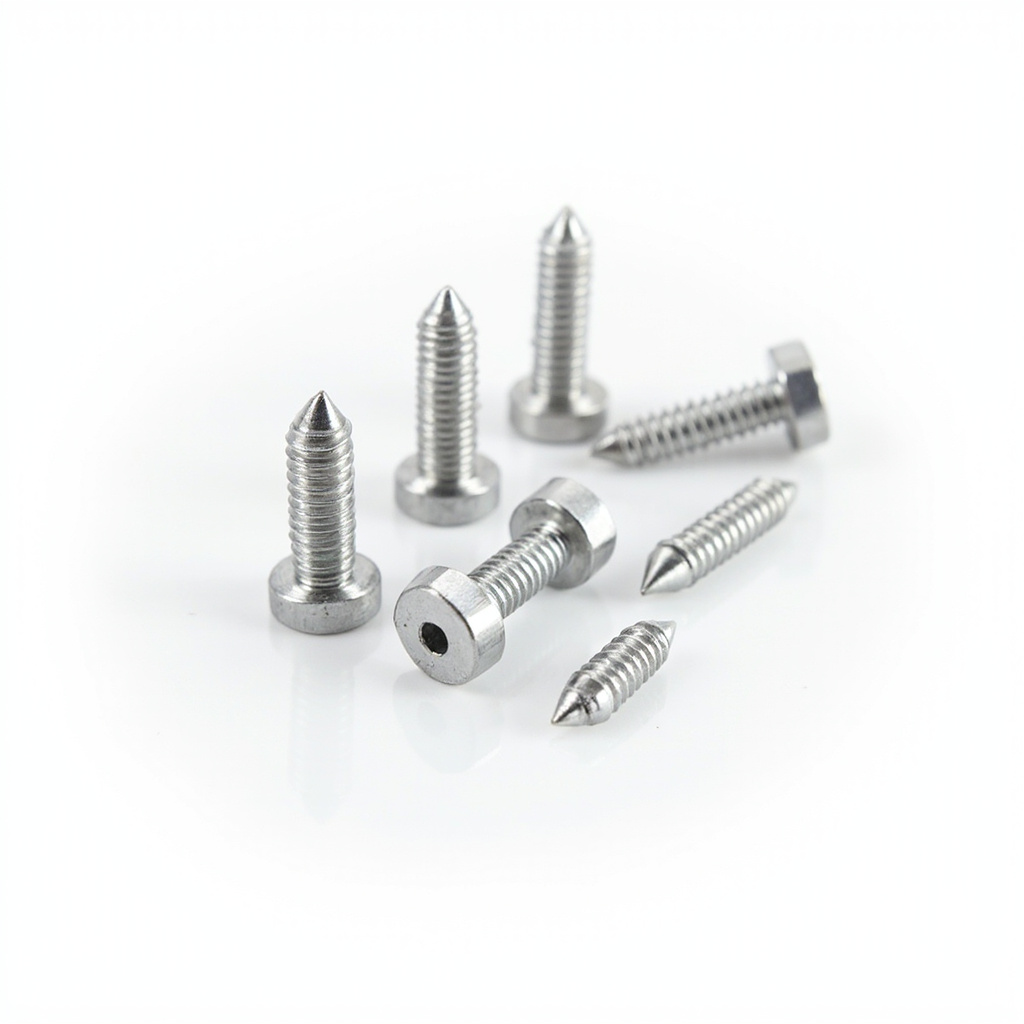
Complete guide to set screws (grub screws) and dowel pins: types, head styles, materials, and applications for shaft collars, gear retention, and precision a...
Set Screw Types and Head Styles
Set screws (also called grub screws) are headless screws with a socket on one or both ends, designed to secure a component onto a shaft or within a bore. They bear against the shaft surface to prevent rotation or axial movement. Key types: Cup point — the most common; the end is a cup shape that seats against the shaft; provides good holding power without damaging the shaft surface; suitable for soft shafts. Flat point — provides a line contact; higher holding power but can damage softer shafts; good for hardened shafts. Cone point — sharp cone that penetrates the shaft surface; highest holding power but marks the shaft; used for permanent or semi-permanent installations. Half-dog point — cylindrical end that engages a shallow hole in the shaft; allows repositioning without marring the shaft surface. Knurled cup point — extra grip for frequent adjustment applications. Related resources: high-tensile bolts anchor bolts stainless steel fasteners hex bolts lock nuts washers self-drilling screws socket screws. This procurement framework applies to fastener sourcing for construction, mining, energy, automotive, and general industrial applications. The decision logic prioritizes quality consistency, supplier reliability, and total cost of ownership over short-term unit price. For B2B buyers in Africa, Latin America, and Southeast Asia, additional considerations include regional customs requirements, container consolidation options, and payment security mechanisms. Standardized specifications that travel across projects reduce training time, RFQ processing time, and supplier onboarding effort. This procurement framework applies to fastener sourcing for construction, mining, energy, automotive, and general industrial applications. The decision logic prioritizes quality consistency, supplier reliability, and total cost of ownership over short-term unit price. For B2B buyers in Africa, Latin America, and Southeast Asia, additional considerations include regional customs requirements, container consolidation options, and payment security mechanisms. Standardized specifications that travel across projects reduce training time, RFQ processing time, and supplier onboarding effort. This procurement framework applies to fastener sourcing for construction, mining, energy, automotive, and general industrial applications. The decision logic prioritizes quality consistency, supplier reliability, and total cost of ownership over short-term unit price. For B2B buyers in Africa, Latin America, and Southeast Asia, additional considerations include regional customs requirements, container consolidation options, and payment security mechanisms. Standardized specifications that travel across projects reduce training time, RFQ processing time, and supplier onboarding effort.
| Point Type | Holding Power | Shaft Damage | Best Use |
|---|---|---|---|
| Cup point | Medium-high | Minimal | General shaft fixing, soft to medium shafts |
| Flat point | High | Moderate | Hardened shafts, permanent installations |
| Cone point | Very high | Significant | Permanent locking, hardened shafts only |
| Half-dog point | Medium | None | Adjustable assemblies, positioning pins |
| Knurled cup | High | Moderate | Frequent adjustment, soft shafts |
Dowel Pins: Precision Location and Alignment
Dowel pins are precisely sized cylindrical pins used to maintain accurate alignment between mating components, prevent relative motion, and enable repeatable positioning. They are inserted into coincident holes in both components. Types: Parallel pins (ground fit) — the most common; manufactured to close tolerances (h6, m6, h7); available in several fit classes; provide precise location and moderate holding force. Spring (tension) pins — split longitudinally and expanded by a ball; insert into standard reamed holes; provide vibration resistance and are reusable; not for precision alignment. Taper pins — gradually taper along their length; driven into matching taper holes; provides very secure fastening and precise location; used in machinery requiring high positional accuracy. Roll pins (coiled spring pins) — similar to spring pins but with a coil rather than slit; higher strength than spring pins; driven into standard holes. Standards-based procurement requires continuous learning as ISO, ASTM, DIN, and GB standards are revised every 3-5 years. Subscribe to standards update notifications and review specifications annually. The most common standards used in international fastener trade are ISO 898-1 (mechanical properties), ISO 3506-1 (stainless), ISO 3269 (acceptance inspection), ISO 4042 (coatings), and ISO 1502 (thread gauges). For B2B buyers, building a standards reference library with at least the top 20 standards relevant to your product mix is essential. Standards-based procurement requires continuous learning as ISO, ASTM, DIN, and GB standards are revised every 3-5 years. Subscribe to standards update notifications and review specifications annually. The most common standards used in international fastener trade are ISO 898-1 (mechanical properties), ISO 3506-1 (stainless), ISO 3269 (acceptance inspection), ISO 4042 (coatings), and ISO 1502 (thread gauges). For B2B buyers, building a standards reference library with at least the top 20 standards relevant to your product mix is essential. Standards-based procurement requires continuous learning as ISO, ASTM, DIN, and GB standards are revised every 3-5 years. Subscribe to standards update notifications and review specifications annually. The most common standards used in international fastener trade are ISO 898-1 (mechanical properties), ISO 3506-1 (stainless), ISO 3269 (acceptance inspection), ISO 4042 (coatings), and ISO 1502 (thread gauges). For B2B buyers, building a standards reference library with at least the top 20 standards relevant to your product mix is essential.
| Pin Type | Tolerance | Holding Power | Best Use |
|---|---|---|---|
| Parallel dowel (h6) | Very tight | High | Precision alignment, permanent |
| Parallel dowel (m6) | Tight | High | General precision alignment |
| Spring/tension pin | Standard hole | Medium | Vibration resistance, reusable |
| Taper pin | Very precise | Very high | Permanent, high accuracy machinery |
| Roll pin (coiled) | Standard hole | Medium-high | High shock loads, reusable |
Materials for Set Screws and Dowel Pins
Material selection for set screws and dowel pins depends on the application: Hardened steel (Rc 45-58) — standard for most set screws and dowel pins; provides good wear resistance and holding power; typically supplied with black oxide or zinc plating. Stainless steel 304/316 — for corrosion-resistant applications; 316 for marine, chemical, food-processing environments; not as hard as hardened steel so less wear resistance. Nylon-tipped set screws — soft nylon tip prevents shaft damage; used for delicate shafts (instrumentation, optical equipment); limited holding power. Case-hardened steel — low-carbon steel with hardened surface; economical for high-volume production; used where only surface hardness matters. For African industrial applications, hardened steel set screws with zinc plating are the standard choice for shaft collars, bearing retention, and gear positioning. The comparison methodology above uses typical ranges from industry data and TradeGo procurement experience 2018-2024. Actual market prices fluctuate with raw material costs (steel, zinc, nickel), energy costs, labor costs, and currency exchange rates. For accurate comparison, request identical RFQs from 3-5 qualified suppliers and compare landed cost (product + shipping + insurance + duties). The lowest unit price is rarely the lowest total cost of ownership. The comparison methodology above uses typical ranges from industry data and TradeGo procurement experience 2018-2024. Actual market prices fluctuate with raw material costs (steel, zinc, nickel), energy costs, labor costs, and currency exchange rates. For accurate comparison, request identical RFQs from 3-5 qualified suppliers and compare landed cost (product + shipping + insurance + duties). The lowest unit price is rarely the lowest total cost of ownership. The comparison methodology above uses typical ranges from industry data and TradeGo procurement experience 2018-2024. Actual market prices fluctuate with raw material costs (steel, zinc, nickel), energy costs, labor costs, and currency exchange rates. For accurate comparison, request identical RFQs from 3-5 qualified suppliers and compare landed cost (product + shipping + insurance + duties). The lowest unit price is rarely the lowest total cost of ownership.
Shaft Collar and Gear Retention Applications
Set screws are most commonly used for: Shaft collars — collars fixed to shafts using cup-point set screws; collars define axial position of components (bearings, pulleys, sprockets); two set screws at 90 degrees to each other provide the most secure grip; always specify cup point for soft shaft materials (aluminum, brass, stainless). Bearing retention — set screws used to secure bearings onto shafts; cup point set screw in the inner ring bore-sealing ring; not recommended for high-vibration or frequent removal applications. Gear and pulley location — set screws bear against a flat or half-dog against a hole in the shaft; half-dog point allows repositioning without shaft damage. Eccentric adjustable fixtures — half-dog set screws engage an eccentric hole in a fixture plate for precise angular adjustment; common in machinery adjustment applications. For any application with frequent removal or adjustment, consider using a split shaft collar with clamp screws instead of set screws. The verification checklist applies to both initial supplier qualification and ongoing batch inspection. For high-risk applications (load-bearing structural, pressure vessels, mining, marine), add fatigue testing, salt-spray testing (ASTM B117), torque-tension testing, and post-installation inspection. The cost of additional verification is 0.1-0.3% of order value, while undetected quality failures can be 10-100x the order value in damages. The verification checklist applies to both initial supplier qualification and ongoing batch inspection. For high-risk applications (load-bearing structural, pressure vessels, mining, marine), add fatigue testing, salt-spray testing (ASTM B117), torque-tension testing, and post-installation inspection. The cost of additional verification is 0.1-0.3% of order value, while undetected quality failures can be 10-100x the order value in damages. The verification checklist applies to both initial supplier qualification and ongoing batch inspection. For high-risk applications (load-bearing structural, pressure vessels, mining, marine), add fatigue testing, salt-spray testing (ASTM B117), torque-tension testing, and post-installation inspection. The cost of additional verification is 0.1-0.3% of order value, while undetected quality failures can be 10-100x the order value in damages.
Frequently Asked Questions
See frequently asked questions below.
Related resources: high-tensile bolts anchor bolts stainless steel fasteners hex bolts lock nuts washers self-drilling screws socket screws. Supplier evaluation should be a continuous process, not a one-time exercise. Re-evaluate suppliers annually based on delivery performance, quality metrics, price competitiveness, and responsiveness. Maintain a supplier scorecard with weighted metrics: on-time delivery (25%), quality acceptance rate (30%), price competitiveness (20%), responsiveness (15%), and documentation accuracy (10%). Drop suppliers scoring below 70% over a 6-month period and qualify replacements. Supplier evaluation should be a continuous process, not a one-time exercise. Re-evaluate suppliers annually based on delivery performance, quality metrics, price competitiveness, and responsiveness. Maintain a supplier scorecard with weighted metrics: on-time delivery (25%), quality acceptance rate (30%), price competitiveness (20%), responsiveness (15%), and documentation accuracy (10%). Drop suppliers scoring below 70% over a 6-month period and qualify replacements. Supplier evaluation should be a continuous process, not a one-time exercise. Re-evaluate suppliers annually based on delivery performance, quality metrics, price competitiveness, and responsiveness. Maintain a supplier scorecard with weighted metrics: on-time delivery (25%), quality acceptance rate (30%), price competitiveness (20%), responsiveness (15%), and documentation accuracy (10%). Drop suppliers scoring below 70% over a 6-month period and qualify replacements.What happens if a set screw keeps loosening on my shaft?
Set screw loosening on shafts is caused by: insufficient tightening torque — ensure you are using the correct socket size and applying adequate torque; a 3mm set screw requires only 0.5-1 N·m, while an M8 requires 5-10 N·m; vibration — specify cup point or knurled cup for vibration environments; consider adding a second set screw at 90 degrees to the first; soft shaft material — cup point set screws indent soft shafts over time; use a shaft with a drilled positioning hole (half-dog) or specify a harder shaft material; inadequate thread engagement — the set screw must thread fully into the component (minimum 1.5× diameter engagement); if the component is too thin, the set screw bottoms out before providing adequate clamping force.
When should I use a taper pin vs a parallel dowel pin?
Use taper pins for: permanent, high-accuracy positioning where the joint will not be disassembled; applications requiring very high positional accuracy (machine tool fixtures, precision instruments); joints where the pin must also transmit shear load. Use parallel dowel pins for: applications where components may need to be disassembled and reassembled; general precision alignment in machinery; where ease of assembly/disassembly is important. Taper pins require matching taper holes (reamed with a taper reamer) which are more expensive to produce than straight holes for parallel dowels.
What is the difference between a spring pin and a roll pin?
Spring pins (tension pins) and roll pins (coiled spring pins) are both split longitudinally to allow compression during insertion, but they differ in manufacture and performance: Spring pins are a single piece of spring steel with a longitudinal slit; roll pins are a coiled strip of steel — essentially a spring wound into a pin shape. Roll pins are significantly stronger than spring pins (approximately 3× the shear strength) and resist jamming better. Roll pins are the preferred choice for most industrial applications; spring pins are used where very precise control of expansion force is needed.
Need set screws or dowel pins for your machinery? Get a factory quote from TradeGo.
Get Quote