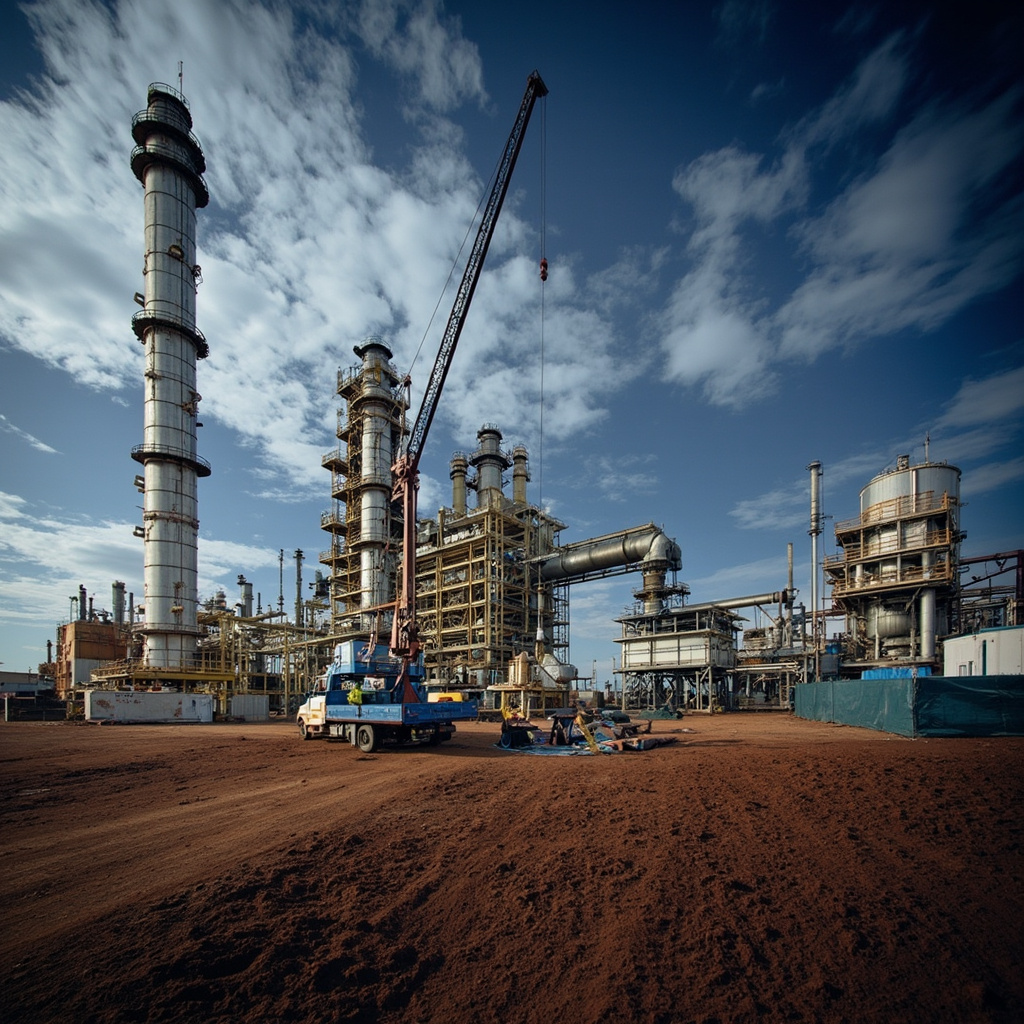
Material grades, API/ASTM/ISO standards, and quality checks for fasteners in Uganda's planned 60,000 bpd Kabaale refinery (Hoima District).
Overview of Uganda Oil Refinery Fastener Requirements
The Uganda Oil Refinery represents one of the largest industrial investments in the country's petroleum sector. Unlike ordinary construction projects, refinery facilities operate continuously under demanding mechanical and chemical conditions where a single fastener failure can lead to equipment shutdowns, environmental incidents, or personnel safety risks.
Critical applications include:
Structural steel connections
Pressure vessel assembly
Pipeline flange joints
Heat exchanger mounting
Storage tank construction
Pipe supports
Electrical equipment anchoring
Mechanical equipment foundations
Each application requires different mechanical properties and corrosion resistance.
API standards form the backbone of refinery engineering because they define acceptable practices for petroleum processing facilities.[2] ASTM standards specify material composition and mechanical properties, while ISO standards govern quality management systems, testing methods, and manufacturing consistency.[3][5]
Uganda National Bureau of Standards (UNBS) requires imported industrial products to comply with national conformity requirements before entering major infrastructure projects.[4] Procurement teams should therefore verify not only product specifications but also documentation including:
Mill Test Certificates (MTC 3.1)
Heat number traceability
Chemical composition reports
Mechanical test reports
Dimensional inspection reports
Coating inspection records
The refinery project's location in Kabaale, Hoima District introduces logistical considerations. Imported industrial fasteners generally arrive through Mombasa Port (Kenya) or Dar es Salaam Port (Tanzania) before inland transport to western Uganda. Buyers should account for inland transportation schedules, customs clearance, and packaging capable of preventing corrosion during extended transit.
From a procurement perspective, selecting qualified manufacturers early minimizes project delays. Documentation deficiencies often cause longer approval cycles than manufacturing itself. Suppliers experienced with refinery EPC projects generally understand inspection hold points, third-party witness testing, and documentation packages expected by international engineering contractors.
Material Grade Specifications for Uganda Refinery Fasteners
Material selection directly affects refinery reliability.
For structural applications exposed primarily to atmospheric conditions, carbon steel remains the most economical option. Common ASTM material grades include:
ASTM A307
ASTM A325 (structural)
ASTM A490 (high-strength structural)
These provide excellent structural performance where operating temperatures remain moderate.[3]
However, refinery process units expose fasteners to hydrocarbons, sulfur compounds, steam, vibration, and thermal cycling. Alloy steel therefore becomes essential in pressure-containing equipment.
Common refinery alloy fasteners include:
ASTM A193 Grade B7
ASTM A193 Grade B16
ASTM A320 L7 (low-temperature service)
ASTM A194 Grade 2H heavy hex nuts
These combinations deliver high tensile strength while maintaining mechanical integrity under elevated temperatures.
For highly corrosive environments, stainless steels become preferable.
Typical refinery grades include:
ASTM F593 Type 304
ASTM F593 Type 316
ASTM A193 B8
ASTM A193 B8M
Grade 316 provides significantly better chloride resistance than Grade 304 because of its molybdenum content, making it suitable for humid processing environments and outdoor installations.
Material selection should never depend solely on strength.
For example:
Carbon steel may possess sufficient tensile capacity but corrode rapidly if protective coatings are damaged.
Stainless steel provides excellent corrosion resistance but generally costs substantially more.
Alloy steel delivers outstanding strength but requires appropriate coatings and maintenance.
Procurement managers should evaluate:
Operating temperature
Chemical exposure
Pressure rating
Maintenance accessibility
Expected service life
Replacement cost
Inspection intervals
Uganda's tropical climate features relatively high humidity throughout much of the year, increasing atmospheric corrosion risks for exposed steel components.[1] Protective coatings and proper material selection therefore reduce lifecycle maintenance costs considerably.
Material traceability is equally important. Every production batch should remain traceable back to raw material heat numbers, ensuring compliance during owner audits and third-party inspections.
API & International Standards for Refinery Fastener Compliance
Compliance begins with understanding which standards govern each application.
API Recommended Practices establish engineering expectations for petroleum facilities, while ASTM standards define material performance and ISO standards provide manufacturing quality assurance.[2][3][5]
Typical refinery documentation references include:
API
Petroleum facility design requirements
Inspection requirements
Pressure equipment recommendations
ASTM
ASTM A193
ASTM A194
ASTM A307
ASTM A325
ASTM A490
ASTM F593
ASTM F594
These standards specify:
Chemical composition
Yield strength
Tensile strength
Hardness
Heat treatment
Manufacturing tolerances
ISO standards typically include:
ISO 9001 quality management
Dimensional standards
Testing procedures
Manufacturing controls
ISO certification alone does not guarantee refinery suitability, but it demonstrates controlled manufacturing systems that improve product consistency.[5]
UNBS additionally verifies imported industrial products entering Uganda's market.[4] Procurement teams should confirm supplier familiarity with local conformity procedures before shipment.
Third-party inspection agencies frequently participate during refinery procurement. Common inspection activities include:
Visual inspection
Dimensional verification
Tensile testing
Hardness testing
Magnetic particle inspection
Ultrasonic testing where required
Coating thickness measurement
Positive Material Identification (PMI)
PMI has become increasingly important because mixed material batches can create catastrophic failures if incorrect alloys enter high-temperature service.
Documentation packages often contain:
EN 10204 3.1 certificates
Inspection reports
Calibration certificates
Coating certificates
Packing lists
Traceability matrices
Buyers should specify documentation requirements during quotation rather than after production, reducing approval delays and avoiding costly rework.
High-Pressure & High-Temperature Fastener Requirements
Refinery process units routinely operate under conditions exceeding those encountered in conventional industrial buildings.
Applications include:
Steam systems
Furnace assemblies
Pressure vessels
Reactor equipment
High-pressure pipelines
Heat exchangers
Under these conditions, bolt preload becomes essential.
Proper preload prevents flange leakage during thermal expansion while maintaining gasket compression.
ASTM A193 Grade B7 remains one of the industry's preferred materials because it combines high tensile strength with excellent high-temperature performance.[3]
However, material selection depends on operating conditions rather than simply choosing the strongest available fastener.
For elevated temperatures, engineers evaluate:
Yield strength retention
Creep resistance
Relaxation characteristics
Thermal expansion compatibility
Fatigue performance
Improper material selection may lead to:
Bolt relaxation
Gasket leakage
Fatigue cracking
Joint separation
Equipment shutdown
High-pressure flange connections also require compatible nuts.
ASTM A194 Grade 2H nuts are commonly paired with A193 B7 studs because both materials provide compatible mechanical performance.
Procurement managers should request:
Mechanical test certificates
Heat treatment records
Thread inspection reports
Hardness reports
Impact testing where specified
Fastener lubrication also influences preload accuracy.
Controlled lubrication reduces friction variability, improving bolt tension consistency during installation.
Installation procedures frequently specify calibrated torque values or hydraulic tensioning rather than relying on operator judgment.
Although galvanized coatings perform well outdoors, they are generally unsuitable for certain high-temperature applications because coating degradation can occur at elevated temperatures. Alternative protective systems should therefore be selected according to engineering specifications rather than cost alone.
Early coordination between the EPC contractor, inspection agency, and manufacturer reduces field installation problems and minimizes schedule risks during mechanical completion.
Corrosion Resistance Needs for Uganda Refinery Fasteners
Corrosion represents one of the primary causes of refinery maintenance expenditure.
Fasteners encounter:
Rainfall
Humidity
Hydrocarbon vapors
Sulfur compounds
Cleaning chemicals
Salt contamination during transportation
Process chemicals
Uganda's tropical climate increases atmospheric corrosion potential, particularly for outdoor structures.[1]
Several protective options exist.
Hot-Dip Galvanizing (HDG)
Advantages:
Thick zinc coating
Long outdoor service life
Excellent structural protection
Lower maintenance costs
Disadvantages:
Larger coating thickness affects thread tolerances
Not appropriate for some high-temperature applications
Electro Zinc Plating
Advantages:
Smooth appearance
Lower initial cost
Good dimensional accuracy
Disadvantages:
Much thinner coating
Shorter corrosion life
Less suitable for aggressive outdoor refinery environments
For structural outdoor steel, HDG generally provides superior long-term value despite higher initial cost because maintenance intervals become significantly longer.
For stainless steel fasteners, passivation enhances corrosion resistance by strengthening the chromium oxide protective layer.
Additional protective measures include:
PTFE coatings
Zinc flake coatings
Xylan coatings
Specialty fluoropolymer systems
Selection depends on chemical compatibility, temperature limits, and maintenance philosophy.
Procurement teams should verify coating quality through:
Coating thickness measurement
Adhesion testing
Salt spray testing where specified
Visual inspection
Thread fit verification
Packaging also influences corrosion performance.
Moisture-resistant export packaging with desiccants, sealed containers, protective oils where applicable, and clearly identified heat numbers help preserve product quality during ocean freight and inland transportation to Uganda.
B2B Supply & Quality Checks for Uganda Refinery Fasteners
Supplier qualification extends beyond manufacturing capability.
Refinery EPC contractors evaluate suppliers based on:
Manufacturing experience
ISO-certified quality systems
Traceability procedures
Refinery project references
Inspection capability
Export documentation
Delivery performance
Quality control typically begins before raw material enters production.
Incoming inspections verify:
Chemical composition
Material certification
Heat number identification
Production inspections monitor:
Forging
Heat treatment
Thread rolling
Surface finish
Dimensional tolerances
Final inspections commonly include:
Tensile testing
Hardness testing
Coating inspection
Thread gauge verification
Visual examination
Packaging inspection
Third-party inspection organizations frequently witness production before shipment.
Documentation packages should include:
EN 10204 3.1 certificates
Packing lists
Certificate of conformity
Coating reports
Mechanical test reports
Dimensional inspection records
Traceability documentation
Bulk packaging should prevent damage throughout transportation from China to East Africa.
Recommended practices include:
Heavy-duty plywood cases
Moisture barrier bags
Vacuum packaging where required
Rust preventive materials
Palletized loading
Clear batch labeling
QR-code traceability
Logistics planning should consider routing through Mombasa Port or Dar es Salaam Port, customs clearance requirements, inland transportation to Hoima, and project delivery schedules coordinated with EPC construction milestones.
From a buyer's perspective, the lowest unit price rarely represents the lowest project cost. Fasteners lacking complete certification or traceability often require replacement or extensive reinspection, resulting in schedule delays far exceeding any initial procurement savings.
Long-term supplier partnerships with experienced refinery fastener manufacturers therefore reduce project risk by ensuring specification compliance, documentation completeness, and dependable delivery performance.
FAQ
### What are the core fastener standards for Uganda oil refinery projects?
Uganda oil refinery fastener requirements primarily reference API engineering practices, ASTM material standards, ISO quality management systems, and applicable Uganda National Bureau of Standards conformity requirements. Together, these standards ensure fasteners can safely perform in high-pressure, high-temperature refinery environments while meeting documentation and traceability expectations.[2][3][4][5]
Which fastener materials suit Uganda's refinery environment?
Refinery applications commonly use graded carbon steel for structural work, alloy steel such as ASTM A193 B7 for pressure systems, and stainless steel grades including 304 and 316 where corrosion resistance is critical. Protective coatings are selected according to operating temperature, humidity, and chemical exposure.[1][3]
### Do Uganda refinery fasteners need third-party certification?
Yes. Major refinery EPC contractors typically require ISO-certified manufacturing systems, ASTM-compliant material certification, API-aligned engineering documentation, EN 10204 3.1 material certificates, and third-party inspection reports where specified to satisfy project quality requirements.[2][3][5]
What coating specifications apply to Uganda refinery fasteners?
Hot-dip galvanizing is widely preferred for outdoor structural applications because of its superior corrosion protection compared with electro zinc plating. Stainless steel fasteners generally require passivation, while specialized fluoropolymer or zinc-flake coatings may be specified for aggressive refinery process environments.[3][5]
### Can B2B manufacturers supply bulk refinery fasteners to Uganda?
Yes. Experienced B2B manufacturers can provide bulk refinery fasteners with complete quality documentation, material traceability, third-party inspection support, export-grade packaging, and logistics coordination through East African ports for delivery to the Uganda Oil Refinery project.[1][4][6]
Frequently Asked Questions
¿Cuáles son las normas requeridas para los fijadores en refinerías de petróleo ugandesas?\n\nLos fijadores deben cumplir con las normas API 6A y ASTM A193 Grade B7 para pernos de alta resistencia. Además, deben satisfacerse los requisitos de ISO 9001 para el sistema de gestión de calidad. Las juntas planas se clasifican según las especificaciones de la serie BX en la norma API 6A.\n\n¿Existen requisitos especiales para el manejo de sulfuro de hidrógeno (H2S)?\n\nSí, debido a las altas concentraciones de H2S en los campos petroleros ugandeses, se deben utilizar pernos de aleaciones resistentes a la corrosión. La clase de calidad A193 B7 por sí sola no es adecuada y debe especificarse con un recubrimiento o forro apropiado. Las pruebas de resistencia a la corrosión (Stress Corrosion Cracking) deben realizarse según las normas ASTM G36.\n\n¿Quels sont les plages de température de fonctionnement autorisées?\n\nLas temperaturas de funcionamiento típicas oscilan entre 30 grados Celsius y 200 grados Celsius. Se debe verificar que los materiales de fijación mantengan sus propiedades mecánicas en este rango. Los pernos de clase B7 son adecuados para temperaturas hasta 450 grados Celsius como máximo, aunque debe considerarse una reducción de los valores de tensión permitidos.\n\n¿Qué código HS se utiliza para la importación?\n\nEl código HS para fijadores industriales y tornillos es 7318. Los subcódigos pueden variar según el tipo y tamaño del tornillo. Los detalles específicos deben consultarse con las autoridades aduaneras ugandesas.\n\n¿Qué pruebas de calidad se requieren antes de la entrega?\n\nLas pruebas requeridas incluyen: análisis de composición química según [1], pruebas de tracción y dureza según [2], así como pruebas de resistencia al impacto según [3]. Todos los resultados deben documentarse en informes de prueba certificados.\n\n¿Existen requisitos especiales para la instalación en ambientes marinos?\n\nSí, en las zonas costeras de Uganda se requiere un recubrimiento resistente a la sal y la corrosión. Se recomienda el uso de recubrimiento epoxi o galvanizado en caliente. Las especificaciones deben cumplir con las normas ISO 12944 para protección contra la corrosión.
What are the core fastener standards for Uganda oil refinery projects?
cts? Uganda oil refinery fastener requirements primarily reference API engineering practices, ASTM material standards, ISO quality management systems, and applicable Uganda National Bureau of Standards conformity requirements. Together, these standards ensure fasteners can safely perform in high-pressure, high-temperature refinery environments while meeting documentation and traceability expectations.[2][3][4][5] Which fastener materials suit Uganda's refinery environment? Refinery applications commonly use graded carbon steel for structural work, alloy steel such as ASTM A193 B7 for pressure systems, and stainless steel grades including 304 and 316 where corrosion resistance is critical. Protective coatings are selected according to operating temperature, humidity, and chemical exposure.[1][3]
Which fastener materials suit Uganda’s refinery environment?
Stainless steel, alloy steel and graded carbon steel fasteners are required, with corrosion-resistant coatings for Uganda’s humid tropical operating conditions.
Do Uganda refinery fasteners need third-party certification?
ion? Yes. Major refinery EPC contractors typically require ISO-certified manufacturing systems, ASTM-compliant material certification, API-aligned engineering documentation, EN 10204 3.1 material certificates, and third-party inspection reports where specified to satisfy project quality requirements.[2][3][5] What coating specifications apply to Uganda refinery fasteners? Hot-dip galvanizing is widely preferred for outdoor structural applications because of its superior corrosion protection compared with electro zinc plating. Stainless steel fasteners generally require passivation, while specialized fluoropolymer or zinc-flake coatings may be specified for aggressive refinery process environments.[3][5]
What coating specs apply to Uganda refinery fasteners?
Hot-dip galvanization and passivation coatings are mandatory to resist humidity, chemical corrosion and outdoor refinery environmental wear.
Can B2B manufacturers supply bulk refinery fasteners to Uganda?
nda? Yes. Experienced B2B manufacturers can provide bulk refinery fasteners with complete quality documentation, material traceability, third-party inspection support, export-grade packaging, and logistics coordination through East African ports for delivery to the Uganda Oil Refinery project.[1][4][6]
Need {topic} for your B2B project? TradeGo supplies ISO/EN/ASTM certified fasteners with full documentation and factory-direct pricing.
Request Quote