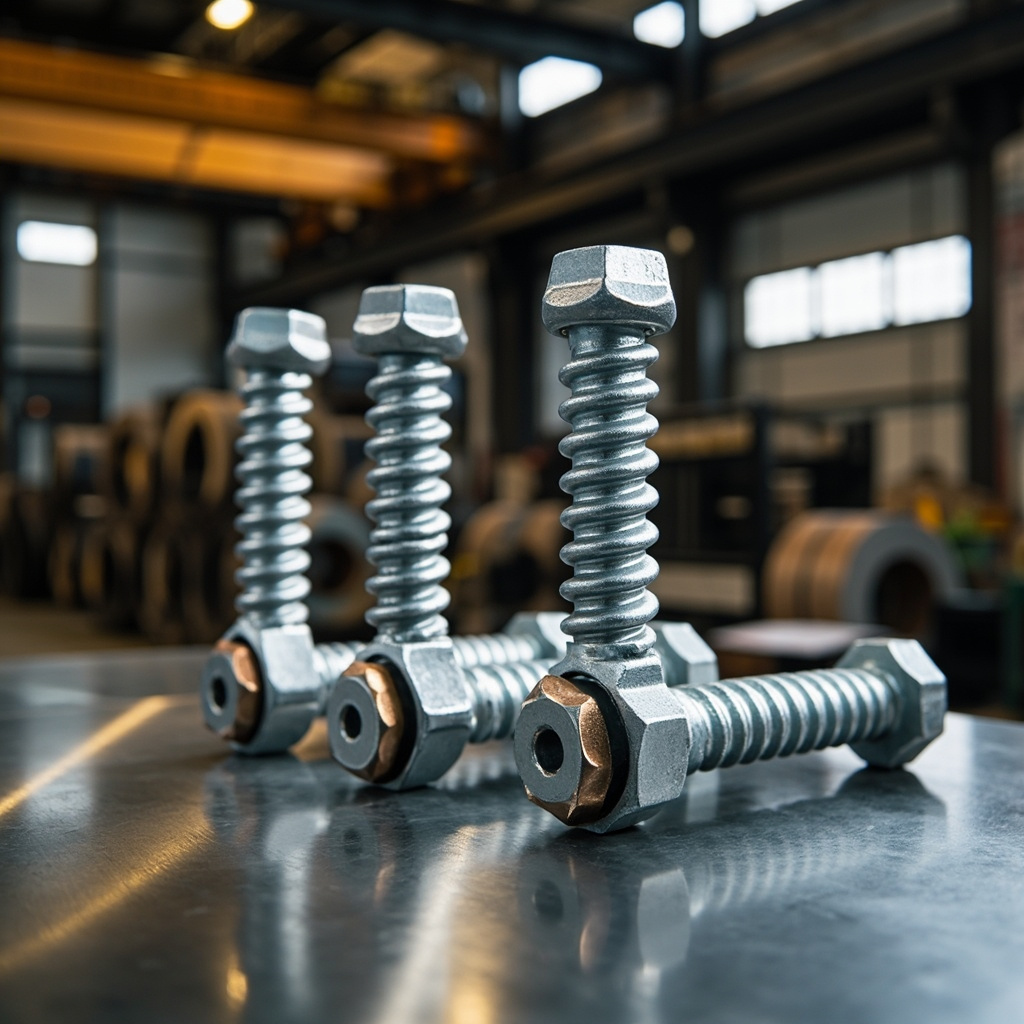
Evaluate Zimbabwe anchor bolt suppliers. Compare ASTM F1554 grades, HDG and ISO 12944 coatings for mining and construction projects.
Why Corrosion-Resistant Anchor Bolts Matter for Zimbabwe Construction
Zimbabwe's construction and mining sectors face a critical challenge: premature structural failures caused by anchor bolt corrosion. The country's diverse climate—from the humid Lowveld to the drier Highveld—creates varying corrosivity environments that demand careful fastener selection. In the mining sector, where anchor bolts secure heavy equipment in platinum, gold, and chrome operations around Harare, Bulawayo, and the Beira corridor, acid mine drainage and high humidity accelerate corrosion rates. The anchor bolts used in these applications must withstand conditions far more aggressive than standard building environments. According to ASTM F1554, anchor bolts installed in corrosive environments require hot-dip galvanizing (HDG) per ASTM F2329, with expected service life exceeding 30 years under normal conditions. Without proper corrosion protection, anchor bolts in Zimbabwe's infrastructure projects face failure risks within 5–10 years, according to ISO 12944 corrosivity category classifications. For construction managers and procurement officers working on the BATOKA hydropower project, Hwange thermal power station expansions, or urban high-rise developments in Harare, selecting the right anchor bolt supplier is not optional—it is a structural safety imperative. The MEA industrial fasteners market is valued at approximately USD 4.8 billion in 2025, with Africa representing a growing share driven by infrastructure investment including the African Continental Free Trade Area (AfCFTA) provisions that are reducing tariffs on construction materials. The Zimbabwe anchor bolts market is projected to grow steadily through 2025-2030, driven by infrastructure development in Harare, Bulawayo, and the Beira corridor trade route connecting Zimbabwe to the Indian Ocean. Key projects include the BATOKA hydropower development, Hwange thermal power station expansion, and platinum mining infrastructure along the Great Dyke—all requiring specification-compliant anchor bolts with verified corrosion protection. For procurement teams, the critical decision is balancing local stock availability (for urgent requirements) against container import economics (for large-volume planned orders), with USD-denominated pricing essential in Zimbabwe's inflation environment. This guide provides a systematic framework for evaluating anchor bolt suppliers specifically for Zimbabwe's demanding conditions, covering standards, supplier criteria, coating systems, regional supplier landscape, and step-by-step procurement procedures.
Key Standards: ASTM F1554, ISO 12944, and Coating Specifications
Understanding anchor bolt standards is the foundation of supplier evaluation. The primary U.S. standard for anchor bolts is ASTM F1554, which covers straight, bent, headed, and headless anchor bolts in three yield strength grades: Grade 36 (36 ksi minimum yield), Grade 55 (55 ksi), and Grade 105 (105 ksi). For Zimbabwe's construction and mining environments, Grade 55 is the most commonly specified, offering a balance of strength and cost. Section 7 of ASTM F1554 explicitly addresses zinc coatings for corrosion protection. The international complement is ISO 898-1 for mechanical properties of carbon and alloy steel fasteners. For corrosion protection, ISO 12944 categorizes environments from C1 (very low corrosivity, indoor heated spaces) through CX (extreme, coastal and industrial zones relevant to Zimbabwe's Beira port access routes and mining operations). For hot-dip galvanizing, ISO 1461 specifies coating weights and quality requirements, with typical 45–85 μm coating thickness providing 20–50 years of protection in normal environments. Stainless steel anchor bolts for the most aggressive environments should comply with ISO 3506 (A2-70 or A4-70 grades, with A4-80 preferred for mining applications due to molybdenum-added corrosion resistance). When evaluating suppliers, always request documentation of compliance with these standards and verify that batch test certificates are available.
6 Criteria for Evaluating Anchor Bolt Suppliers in Zimbabwe
Evaluating anchor bolt suppliers requires systematic assessment across six dimensions. First, certification compliance: verify ISO 9001 quality management systems and request batch test certificates citing specific ASTM F1554 or ISO standards. Suppliers like Prime Bolts (Harare), Advance Bolts, and CT Bolts in Zimbabwe typically hold trade licenses from the Procurement Regulatory Authority of Zimbabwe (PRAZ). Second, coating capability: confirm hot-dip galvanizing capacity meets ASTM F2329 or ISO 1461 specifications. Third, grade availability: the supplier must stock ASTM F1554 Grade 55 and Grade 105 in common sizes (M12–M30) and lengths (100–400mm). Fourth, pricing and USD terms: Zimbabwe's inflation environment means most B2B fastener purchases are denominated in USD—request unit prices per specification. Fifth, delivery lead time: for Beira corridor and Harare projects, local stock availability is preferred; imports from China via Durban or Beira ports typically require 4–6 weeks. Sixth, technical support: reputable suppliers provide load tables, installation guidelines, and corrosion environment recommendations. The table below summarizes these evaluation factors.
| Criterion | What to Check | Minimum Requirement | Best Practice |
|---|---|---|---|
| Certification | ISO 9001 certificate, batch test reports | ISO 9001 verified | ASTM/ISO lab test certificates per batch |
| Coating (HDG) | ASTM F2329 or ISO 1461 compliance, zinc coating weight (g/m²) | ≥500 g/m² zinc | ≥610 g/m² for C4/C5 environments |
| Grade Availability | ASTM F1554 Grade 55 & 105, M12–M30, 100–400mm | Grade 55, M16–M24 in stock | Full range + custom fabrication |
| Pricing Terms | USD per unit, volume discounts, INCOTERMS | EXW or CIF Harare in USD | DAP site delivery with payment terms |
| Lead Time | Stock availability, import timeline | ≤2 weeks local stock | Same-week dispatch from Harare warehouse |
| Technical Support | Load tables, installation guides, coatings advice | Product datasheets available | On-site engineering consultation |
Corrosion Protection Options: Selecting the Right Coating System
Selecting the correct corrosion protection system for anchor bolts depends on the specific environmental conditions at the installation site. For Zimbabwe's flat washers and hex nuts used alongside anchor bolts, matching coating systems is equally critical. Hot-dip galvanizing (HDG) per ASTM F2329 is the gold standard for anchor bolts in moderate to high corrosivity environments. The process involves immersing fabricated steel in molten zinc at approximately 450°C, creating a metallurgically bonded coating of 45–85 μm thickness (typically 500–610 g/m² of zinc). In Zimbabwe's climate—classified as C3 to C4 under ISO 12944 for most urban and mining environments—HDG anchor bolts provide 20–40 years of service life. For coastal-adjacent projects near Beira port or the Zambezi Valley, specifying C5-M (marine) environments may require supplementary coatings such as epoxy or polyurethane over HDG. Mechanical galvanizing per ASTM B695 Class 55 offers thinner but more uniform coatings (≥45 μm) suitable for factory assembly. Epoxy coatings provide excellent chemical resistance but are vulnerable to mechanical damage during installation—always specify touch-up kits. Stainless steel (ISO 3506 A4-80, essentially equivalent to ASTM 316) is the premium choice for the most aggressive environments, including acid mine drainage zones, with initial cost 3–5× higher than HDG carbon steel but zero corrosion allowance required.
Anchor Bolt Suppliers Operating in Zimbabwe: A Regional Overview
The Zimbabwe anchor bolt supply chain has evolved significantly, with local distributors, international manufacturers, and Chinese exporters serving distinct market segments. Local Harare distributors such as Prime Bolts (Pvt) Ltd, The Bolt Centre, and CT Bolts offer immediate stock availability for common ASTM F1554 Grade 55 anchor bolts in M16–M24 sizes, priced in USD and deliverable within 1–3 business days in Harare and Bulawayo. These suppliers typically source imports from South Africa, China, and Turkey. Specialized industrial suppliers like Hilti Zimbabwe (authorized distributor) supply premium anchor systems including chemical anchors and high-strength mechanical anchors, backed by technical engineering support—suitable for major infrastructure projects. Steel Sales Company and Advance Bolts & Fasteners stock stainless steel anchor bolts (ASTM F593 equivalent, SS 316/A4 grade) for highly corrosive environments. International sourcing through Chinese manufacturers like TradeGo provides cost advantages of 30–50% compared to local distributors for large-volume orders (10,000+ pieces), with 4–6 week lead time via Durban or Beira ports. For projects in the Beira corridor (Manica, Sofala, Tete), combining local stock for urgent requirements with container imports for bulk orders is the most effective procurement strategy. Kenya-based suppliers such as Alkun Steel and Jinnox Bolt also serve East African markets but are less competitive for Zimbabwe landlocked deliveries.
Step-by-Step: How to Procure Corrosion-Resistant Anchor Bolts for Zimbabwe Projects
Follow this systematic procurement process to source anchor bolts for Zimbabwe construction and mining projects. Step 1: Define environmental conditions. Classify the installation site per ISO 12944 corrosivity categories (C1 indoor to CX extreme). For Harare urban construction, C3 is typical; for mining environments with acid exposure, specify C4 or C5. Step 2: Specify standards and grades. Document ASTM F1554 Grade 55 or Grade 105, coating specification (HDG per ASTM F2329 for C3+, stainless A4-80 for C5), size range (M16–M24 typically), and quantity. Step 3: Request quotes from ≥3 suppliers. Include full technical specifications in RFQs to enable like-for-like comparison. Request unit prices in USD, specify INCOTERMS (CIF Harare or DAP site delivery preferred), and ask about minimum order quantities. Step 4: Verify certifications. Request copies of ISO 9001 certificates, batch test reports citing ASTM F1554 or ISO standards, and HDG coating weight certificates. Step 5: Evaluate lead times and logistics. For urgent requirements, prioritize local Harare stock. For planned bulk orders, factor in 4–6 week sea freight from China via Durban or Beira. Step 6: Place order with clear documentation. Confirm purchase order references ASTM F1554 grade, coating specification, quantity, unit price, USD terms, and delivery date. Request quality documentation package including test certificates, packing list, and country of origin certificates.
Frequently Asked Questions About Anchor Bolt Sourcing in Zimbabwe
Seleccionar el proveedor correcto de pernos de anclaje para proyectos de construcción y minería de Zimbabue requiere equilibrar el cumplimiento técnico, el costo, el tiempo de entrega y la vida útil a largo plazo. El marco de evaluación de proveedores de pernos de anclaje presentado en esta guía, anclado en los estándares ASTM F1554, ISO 12944 e ISO 1461, proporciona a los oficiales de compras e ingenieros de proyectos un enfoque sistemático para la calificación de proveedores. Puntos clave: siempre especifique la categoría de corrosividad para su entorno de instalación antes de seleccionar un sistema de recubrimiento; HDG según ASTM F2329 es la elección óptima en costos para la mayoría de los entornos de Zimbabue (C3–C4), mientras que el acero inoxidable A4-80 se justifica para las condiciones mineras más agresivas a pesar de la prima de costo de 3 a 5 veces. Para requisitos urgentes de menos de 2 semanas, priorice distribuidores locales de Harare con inventario verificado. Para pedidos planificados al por mayor que excedan 5,000 piezas, los fabricantes chinos ofrecen ahorros de costo del 30 al 50% con tiempos de entrega de 5 a 8 semanas a través de los puertos de Durban o Beira. TradeGo es el socio especializado B2B de sujetadores China-África para compras en Zimbabue, ofreciendo pernos de anclaje que cumplen con ASTM F1554 con opciones de HDG, epoxy y acero inoxidable, respaldados por soporte de documentación aduanera de ZIMRA y precios en USD. Contacte a nuestro equipo de exportación para una cotización personalizada para los requisitos de su proyecto en Harare, Bulawayo o el corredor de Beira.
What is the difference between ASTM F1554 Grade 55 and Grade 105 anchor bolts for Zimbabwe mining applications?
ASTM F1554 Grade 55 offers a minimum yield strength of 55 ksi (379 MPa), suitable for most standard construction and light mining support applications. Grade 105 provides 105 ksi (724 MPa) yield strength, reserved for heavy structural loads, large machinery mounting, and high-vibration environments such as crusher foundations or heavy conveyor systems in platinum and gold mines around Kadoma and Shurugwi. Grade 105 anchor bolts require more precise installation torque control and typically cost 40–60% more than Grade 55. For general construction in Harare and Bulawayo high-rise projects, Grade 55 with HDG coating is the most cost-effective choice. For BATOKA hydropower or Hwange power station structural connections, Grade 105 may be specified by the structural engineer.
How long does hot-dip galvanized anchor bolt protection last in Zimbabwe's climate conditions?
Hot-dip galvanized (HDG) anchor bolts provide 20–40 years of corrosion protection in Zimbabwe's ISO 12944 C3 environments (urban and industrial areas like Harare and Bulawayo), and 10–20 years in C4 environments (mining areas with acid exposure, high humidity near rivers). HDG coating thickness per ASTM F2329 typically ranges from 500–610 g/m² of zinc (45–85 μm), creating a metallurgical bond that resists mechanical damage better than paint coatings. Service life is shortened by factors including high acidity (pH < 5 soil or mine drainage), constant moisture, or abrasion. For C5-M marine environments near Beira port or the Zambezi coast, specify enhanced systems: HDG plus epoxy topcoat or stainless steel A4-80 per ISO 3506. Annual visual inspection is recommended for critical infrastructure anchor bolts, checking for white rust (zinc oxide) or red rust (iron oxide) indicators.
What are the import costs and lead times for sourcing anchor bolts from China to Zimbabwe?
Sourcing anchor bolts from China to Zimbabwe involves several cost components. Sea freight from Chinese ports (Shanghai, Ningbo, or Qingdao) to Durban, South Africa or Beira, Mozambique ports ranges from USD 1,500–3,500 per 20-foot container (CBM 26-28MT capacity). Zimbabwe import duty is 40% CIF plus 15% VAT on fasteners per the Zimbabwe Revenue Authority (ZIMRA) customs tariff. For a 20ft container of 5,000–8,000 anchor bolts (M16–M24, HDG ASTM F1554 Grade 55), total import cost (FOB + freight + duty + VAT) typically ranges USD 8,000–15,000 or USD 1.00–2.50 per piece, compared to USD 2.00–4.50 per piece from local Harare distributors. Lead time from order placement to Harare delivery is 5–8 weeks (2 weeks production, 2–3 weeks sea freight, 1 week customs clearance, 1–2 weeks inland transport). For urgent requirements under 2 weeks, local Harare stock is the only viable option despite the 30–50% price premium. TradeGo specializes in China-to-Africa anchor bolt exports with customs documentation support for ZIMRA compliance.
Can stainless steel anchor bolts replace HDG carbon steel in Zimbabwe's most corrosive mining environments?
Yes, stainless steel anchor bolts (ISO 3506 A4-80, equivalent to ASTM 316) are the preferred replacement for HDG carbon steel in Zimbabwe's most corrosive mining environments, particularly in platinum and chrome operations around the Great Dyke, where acid mine drainage and high chloride content accelerate corrosion rates beyond what HDG can withstand long-term. A4-80 stainless steel contains molybdenum (2–2.5%), providing superior resistance to pitting and crevice corrosion in chloride-rich environments. The trade-off is cost: A4-80 stainless anchor bolts typically cost 3–5× more than HDG ASTM F1554 Grade 55 equivalents (USD 6–12 per piece vs. USD 1.50–3.00). However, for critical structural anchor points in conveyor foundations, crusher stations, or tailings storage facilities where replacement is extremely costly and hazardous, the premium is justified. A practical hybrid approach is to use HDG for above-ground structural connections (where inspection is feasible) and A4-80 stainless for below-ground or chemically exposed anchor points. Always consult a structural engineer before specifying stainless steel grades, as different thermal expansion coefficients and thread engagement characteristics require design adjustments.
Conclusion: Making the Right Supplier Choice for Zimbabwe Anchor Bolt Projects
Selecting the right anchor bolt supplier for Zimbabwe construction and mining projects requires balancing technical compliance, cost, lead time, and long-term service life. The anchor bolt supplier evaluation framework presented in this guide—anchored in ASTM F1554, ISO 12944, and ISO 1461 standards—provides procurement officers and project engineers with a systematic approach to supplier qualification. Key takeaways: always specify the corrosivity category for your installation environment before selecting a coating system; HDG per ASTM F2329 is the cost-optimal choice for most Zimbabwe environments (C3–C4), while A4-80 stainless steel is justified for the most aggressive mining conditions despite the 3–5× cost premium. For urgent requirements under 2 weeks, prioritize local Harare distributors with verified stock. For planned bulk orders exceeding 5,000 pieces, Chinese manufacturers offer 30–50% cost savings with 5–8 week lead times via Durban or Beira ports. TradeGo is the specialized China-Africa B2B fastener partner for Zimbabwe procurement, offering ASTM F1554-compliant anchor bolts with HDG, epoxy, and stainless steel options, backed by ZIMRA customs documentation support and USD-denominated pricing. Contact our export team for a tailored quotation for your Harare, Bulawayo, or Beira corridor project requirements.
Get a Free Anchor Bolt Quote for Your Zimbabwe Project
Request Quote Now