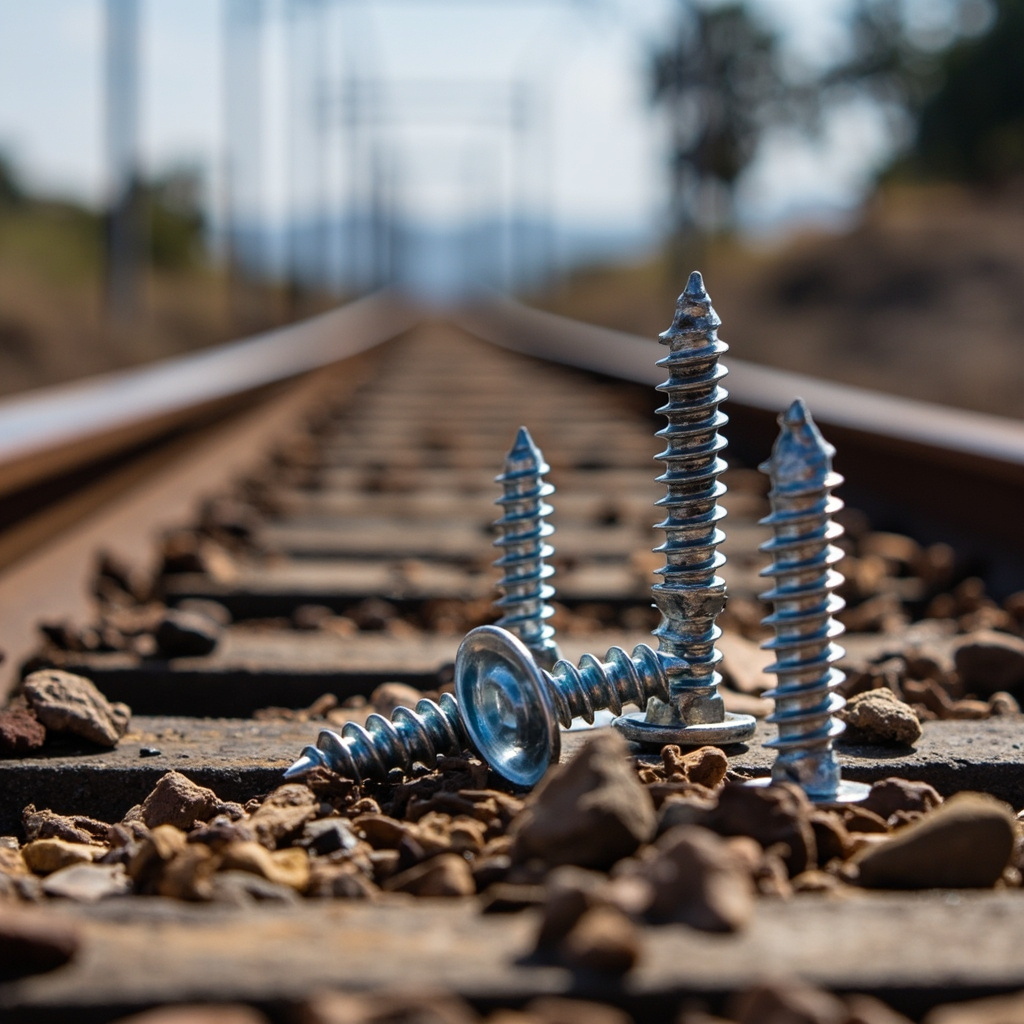
Explore Tanzania SGR railway fasteners specifications, standards, and procurement requirements. Expert guide to compatible fastener solutions for Standard Gauge Railway projects.
Tanzania SGR Railway Fastener Standards and Specifications
Tanzania SGR railway fasteners must meet rigorous international standards that ensure track integrity under heavy freight and passenger loads across the 1,219-kilometer Standard Gauge Railway corridor connecting Dar es Salaam to Morogoro, Makutupora, and ultimately to Lake Victoria [1][2]. The Tanzania Railways Corporation has mandated compliance with EN 13481 standards series, which define performance requirements for rail fastening systems used in ballasted track applications [3]. Unlike informal infrastructure projects, SGR construction demands documented verification that each fastener lot meets specified mechanical properties before installation approval. The material specification hierarchy for Tanzania SGR fasteners typically requires Grade 8.8 high-strength bolts for general fastening applications and Grade 10.9 for critical connection points where fatigue resistance is paramount [4]. Grade 8.8 bolts deliver minimum tensile strength of 830 MPa and yield strength of 660 MPa, sufficient for standard rail clip retention. Grade 10.9 variants push tensile strength to 1,040 MPa minimum, providing the additional safety margin required for high-speed passenger operations planned on the network. For procurement managers, specifying the correct grade directly impacts both cost and structural performance—Grade 10.9 costs approximately 15-20% more than Grade 8.8 but provides 25% greater fatigue life under cyclic loading conditions. Corrosion protection requirements in Tanzania's diverse climate demand careful specification attention. The coastal corridor near Dar es Salaam requires hot-dip galvanizing with minimum 70 micrometer zinc coating thickness to withstand salt exposure, while inland sections may permit 45-55 micrometer coatings [5]. Projects near Lake Victoria face humidity challenges requiring equivalent protection. Zinc-plating, while cheaper, provides only 5-10 micrometers and fails within 5-7 years in Tanzania's tropical conditions—unacceptable for infrastructure with 25-30 year design life. The African Development Bank has financed significant portions of this infrastructure development, emphasizing durability requirements that justify proper corrosion protection investments [5].
SGR Rail Clip and Elastic Fastener Systems
Rail clips constitute the primary elastic fastener elements maintaining rail-to-sleeper connection through toe load application resisting rail longitudinal movement. The Tanzania SGR project specifications require E-clip systems for standard applications, with K-clip configurations specified for high-stress zones including curves exceeding 1,500-meter radius and gradient sections exceeding 1.5% [2][4]. E-clips deliver toe loads ranging from 800-1,200 daN depending on clip geometry, while K-clips provide enhanced 1,400-1,800 daN capacity for demanding locations. Elastic clip selection critically affects track stability and maintenance intervals. E-clip systems offer cost advantages of 10-15% compared to K-clips and simpler installation procedures requiring only standard claw bars. However, K-clip installations demonstrate 30% longer service intervals in heavy axle load operations, reducing lifecycle maintenance costs despite higher initial procurement expense. For Tanzania SGR projects targeting 25-ton axle loads, the K-clip premium proves economically justified at high-traffic sections [4]. Installation torque specifications for SGR rail clips require verification procedures ensuring consistent toe load application. Standard E-clip installation demands 200-250 Nm applied torque, measured with calibrated torque wrenches at each clip position. Quality verification involves random抽样 testing where 5% of installed clips undergo re-torque verification, with acceptance criteria requiring loads within ±15% of specification. Clip tension monitoring during construction detects under-torqued installations before they compromise track geometry [2]. Procurement managers should verify supplier capacity for both clip types, as mixed-specification projects require coordinated inventory management. Regional availability of compatible clip systems varies significantly—international suppliers with established logistics networks to Dar es Salaam Port can supply both types within 8-12 weeks, while local distributors typically stock only standard E-clips with K-clips requiring special orders and 4-6 additional weeks lead time [1].
Base Plate and Anchor Bolt Specifications for Tanzania SGR
Base plates for Tanzania SGR applications require dimensional precision ensuring proper rail seat alignment and load distribution to concrete sleepers. Standard SGR base plates measure 150mm × 300mm × 20mm, featuring four pre-drilled anchor bolt holes on 140mm × 200mm centers. The plate surface incorporates anti-skid texture preventing lateral plate movement under dynamic loads. Material specification requires Grade 250 minimum yield strength steel, typically ASTM A36 or equivalent EN 10025 S275JR, with hot-dip galvanizing after fabrication [3]. Anchor bolt specifications for SGR concrete sleeper installations require Grade 8.8 minimum tensile properties with embedding lengths determined by pull-out resistance calculations. Standard specifications mandate 500mm minimum embedment in M50-grade concrete, achieving minimum 150 kN pull-out resistance per bolt. The anchor cage design employs four bolts per sleeper at standard spacing of 600mm, providing aggregate anchor resistance exceeding calculated longitudinal and lateral track forces [2][4]. Load transfer mechanisms in SGR fastening systems involve composite action between rail, clips, base plate, anchor bolts, and concrete sleeper. The base plate functions as a load-spreading element reducing bearing stress on concrete from approximately 80 MPa at the rail seat to 8-10 MPa at the plate-concrete interface. This stress reduction prevents concrete crushing and maintains gauge geometry over millions of load cycles. Quality inspection criteria require dimensional verification of plate flatness (maximum 0.5mm deviation) and hole position tolerance (±1mm from specification) [3]. Procurement specifications for Tanzania SGR base plates should include requirements for matched anchor bolt sets, as mismatched thread specifications cause installation delays. Supplier documentation must confirm bolt-to-plate hole compatibility, preferably through assembly verification at origin before shipping to Tanzania. Dar es Salaam Port clearance and inland transportation to construction sites demands packaging specifications preventing galvanizing damage during handling and transport [1].
SGR Rail Fastening Components Procurement Guide
Identifying qualified Tanzania SGR fastener suppliers requires systematic evaluation of manufacturing capability, certification status, and logistics infrastructure. Primary evaluation criteria include ISO 9001:2015 certification as baseline quality management verification, with ISO 3834 welding certification required for fabricated components like base plates. Suppliers should demonstrate rail industry experience through references from similar gauge railway projects, preferably in African or tropical climate environments [1][6]. Technical documentation requirements for procurement contracts should specify full material traceability including heat numbers, chemical composition reports (confirming carbon content below 0.25% for weldable steel grades), mechanical test certificates from accredited laboratories, and dimensional inspection reports. Third-party inspection at origin, arranged through agencies like SGS, Bureau Veritas, or Intertek, provides independent verification before shipment—a non-negotiable requirement for projects financed by development banks [5]. Inspection protocols typically include visual examination, dimensional sampling per ANSI/ASQ Z1.4 (ISO 2859-1) AQL 1.0 for critical dimensions, and mechanical property verification through tensile and hardness testing. Lead times for Tanzania SGR fastener procurement vary significantly by component complexity. Standard E-clips and fasteners require 4-6 weeks manufacturing plus 2-3 weeks sea freight to Dar es Salaam. Custom-specified K-clips and engineered base plates demand 8-12 weeks production lead time. Inland transportation from port to construction sites adds 1-2 weeks depending on final destination. Procurement managers should plan 16-20 week total lead times for initial project phases, with subsequent batches achievable in 8-10 weeks once supplier relationships and specifications are established. Cost factors affecting fastener selection include not only unit prices but logistics, duties, and quality assurance expenses. CIF Dar es Salaam pricing typically includes 15-25% logistics costs from Chinese manufacturers, plus Tanzania import duties of 10-25% depending on harmonized tariff classification. Quality assurance budgets should allocate 2-3% of fastener value for third-party inspection services. Building direct relationships with fastener manufacturers eliminates distributor margins, typically reducing costs by 8-12% while providing direct technical communication channels [1][6].
Tanzania SGR Fastener Quality Assurance and Testing
Material testing requirements for Tanzania SGR railway fasteners establish verification protocols ensuring each batch meets specification before installation. Chemical composition analysis using optical emission spectrometry confirms alloying element percentages within specified ranges. Carbon content critically affects hardness and strength development—Grade 8.8 bolts typically contain 0.25-0.40% carbon, while Grade 10.9 requires 0.30-0.50% carbon with appropriate manganese additions [3]. Dimensional inspection procedures follow standardized sampling plans accepting or rejecting lots based on measured characteristics. Critical dimensions including thread pitch, major diameter, and overall length undergo 100% inspection for first article samples, transitioning to reduced sampling (AQL 1.0) for production lots. Thread gauge verification using GO/NO-GO gauges provides efficient functional testing confirming thread compatibility with mating components. Surface finish inspection verifies galvanizing coverage and thickness using magnetic induction gauges calibrated to ASTM E376 standards. Mechanical property verification methods include tensile testing determining ultimate tensile strength, yield strength, and elongation percentage. Hardness testing using Rockwell or Vickers methods provides rapid quality indication, with Grade 8.8 requiring 23-32 HRC and Grade 10.9 requiring 33-39 HRC. Proof load testing applies specified axial load without plastic deformation, confirming thread strength adequate for installation stresses. Impact testing at -20°C assesses low-temperature toughness, relevant for highland sections where overnight temperatures drop below 10°C. Fatigue testing considerations for SGR applications simulate millions of load cycles representing service conditions over fastener design life. Standard fatigue tests apply cyclic loading at 70-80% of proof load for 2 million cycles minimum, with acceptance requiring no failure. Projects specifying AREMA standards require 5 million cycles at reduced load levels. The Tanzania SGR specification mandates 2 million cycle testing with documentation, simulating the heavy axle load traffic projected for the corridor [2][4]. Certification requirements for Tanzania projects demand documentation packages including mill test reports, heat numbers, manufacturing records, and third-party inspection certificates. Tanzania Bureau of Standards (TBS) certification may be required for locally delivered fasteners, while project-specific quality plans establish hold points requiring inspection agency approval before release to construction [1][6]. Third-party inspection services operating at Chinese manufacturing facilities provide cost-effective quality verification, typically charging $300-500 per inspection day plus travel expenses.
SGR Fastener Installation and Maintenance in Tanzania
Installation best practices for rail fastening systems begin with proper sleeper preparation before fastener installation. Concrete sleeper surfaces must be clean, dry, and free from debris or curing compounds that would reduce base plate friction. Anchor bolt threads require cleaning and lubrication with appropriate compound preventing galling during torque application. Base plate installation involves positioning with alignment pins ensuring correct gauge and cross-level before anchor nut tightening [2]. Tools required for SGR fastener installation include calibrated torque wrenches (±3% accuracy) for controlled fastening, thread gauges for verification, impact wrenches for production fastening with torque verification, and tension measuring devices for clip load verification. Construction specifications typically require torque wrenches calibrated monthly against NIST-traceable standards. The Tanzania SGR quality management requirements mandate tool calibration records available for audit at any construction phase [3]. Inspection checkpoints during track construction verify fastener installation quality at defined intervals. Initial installation undergoes 100% inspection confirming correct component positioning, torque values, and clip engagement. Subsequent statistical sampling at 5% frequency during production installation verifies consistency. Critical checkpoints include pre-concrete pour verification of anchor bolt positioning and embedment, post-tensioning verification after rail installation, and final inspection before track handover. Maintenance schedules for railway fasteners involve periodic inspection and replacement cycles extending track system life. Visual inspection of clips and bolts occurs at 6-month intervals, with detailed torque verification annually. Clip replacement typically occurs at 15-20 year intervals depending on traffic levels, while anchor bolts may remain serviceable for 25-30 years if corrosion protection remains intact. Inspection frequency increases near coastal sections where accelerated corrosion may reduce service life [5]. Common failure modes for SGR fasteners include clip fatigue fractures, bolt thread damage, and corrosion-related loss of preload. Prevention strategies emphasize proper installation torque ensuring adequate clamp force, appropriate corrosion protection matching environmental conditions, and regular inspection detecting degradation before failure. Training requirements for maintenance personnel include theoretical instruction on fastener function and failure modes, plus practical training in inspection and replacement procedures. Tanzania Railway Corporation guidelines recommend minimum 40-hour initial training with annual refresher courses [1].
Need a quote for Tanzania SGR railway fasteners? Contact TradeGo for factory pricing and SADC logistics.
Request Quote