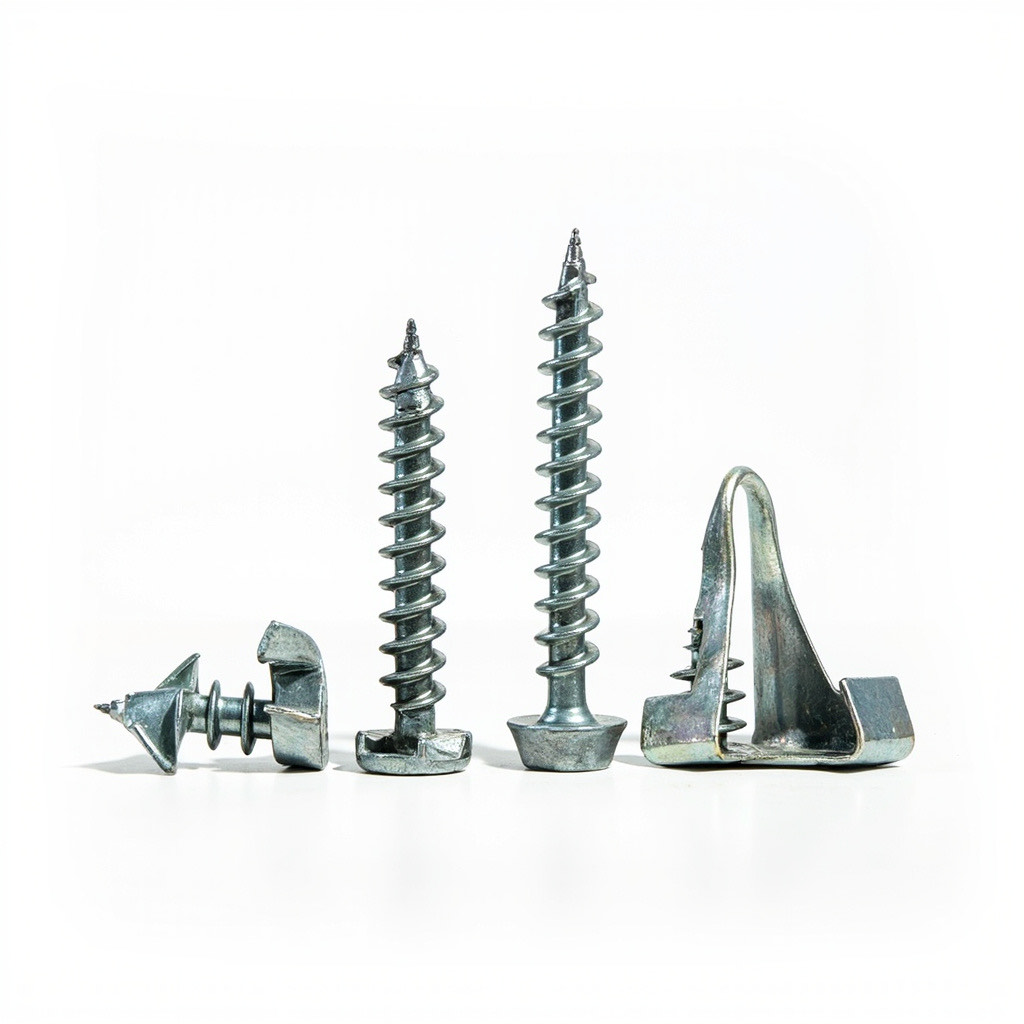
Guia completo de fixadores para construção em madeira na África.
Tipos de fixadores para madeira estrutural na África
A construção em madeira estrutural em África utiliza vários tipos de fixadores especializados: Placas de pregos (placas de gang-nail) — placas de aço galvanizado com dentes estampados semelhantes a pregos numa das faces; pressionadas em juntas de madeira na fábrica; o fixador principal para treliças de telhado pré-fabricadas; espessura tipicamente de 1.0-2.0mm galvanizado; deve ser protegido da humidade para evitar a corrosão. Anéis divididos (split rings) — anéis de aço circulares com borda serrilhada, inseridos em ranhuras pré-perfuradas na madeira; fornecem resistência ao corte em conexões de madeira com madeira; usados em estruturas de madeira pesada. Conectores de placa de corte (shear plate) — semelhantes aos anéis divididos, mas instalados em pares em faces opostas da madeira; usados em conexões de momento de alta carga. Parafusos de cabeça quadrada (tirafondos) — parafusos pesados para madeira com cabeça quadrada; usados para conexões de momento em construção de postes e vigas. Recursos relacionados: parafusos de alta resistência chumbadores fixadores de aço inoxidável parafusos sextavados porcas autotravantes anilhas parafusos autoperfurantes parafusos de cabeça cilíndrica. Esta estrutura de aquisição aplica-se ao fornecimento de fixadores para construção, mineração, energia, automotiva e aplicações industriais em geral. A lógica de decisão prioriza a consistência da qualidade, a confiabilidade do fornecedor e o custo total de propriedade em relação ao preço unitário de curto prazo. Para compradores B2B em África, América Latina e Sudeste Asiático, considerações adicionais incluem requisitos alfandegários regionais, opções de consolidação de contentores e mecanismos de segurança de pagamento. Especificações padronizadas que se aplicam a todos os projetos reduzem o tempo de formação, o tempo de processamento de RFQ e o esforço de integração do fornecedor.
Ferragens para conexão de tesouras de telhado
As treliças de telhado de madeira pré-fabricadas utilizam ferragens de conexão específicas: Clips de treliça (placas de fixação angular) — placas de aço galvanizado leves que conectam membros da treliça nos nós; o padrão de pregagem angular permite uma instalação rápida em campo; não são conexões de momento estruturais, mas transferem cargas de corte. Placas de reforço (gusset plates) — placas galvanizadas maiores que cobrem a interseção dos membros da treliça; prensadas com equipamento hidráulico na fábrica; tipicamente aço galvanizado de 2-3mm. Placas de parafuso — placas de aço com orifícios pré-perfurados para parafusos passantes; usadas onde parafusos são especificados no projeto estrutural. Suportes de suspensão (hanger brackets) — suportes de aço que sustentam vigas de piso ou terças de vigas ou paredes; use suportes de viga com orifícios para pregos para conexões madeira-madeira, ou suportes para vigas I para produtos de madeira engenheirada. Abraçadeiras de furacão (hurricane ties) — tiras de aço galvanizado que conectam treliças de telhado às placas de parede; essenciais em áreas costeiras africanas sujeitas a ventos fortes e tempestades; especifique Simpson Strong-Tie ou equivalente. A aquisição baseada em normas exige aprendizagem contínua, uma vez que as normas ISO, ASTM, DIN e GB são revistas a cada 3-5 anos. Subscreva notificações de atualização de normas e reveja as especificações anualmente. As normas mais comuns usadas no comércio internacional de fixadores são ISO 898-1 (propriedades mecânicas), ISO 3506-1 (inoxidável), ISO 3269 (inspeção de aceitação), ISO 4042 (revestimentos) e ISO 1502 (calibradores de rosca). Para compradores B2B, construir uma biblioteca de referência de normas com pelo menos as 20 principais normas relevantes para o seu mix de produtos é essencial.
Fixadores para madeira tratada: ACQ e CCA
A madeira tratada (madeira preservada) é padrão na construção africana para aplicações externas e estruturais, mas os produtos químicos de tratamento criam desafios de compatibilidade com fixadores: ACQ (Cobre Alcalino Quaternário) — o tratamento moderno mais comum; altamente corrosivo para aço padrão, zincado e até mesmo fixadores galvanizados a fogo (HDG); requer aço inoxidável 316 ou fixadores revestidos com polímero (por exemplo, epóxi de zinco). CCA (Arseniato de Cobre Cromatado) — tratamento mais antigo ainda encontrado em estruturas existentes; extremamente corrosivo para o aço; requer galvanização a fogo (HDG) ou aço inoxidável; não utilize zincado. Fixadores galvanizados a fogo funcionam com CCA, mas não com ACQ na espessura de revestimento padrão de 45μm. Para madeira tratada com ACQ em aplicações externas, especifique aço inoxidável 316 ou HDG com no mínimo 45μm (uma galvanização mais pesada pode funcionar, mas não é garantida). Verifique sempre o tipo de tratamento com o fornecedor de madeira e combine o material do fixador adequadamente. A metodologia de comparação acima utiliza intervalos típicos de dados do setor e da experiência de compras da TradeGo de 2018-2024. Os preços reais de mercado flutuam com os custos das matérias-primas (aço, zinco, níquel), custos de energia, custos laborais e taxas de câmbio. Para uma comparação precisa, solicite RFQs idênticas a 3-5 fornecedores qualificados e compare o custo total de entrega (produto + frete + seguro + taxas). O preço unitário mais baixo raramente representa o menor custo total de propriedade.
Espécies de madeira africana e retenção de fixadores
As espécies de madeira africana variam significativamente em densidade e características de retenção de fixadores: Madeiras de lei (teca, mogno africano, iroko) — alta densidade (600-900 kg/m³); excelente retenção de fixadores, mas requerem pré-perfuração; risco de rachaduras se perfurado muito perto da borda. Espécies de pinho (importadas ou cultivadas localmente) — densidade média (400-600 kg/m³); retenção moderada de fixadores; a madeira estrutural mais comum em treliças de telhado africanas; faça pré-perfuração para fixadores grandes. Espécies de eucalipto (cultivadas em plantações africanas) — alta densidade (700-900 kg/m³); excelente resistência, mas difícil de pregar; recomenda-se a pré-perfuração. Para conexões estruturais em madeiras de lei, especifique tirafondos ou parafusos de cabeça quadrada com furos piloto; pregos padrão podem rachar a madeira e fornecer resistência à extração inadequada. Consulte sempre o engenheiro estrutural para o design de conexões em espécies de madeira não padrão. A lista de verificação de verificação aplica-se tanto à qualificação inicial do fornecedor quanto à inspeção contínua de lotes. Para aplicações de alto risco (estruturais de suporte de carga, vasos de pressão, mineração, marítimo), adicione testes de fadiga, testes de névoa salina (ASTM B117), testes de torque-tensão e inspeção pós-instalação. O custo da verificação adicional é de 0.1-0.3% do valor do pedido, enquanto falhas de qualidade não detectadas podem representar 10-100x o valor do pedido em danos.
Perguntas frequentes
See frequently asked questions below.
Can I use standard HDG bolts with ACQ-treated timber?
No — ACQ (Alkaline Copper Quaternary) treated timber will rapidly corrode standard hot-dip galvanized fasteners. The high alkalinity of ACQ accelerates zinc corrosion, and once the zinc is consumed, the underlying steel corrodes. For outdoor ACQ-treated timber applications, specify stainless steel 316 or specialized ACQ-compatible coated fasteners. For indoor ACQ-treated timber (above ground, protected from direct moisture), some manufacturers claim HDG works, but SS316 remains the safer choice.
What is the difference between a coach screw and a lag screw?
Technically, 'coach screw' and 'lag screw' are the same thing — a heavy wood screw with a hex head. In the UK and much of Africa, they are called coach screws; in North America, they are called lag screws. Both have a coarse thread designed for wood and require pre-drilling. The hex head is driven with a spanner or socket wrench. They are used for heavy timber connections where bolts are impractical.
How do I prevent splitting when nailing near the end of timber?
Splitting is caused by the nail wedging the wood fibers apart. Prevention methods: Pre-drill pilot holes — for hardwoods and near end grain, drill a pilot hole slightly smaller than the nail diameter; for softwoods, pre-drilling is only needed near the end. Stagger nail positions — instead of driving two nails in a straight line, stagger them at slight angles; this reduces the splitting plane. Use nails with smaller diameter — spiral shank or annular ring shank nails split less than smooth shank. Nail to the side grain, not end grain where possible — end grain has much lower holding power and splits more easily. Maintain minimum edge distances — typically 2x nail diameter from the edge and 10x nail diameter from the end.
Need timber construction fasteners for your African project? Get a factory quote from TradeGo.
Get Quote