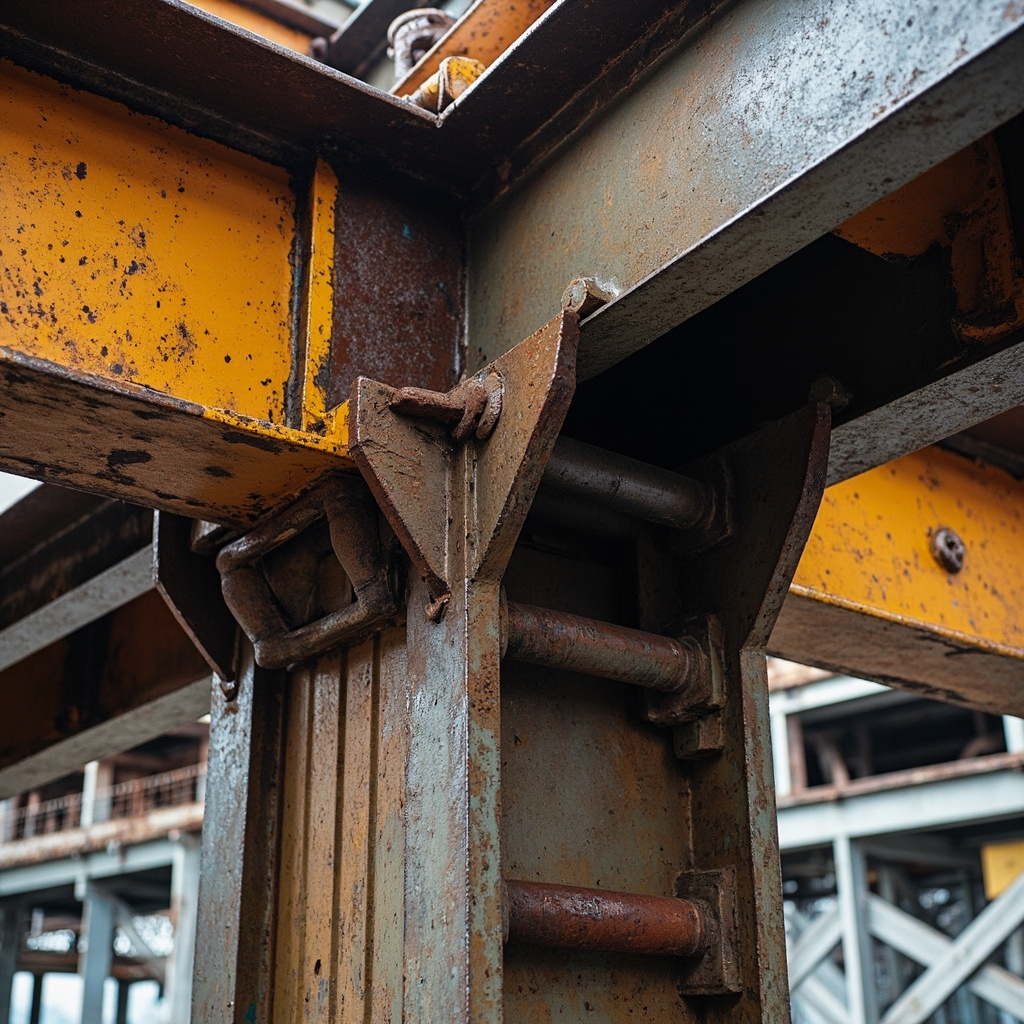
Vollständiger Leitfaden zu Stahlbau-Verbindungsbefestigungen.
Arten von Stahlbauverbindungen
Stahlbauverbindungen werden nach ihrem Kraftübertragungsmechanismus klassifiziert: Scherfugenverbindungen — übertragen nur Scherkräfte (kein Moment); das Trägerende ist frei drehbar; Annahme für die Bemessung: gelenkige Verbindung; üblich bei einfachen Konstruktionen (Lagerhallen, eingeschossige Rahmen). Momentenverbindungen — übertragen sowohl Scherkräfte als auch Biegemomente; das Trägerende ist gegen Drehung eingespannt; komplexer und teurer; dort eingesetzt, wo die strukturelle Stabilität Kontinuität erfordert. Aussteifungsverbindungen — übertragen Zug- oder Druckkräfte entlang diagonaler Elemente; verwendet in ausgesteiften Rahmen für die seitliche Stabilität; relativ einfache Konstruktion. Fußplattenverbindungen — übertragen Lasten von der Stütze auf das Betonfundament; Ankerbolzen (J-Schrauben oder Ankerstangen), die in Beton eingebettet sind; die kritische Schnittstelle zwischen Struktur und Fundament. Jeder Verbindungstyp hat unterschiedliche Anforderungen an Befestigungselemente und Bemessungsannahmen. Zugehörige Ressourcen: hochfeste Schrauben Ankerbolzen Edelstahl-Befestigungselemente Sechskantschrauben Sicherungsmuttern Unterlegscheiben selbstbohrende Schrauben Innensechskantschrauben. Dieser Beschaffungsrahmen gilt für die Beschaffung von Verbindungselementen für Bauwesen, Bergbau, Energie, Automobilindustrie und allgemeine industrielle Anwendungen. Die Entscheidungslogik priorisiert Qualitätskonstanz, Lieferantenzuverlässigkeit und Gesamtkosten gegenüber kurzfristigen Stückpreisen. Für B2B-Käufer in Afrika, Lateinamerika und Südostasien umfassen zusätzliche Überlegungen regionale Zollanforderungen, Optionen für die Containerkonsolidierung und Mechanismen zur Zahlungssicherung. Standardisierte Spezifikationen, die projektübergreifend gültig sind, reduzieren den Schulungsaufwand, die RFQ-Bearbeitungszeit und den Aufwand für das Lieferanten-Onboarding.
Schraubverbindungen und Stirnplattenanschlüsse
Schraubverbindungen im Stahlbau nehmen verschiedene Formen an: Flanschstoß (Stegstoß) — Verbindung zweier Trägerenden mit Flansch- und Stegblechen; verwendet hochfeste Sechskantschrauben in Verbindungen mit Lochleibung; typischerweise M20 oder M24 der Festigkeitsklasse 8.8 oder 10.9. Anschlussblech (Fin plate) — ein dünnes Endblech, das an ein Element geschweißt und an das andere geschraubt wird; einfach in der Fertigung und Montage; verwendet Schrauben der Klasse 8.8 bei einschnittiger Scherung. Endplatte (Scher-Endplatte) — eine an das Trägerende geschweißte Platte, die mit dem Anschlusselement verschraubt wird; kann bei ausreichender Dicke für Momentensteifigkeit erweitert werden. Geschraubte Konsolverbindungen — Winkel oder Platten, die für die Scherübertragung an den Trägersteg oder -flansch geschraubt werden; üblich in Industriegebäuden für Kranbahnverbindungen. Alle strukturellen Verschraubungen müssen strukturelle Schrauben (ISO 4014/4017, ASTM A325 oder gleichwertig) mit korrekter Vorspannung verwenden, keine gewöhnlichen Sechskantschrauben. Die normbasierte Beschaffung erfordert kontinuierliches Lernen, da ISO-, ASTM-, DIN- und GB-Normen alle 3-5 Jahre überarbeitet werden. Abonnieren Sie Benachrichtigungen zu Normenaktualisierungen und überprüfen Sie die Spezifikationen jährlich. Die gebräuchlichsten Normen im internationalen Handel mit Verbindungselementen sind ISO 898-1 (mechanische Eigenschaften), ISO 3506-1 (Edelstahl), ISO 3269 (Abnahmeprüfung), ISO 4042 (Beschichtungen) und ISO 1502 (Gewindelehren). Für B2B-Käufer ist der Aufbau einer Normen-Referenzbibliothek mit mindestens den 20 wichtigsten Normen für den eigenen Produktmix unerlässlich.
Vorspannanforderungen für Strukturverbindungen
Strukturelle Verbindungen sind für ihre korrekte Funktion auf Vorspannung (Klemmkraft) angewiesen: Bei Scherfugenverbindungen (Lochleibungstyp) ist die Vorspannung nicht kritisch — die Schrauben übertragen die Last durch Lochleibung; Schrauben werden typischerweise „handfest“ angezogen, gefolgt von einer Teilumdrehung. Bei reibschlüssigen Verbindungen (gleitfest) ist die Vorspannung kritisch — die Vorspannung erzeugt Reibung zwischen den verbundenen Platten; Schrauben werden auf 50-75% der Prüfkraft gespannt; die Verbindung darf unter Auslegungslast nicht gleiten. Für scherfeste Verbindungen im afrikanischen Bauwesen ist die Drehmoment-Drehwinkel-Methode am gebräuchlichsten: Schritt 1 — alle Schrauben handfest anziehen (von der Mitte nach außen, Sternmuster); Schritt 2 — Position der Mutter markieren; Schritt 3 — jede Mutter um eine 1/2 Umdrehung (für Schrauben < M24) oder 3/4 Umdrehung (für Schrauben ab M24) weiterdrehen. Für gleitfeste Verbindungen sind DTI-Unterlegscheiben (Direkt-Spannungsindikatoren) oder ein kalibrierter Drehmomentschlüssel zur Überprüfung der Vorspannung anzugeben. Die oben genannte Vergleichsmethodik verwendet typische Bereiche aus Industriedaten und der TradeGo-Beschaffungserfahrung von 2018-2024. Die tatsächlichen Marktpreise schwanken mit den Rohstoffkosten (Stahl, Zink, Nickel), Energiekosten, Arbeitskosten und Wechselkursen. Für einen genauen Vergleich fordern Sie identische Angebote von 3-5 qualifizierten Lieferanten an und vergleichen Sie die gelieferten Kosten (Produkt + Versand + Versicherung + Zölle). Der niedrigste Stückpreis ist selten der niedrigste Preis bei den Gesamtkosten.
Stützenfußanschlüsse
Stützenfußplatten übertragen die gesamte Gebäudelast auf das Betonfundament: Ankerstangen (J-Schrauben, L-Schrauben) — typischerweise M20 bis M36, abhängig von Stützengröße und Last; beim Betonieren eingebettet; müssen präzise positioniert werden, um dem Lochmuster der Fußplatte zu entsprechen; beim Betonieren werden Schablonen verwendet. Untergießen der Fußplatte — nach der Stützenmontage wird der Raum zwischen Platte und Beton mit schwindfreiem Mörtel untergossen; Ankermuttern werden nach dem Aushärten des Mörtels festgezogen. Überstand der Ankerstangen — Ankerstangen müssen ausreichend weit über die Betonoberfläche hinausragen, um Fußplatte, Unterlegscheibe und Mutter aufzunehmen; typischerweise 3-5 Gewindegänge über der Mutter. Niederhalterschrauben vs. Fußplatten — einige Konstruktionen verwenden eingebettete Platten mit geschweißten Bolzen anstelle von herausragenden Ankerstangen; dies erfordert ein anderes Installationsverfahren. Die Prüfcheckliste gilt sowohl für die erste Lieferantenqualifizierung als auch für die laufende Chargeninspektion. Für Hochrisikoanwendungen (tragende Strukturen, Druckbehälter, Bergbau, Schifffahrt) sollten Ermüdungstests, Salzsprühnebeltests (ASTM B117), Drehmoment-Spannungstests und Inspektionen nach der Installation hinzugefügt werden. Die Kosten für zusätzliche Überprüfungen liegen bei 0,1-0,3% des Auftragswerts, während unentdeckte Qualitätsmängel Schäden in Höhe des 10- bis 100-Fachen des Auftragswerts verursachen können.
Spezifikationen für den Stahlbau in Afrika
Für Stahlbauprojekte in Afrika gelten folgende Spezifikationen für Befestigungselemente: Südafrikanische Projekte — SANS 2001-C2 (Montage von Stahlbauten) und SANS 1431 (hochfeste strukturelle Schrauben) sind maßgebend; für tragende Hauptverbindungen sind SABS-zertifizierte Schrauben erforderlich. Ost-/Westafrikanische Projekte — folgen oft einer Kombination aus BS 5950 (UK) oder AISC (US) Normen für die Bemessung; ISO 4014/4017 für Schraubenspezifikationen; Materialzeugnisse (MTRs) sind erforderlich. Tansania/Kenia — lokale Normen (KS, TZ Standards) können für Regierungsprojekte gelten; für private Projekte werden internationale Normen akzeptiert. Überprüfen Sie bei allen strukturellen Verbindungen: Schraubengüte entspricht der Spezifikation des Statikers; Unterlegscheiben sind für den Schraubentyp und die Beschichtung geeignet; strukturelle Schrauben sind mit Güte (8.8, 10.9) und Herstellermarke gekennzeichnet; Konformitätsbescheinigungen sind verfügbar. Die Lieferantenbewertung sollte ein kontinuierlicher Prozess sein, keine einmalige Übung. Evaluieren Sie Lieferanten jährlich basierend auf Lieferleistung, Qualitätskennzahlen, Preiswettbewerbsfähigkeit und Reaktionsfähigkeit. Führen Sie eine Lieferanten-Scorecard mit gewichteten Metriken: Pünktliche Lieferung (25%), Qualitätsakzeptanzrate (30%), Preiswettbewerbsfähigkeit (20%), Reaktionsfähigkeit (15%) und Dokumentationsgenauigkeit (10%). Trennen Sie sich von Lieferanten, die über einen Zeitraum von 6 Monaten unter 70% punkten, und qualifizieren Sie Ersatz.
Häufig gestellte Fragen
See frequently asked questions below.
What is the difference between a bearing-type and a friction-type (slip-critical) connection?
In a bearing-type connection, the bolts carry the applied load by bearing against the connected plates — the bolt itself is in shear. The preload (clamp force) doesn't matter as much; the bolt just needs to be snug-tight. In a friction-type (slip-critical) connection, the applied load is transferred by friction between the connected plates, created by the bolt's preload. If the preload is insufficient, the joint slips — causing failure. Slip-critical connections require higher preload (verified by DTI washers or calibrated wrench), and the connected surfaces must be free of paint and mill scale (cleaned to bare metal) to achieve the specified coefficient of friction.
Why do structural bolts have washers under both the head and the nut?
Under the bolt head — distributes the load from the bolt head onto the connected plate, preventing localized bearing stress that could deform the plate; hardened washers are used with high-strength bolts to prevent embedding. Under the nut — serves the same purpose on the other side of the joint; the nut bearing surface is smaller than the head, so the washer is even more important here. For structural connections using high-strength bolts (Grade 8.8, 10.9), hardened washers (to HRC 38-45) are specified for both positions. Using standard (soft) washers with high-strength bolts can cause the washer to deform and lose preload.
What is the maximum bolt spacing in a structural connection?
Bolt spacing is governed by the structural design code (BS 5950, AISC, SANS, etc.) and the design loads. General guidelines: Minimum spacing — not less than 2.5× bolt diameter (to prevent edge splitting); Maximum spacing in tension — not more than 14× t (thinner connected plate) or 200mm; Maximum spacing in compression — not more than 24× t or 300mm; Edge distance — minimum edge distance varies from 1.5D to 2.0D depending on edge condition (sheared, rolled, etc.) and loading direction. Always follow the structural engineer's connection design — these are general guidelines only.
Need structural steel connection fasteners for your project? Get a factory quote from TradeGo.
Get Quote