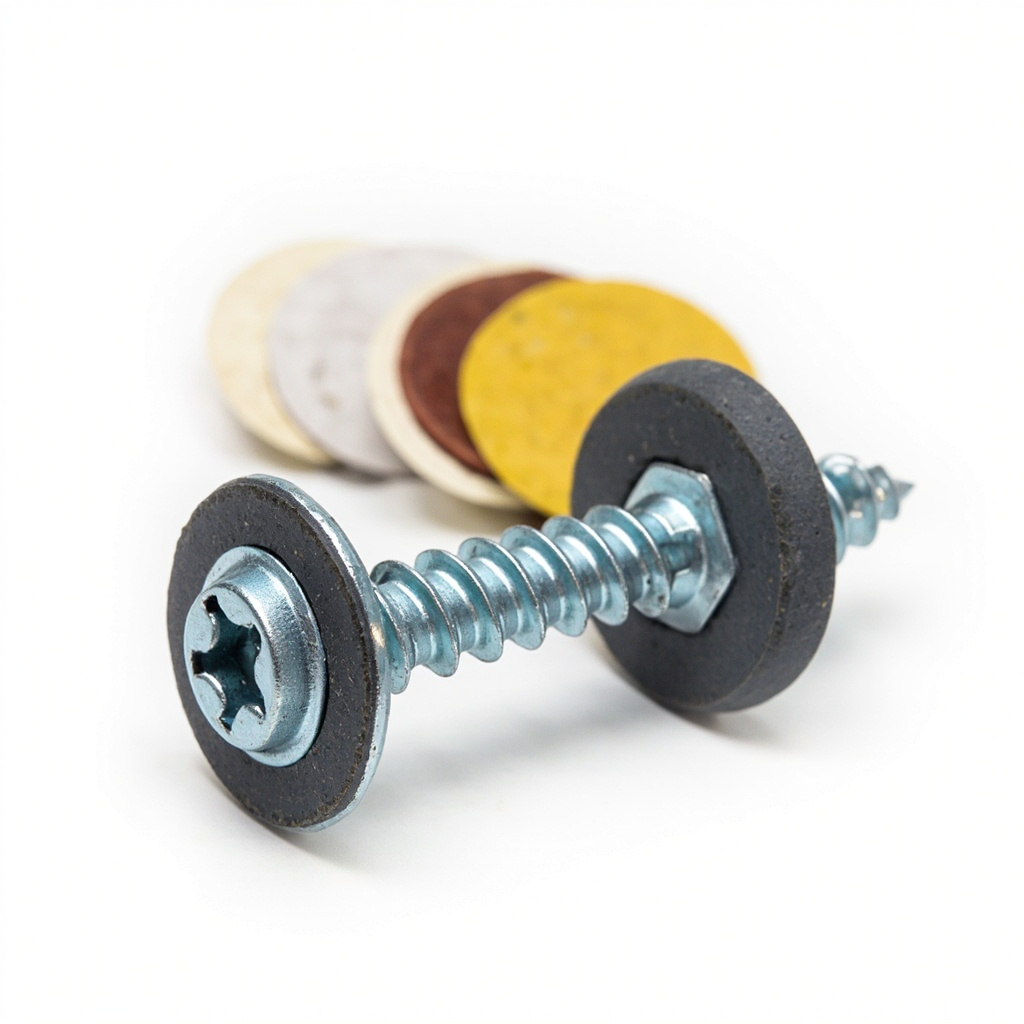
Everything you need to know about roofing screws with EPDM <a href="/products#washers" class="text-primary-600 hover:text-primary-800 underline.
EPDM Washer Technology and Benefits
EPDM (Ethylene Propylene Diene Monomer) rubber washers are the industry standard for roofing screw weatherproofing. The EPDM washer creates a compression seal between the screw head and the roofing panel, preventing water ingress through the fastener hole. Quality EPDM washers are UV-stabilized and maintain their elasticity for 15-20 years in direct sunlight exposure, making them essential for metal roofing in tropical and subtropical regions. The washer is bonded to a galvanized steel backing plate that distributes clamping force evenly and prevents the rubber from extruding under pressure. Two common washer sizes exist: 14mm diameter for standard corrugated roofing and 19mm or larger for standing seam and insulated panel applications. When sourcing roofing screws for African and Middle Eastern markets, always verify that the EPDM washer is UV-resistant and meets relevant standards such as ASTM D1418 or equivalent. Related resources: high-tensile bolts anchor bolts stainless steel fasteners hex bolts lock nuts washers self-drilling screws socket screws. This procurement framework applies to fastener sourcing for construction, mining, energy, automotive, and general industrial applications. The decision logic prioritizes quality consistency, supplier reliability, and total cost of ownership over short-term unit price. For B2B buyers in Africa, Latin America, and Southeast Asia, additional considerations include regional customs requirements, container consolidation options, and payment security mechanisms. Standardized specifications that travel across projects reduce training time, RFQ processing time, and supplier onboarding effort. This procurement framework applies to fastener sourcing for construction, mining, energy, automotive, and general industrial applications. The decision logic prioritizes quality consistency, supplier reliability, and total cost of ownership over short-term unit price. For B2B buyers in Africa, Latin America, and Southeast Asia, additional considerations include regional customs requirements, container consolidation options, and payment security mechanisms. Standardized specifications that travel across projects reduce training time, RFQ processing time, and supplier onboarding effort. This procurement framework applies to fastener sourcing for construction, mining, energy, automotive, and general industrial applications. The decision logic prioritizes quality consistency, supplier reliability, and total cost of ownership over short-term unit price. For B2B buyers in Africa, Latin America, and Southeast Asia, additional considerations include regional customs requirements, container consolidation options, and payment security mechanisms. Standardized specifications that travel across projects reduce training time, RFQ processing time, and supplier onboarding effort.
| Washer Size | Application | Screw Diameter | Seal Area |
|---|---|---|---|
| 14mm | Corrugated metal roofing | #10-12 (5.0-5.5mm) | Standard |
| 19mm | Standing seam, insulated panels | #12-14 (5.5-6.3mm) | Wide seal |
| 25mm+ | Overlay joints, flashings | 1/4" (6.3mm) | Extra wide seal |
Roofing Screw Types and Sizing
Roofing screws are classified by head type, thread type, and drill point capacity. The most common head style is the hex washer head (HWH) with integrated EPDM washer, which provides both driving torque and weatherproofing in one component. Stitcher screws have a smaller pan head with separate EPDM washer for side-lap connections. Thread types include standard spaced thread for metal-to-wood and fine thread for metal-to-metal connections. The drill point is critical — it must be long enough to penetrate all layers of material before the threads engage. A #1 drill point penetrates up to 2mm of steel, #2 up to 3mm, and #3 up to 5mm. For typical metal roofing over purlins, a #10×1" screw with #1 drill point is standard for 0.4-0.5mm roofing sheets. For thicker insulated panels, #12×2" or longer screws with #2 or #3 drill points are required. Always specify drill point capacity when ordering to prevent installation failures. Standards-based procurement requires continuous learning as ISO, ASTM, DIN, and GB standards are revised every 3-5 years. Subscribe to standards update notifications and review specifications annually. The most common standards used in international fastener trade are ISO 898-1 (mechanical properties), ISO 3506-1 (stainless), ISO 3269 (acceptance inspection), ISO 4042 (coatings), and ISO 1502 (thread gauges). For B2B buyers, building a standards reference library with at least the top 20 standards relevant to your product mix is essential. Standards-based procurement requires continuous learning as ISO, ASTM, DIN, and GB standards are revised every 3-5 years. Subscribe to standards update notifications and review specifications annually. The most common standards used in international fastener trade are ISO 898-1 (mechanical properties), ISO 3506-1 (stainless), ISO 3269 (acceptance inspection), ISO 4042 (coatings), and ISO 1502 (thread gauges). For B2B buyers, building a standards reference library with at least the top 20 standards relevant to your product mix is essential. Standards-based procurement requires continuous learning as ISO, ASTM, DIN, and GB standards are revised every 3-5 years. Subscribe to standards update notifications and review specifications annually. The most common standards used in international fastener trade are ISO 898-1 (mechanical properties), ISO 3506-1 (stainless), ISO 3269 (acceptance inspection), ISO 4042 (coatings), and ISO 1502 (thread gauges). For B2B buyers, building a standards reference library with at least the top 20 standards relevant to your product mix is essential.
| Drill Point | Steel Capacity | Typical Screw Size | Application |
|---|---|---|---|
| #1 | Up to 2mm | #10 × 3/4" to 1" | Thin metal sheet to wood |
| #2 | Up to 3mm | #12 × 1" to 2" | Metal to metal, thicker gauge |
| #3 | Up to 5mm | #14 × 1-1/2" to 3" | Heavy gauge, insulated panels |
| #4 | Up to 6mm | 1/4" × 2" to 4" | Structural steel connections |
Installation Techniques for Leak-Free Roofs
Proper installation technique is the single most important factor in preventing roof leaks at fastener points. The key principle is to achieve proper compression of the EPDM washer without over-driving or under-driving the screw. The EPDM washer should be visibly compressed but not bulging beyond the metal backing plate. Over-driving crushes the washer and creates a gap, while under-driving leaves the seal incomplete. Use an adjustable clutch screw gun rather than a drill driver to control torque precisely. Set the clutch to engage at the point where the washer just begins to compress. Install screws perpendicular to the roof surface — angled installation creates uneven compression and potential leak paths. In corrugated roofing, place screws in the valley (low point) rather than the crest for better water shedding. Space screws according to the roofing manufacturer's specification, typically 2-3 fasteners per linear meter along purlins. For projects in high-wind regions of Southern Africa, increase fastener density by 25-30% and consider using screws with larger washers. For more information, also see our guides on [IBR nails](/en/industry/ibr-roofing-nails-installation-guide), [self-drilling screws](/en/industry/self-drilling-screws-selection-guide), [material selection](/en/industry/galvanized-vs-stainless-steel-fasteners). The comparison methodology above uses typical ranges from industry data and TradeGo procurement experience 2018-2024. Actual market prices fluctuate with raw material costs (steel, zinc, nickel), energy costs, labor costs, and currency exchange rates. For accurate comparison, request identical RFQs from 3-5 qualified suppliers and compare landed cost (product + shipping + insurance + duties). The lowest unit price is rarely the lowest total cost of ownership. The comparison methodology above uses typical ranges from industry data and TradeGo procurement experience 2018-2024. Actual market prices fluctuate with raw material costs (steel, zinc, nickel), energy costs, labor costs, and currency exchange rates. For accurate comparison, request identical RFQs from 3-5 qualified suppliers and compare landed cost (product + shipping + insurance + duties). The lowest unit price is rarely the lowest total cost of ownership. The comparison methodology above uses typical ranges from industry data and TradeGo procurement experience 2018-2024. Actual market prices fluctuate with raw material costs (steel, zinc, nickel), energy costs, labor costs, and currency exchange rates. For accurate comparison, request identical RFQs from 3-5 qualified suppliers and compare landed cost (product + shipping + insurance + duties). The lowest unit price is rarely the lowest total cost of ownership.
How long do EPDM washers last on a roof?
Quality UV-stabilized EPDM washers typically last 15-20 years. In extremely hot climates (surface temperatures above 80°C), lifespan may reduce to 10-15 years. Always choose screws with UV-stabilized washers for roof applications.
Can I reuse roofing screws after removal?
No. The EPDM washer takes a compression set after installation and will not reseal properly if removed and reinstalled. Always use new screws for any re-roofing or repair work.
Frequently Asked Questions
See frequently asked questions below.
Related resources: high-tensile bolts anchor bolts stainless steel fasteners hex bolts lock nuts washers self-drilling screws socket screws. The verification checklist applies to both initial supplier qualification and ongoing batch inspection. For high-risk applications (load-bearing structural, pressure vessels, mining, marine), add fatigue testing, salt-spray testing (ASTM B117), torque-tension testing, and post-installation inspection. The cost of additional verification is 0.1-0.3% of order value, while undetected quality failures can be 10-100x the order value in damages. The verification checklist applies to both initial supplier qualification and ongoing batch inspection. For high-risk applications (load-bearing structural, pressure vessels, mining, marine), add fatigue testing, salt-spray testing (ASTM B117), torque-tension testing, and post-installation inspection. The cost of additional verification is 0.1-0.3% of order value, while undetected quality failures can be 10-100x the order value in damages. The verification checklist applies to both initial supplier qualification and ongoing batch inspection. For high-risk applications (load-bearing structural, pressure vessels, mining, marine), add fatigue testing, salt-spray testing (ASTM B117), torque-tension testing, and post-installation inspection. The cost of additional verification is 0.1-0.3% of order value, while undetected quality failures can be 10-100x the order value in damages.What are Installation Guide and how are they used?
Installation Guide are essential components in construction and manufacturing. Proper selection depends on load requirements, environmental conditions, and material compatibility.
How do I choose the right fastener for my project?
Consider the material being fastened, load requirements, environmental exposure, and applicable standards. Consult with a professional if unsure about specifications.
What materials are available for these fasteners?
Common materials include carbon steel, stainless steel, alloy steel, and specialty alloys. Each offers different strength, corrosion resistance, and cost characteristics.
Do you offer custom manufacturing?
Yes, we offer custom fastener manufacturing to spec. Contact our sales team with your requirements for pricing and lead times.
Need roofing screws for your next project? Get bulk pricing and technical support from TradeGo Fasteners.
Get Quote