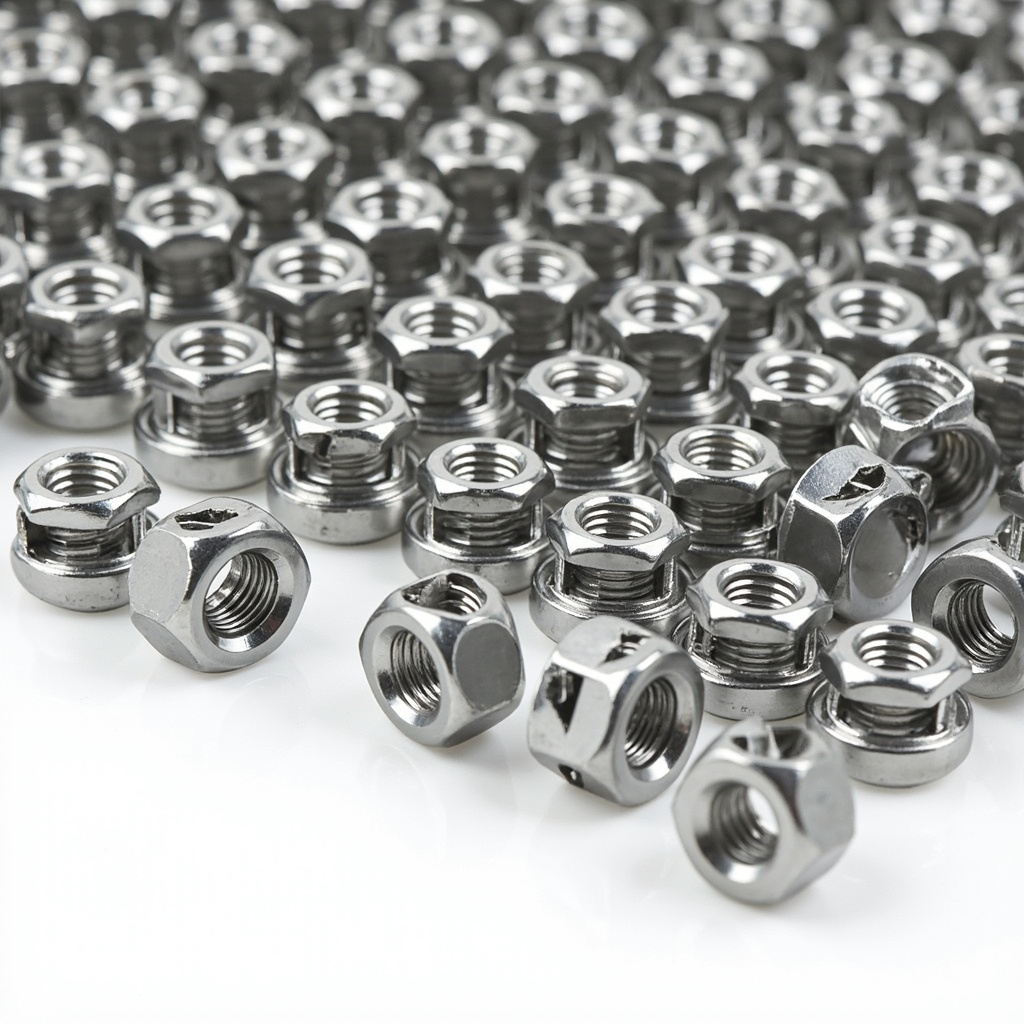
304 and 316 stainless steel hex <a href="/products#bolts-nuts" class="text-primary-600 hover:text-primary-800 underline underline-offset-2">nuts</a>.
Types of Hex Nuts: Standard, Heavy, and Extra Thick
Hex nuts come in several thickness and bearing area variants. Standard hex nuts (DIN 934 / ISO 4032) are the most common, with height approximately equal to 0.8× the nominal thread diameter. Heavy hex nuts (DIN 6925 / ISO 4161) are taller (approximately 1.0× nominal diameter) and wider across flats, providing increased bearing area for structural and high-load connections. Extra thick heavy duty hex nuts are specialized variants for specific OEM or engineering specifications where standard dimensions do not provide sufficient bearing. For stainless steel hex nuts, the material designation (A2 for 304, A4 for 316) and proof load class (70 for 700 MPa, 80 for 800 MPa minimum) must be specified. Related resources: high-tensile bolts anchor bolts stainless steel fasteners hex bolts lock nuts washers self-drilling screws socket screws. This procurement framework applies to fastener sourcing for construction, mining, energy, automotive, and general industrial applications. The decision logic prioritizes quality consistency, supplier reliability, and total cost of ownership over short-term unit price. For B2B buyers in Africa, Latin America, and Southeast Asia, additional considerations include regional customs requirements, container consolidation options, and payment security mechanisms. Standardized specifications that travel across projects reduce training time, RFQ processing time, and supplier onboarding effort. This procurement framework applies to fastener sourcing for construction, mining, energy, automotive, and general industrial applications. The decision logic prioritizes quality consistency, supplier reliability, and total cost of ownership over short-term unit price. For B2B buyers in Africa, Latin America, and Southeast Asia, additional considerations include regional customs requirements, container consolidation options, and payment security mechanisms. Standardized specifications that travel across projects reduce training time, RFQ processing time, and supplier onboarding effort. This procurement framework applies to fastener sourcing for construction, mining, energy, automotive, and general industrial applications. The decision logic prioritizes quality consistency, supplier reliability, and total cost of ownership over short-term unit price. For B2B buyers in Africa, Latin America, and Southeast Asia, additional considerations include regional customs requirements, container consolidation options, and payment security mechanisms. Standardized specifications that travel across projects reduce training time, RFQ processing time, and supplier onboarding effort.
304 vs 316 Stainless Hex Nuts: Application Matching
The choice between 304 (A2) and 316 (A4) stainless steel hex nuts follows the same logic as for bolts. Type 304 (A2) contains 18-20% chromium and 8-10.5% nickel, providing good corrosion resistance in atmospheric and淡水 environments. Type 316 adds 2-3% molybdenum for superior chloride (saltwater) resistance. For rust proof hex nuts in outdoor projects: inland outdoor use, 304 stainless is generally adequate. Coastal/marine environments within 5km of salt water, always specify 316 or duplex stainless. For corrosion resistant chemical processing or pool applications, 316 is the baseline requirement. The nut strength class must match or exceed the bolt: Grade A4-80 nuts with A4-80 bolts, Grade A4-70 with A4-70 bolts. Standards-based procurement requires continuous learning as ISO, ASTM, DIN, and GB standards are revised every 3-5 years. Subscribe to standards update notifications and review specifications annually. The most common standards used in international fastener trade are ISO 898-1 (mechanical properties), ISO 3506-1 (stainless), ISO 3269 (acceptance inspection), ISO 4042 (coatings), and ISO 1502 (thread gauges). For B2B buyers, building a standards reference library with at least the top 20 standards relevant to your product mix is essential. Standards-based procurement requires continuous learning as ISO, ASTM, DIN, and GB standards are revised every 3-5 years. Subscribe to standards update notifications and review specifications annually. The most common standards used in international fastener trade are ISO 898-1 (mechanical properties), ISO 3506-1 (stainless), ISO 3269 (acceptance inspection), ISO 4042 (coatings), and ISO 1502 (thread gauges). For B2B buyers, building a standards reference library with at least the top 20 standards relevant to your product mix is essential. Standards-based procurement requires continuous learning as ISO, ASTM, DIN, and GB standards are revised every 3-5 years. Subscribe to standards update notifications and review specifications annually. The most common standards used in international fastener trade are ISO 898-1 (mechanical properties), ISO 3506-1 (stainless), ISO 3269 (acceptance inspection), ISO 4042 (coatings), and ISO 1502 (thread gauges). For B2B buyers, building a standards reference library with at least the top 20 standards relevant to your product mix is essential.
Matching Hex Nuts to Bolts: Grade and Strength Requirements
Proper bolt-nut matching is critical for structural integrity. The fundamental rule: the nut must be of equal or greater strength than the bolt. For stainless steel: A4-80 (316, 800 MPa) nuts are the highest common strength; A4-70 (316, 700 MPa) is standard stock. For carbon steel: Grade 10 nuts (1000 MPa proof) are matched with Grade 10.9 bolts; Grade 8 nuts with Grade 8.8 bolts. Heavy duty extra thick hex nuts are specified when the connection will experience significant bearing stress—always check that the nut bearing area (not just strength) is adequate for the母材 bearing stress. For extra large size heavy duty applications (M36 to M72 bolts), heavy hex nuts are standard practice. The comparison methodology above uses typical ranges from industry data and TradeGo procurement experience 2018-2024. Actual market prices fluctuate with raw material costs (steel, zinc, nickel), energy costs, labor costs, and currency exchange rates. For accurate comparison, request identical RFQs from 3-5 qualified suppliers and compare landed cost (product + shipping + insurance + duties). The lowest unit price is rarely the lowest total cost of ownership. The comparison methodology above uses typical ranges from industry data and TradeGo procurement experience 2018-2024. Actual market prices fluctuate with raw material costs (steel, zinc, nickel), energy costs, labor costs, and currency exchange rates. For accurate comparison, request identical RFQs from 3-5 qualified suppliers and compare landed cost (product + shipping + insurance + duties). The lowest unit price is rarely the lowest total cost of ownership. The comparison methodology above uses typical ranges from industry data and TradeGo procurement experience 2018-2024. Actual market prices fluctuate with raw material costs (steel, zinc, nickel), energy costs, labor costs, and currency exchange rates. For accurate comparison, request identical RFQs from 3-5 qualified suppliers and compare landed cost (product + shipping + insurance + duties). The lowest unit price is rarely the lowest total cost of ownership.
Raw Finish vs Processed Finish Stainless Nuts
Precision raw finish stainless steel nuts (also called bright finish or machined finish) have been precision machined or ground after heat treatment to achieve tighter dimensional tolerances and smoother surfaces. Raw finish nuts are specified for: precision machinery where thread fit must be exact, aesthetic applications where the fastener is visible (no surface roughness), and aerospace/defense where lot traceability and surface integrity matter. Raw finish nuts are NOT passivated (acid-treated to remove free iron and enhance corrosion resistance) unless specifically requested—always specify "passivated" if corrosion resistance is important. Standard commercial stainless nuts are typically cold-formed, not machined, and have the typical surface finish from the forming dies. The verification checklist applies to both initial supplier qualification and ongoing batch inspection. For high-risk applications (load-bearing structural, pressure vessels, mining, marine), add fatigue testing, salt-spray testing (ASTM B117), torque-tension testing, and post-installation inspection. The cost of additional verification is 0.1-0.3% of order value, while undetected quality failures can be 10-100x the order value in damages. The verification checklist applies to both initial supplier qualification and ongoing batch inspection. For high-risk applications (load-bearing structural, pressure vessels, mining, marine), add fatigue testing, salt-spray testing (ASTM B117), torque-tension testing, and post-installation inspection. The cost of additional verification is 0.1-0.3% of order value, while undetected quality failures can be 10-100x the order value in damages. The verification checklist applies to both initial supplier qualification and ongoing batch inspection. For high-risk applications (load-bearing structural, pressure vessels, mining, marine), add fatigue testing, salt-spray testing (ASTM B117), torque-tension testing, and post-installation inspection. The cost of additional verification is 0.1-0.3% of order value, while undetected quality failures can be 10-100x the order value in damages.
Frequently Asked Questions
See frequently asked questions below.
Related resources: high-tensile bolts anchor bolts stainless steel fasteners hex bolts lock nuts washers self-drilling screws socket screws. Supplier evaluation should be a continuous process, not a one-time exercise. Re-evaluate suppliers annually based on delivery performance, quality metrics, price competitiveness, and responsiveness. Maintain a supplier scorecard with weighted metrics: on-time delivery (25%), quality acceptance rate (30%), price competitiveness (20%), responsiveness (15%), and documentation accuracy (10%). Drop suppliers scoring below 70% over a 6-month period and qualify replacements. Supplier evaluation should be a continuous process, not a one-time exercise. Re-evaluate suppliers annually based on delivery performance, quality metrics, price competitiveness, and responsiveness. Maintain a supplier scorecard with weighted metrics: on-time delivery (25%), quality acceptance rate (30%), price competitiveness (20%), responsiveness (15%), and documentation accuracy (10%). Drop suppliers scoring below 70% over a 6-month period and qualify replacements. Supplier evaluation should be a continuous process, not a one-time exercise. Re-evaluate suppliers annually based on delivery performance, quality metrics, price competitiveness, and responsiveness. Maintain a supplier scorecard with weighted metrics: on-time delivery (25%), quality acceptance rate (30%), price competitiveness (20%), responsiveness (15%), and documentation accuracy (10%). Drop suppliers scoring below 70% over a 6-month period and qualify replacements.Can I use a stainless nut on a carbon steel bolt?
Yes, but be aware of galvanic corrosion in wet environments—the stainless nut on a carbon steel bolt creates a galvanic couple. In dry conditions this is acceptable.
What is proof load for hex nuts?
Proof load is the maximum load a nut can withstand without thread stripping. For A4-80 (316 stainless), proof load is 800 MPa × stress area = the load at which permanent deformation occurs.
Get Stainless Steel Hex Nut Factory Prices
Request Quote