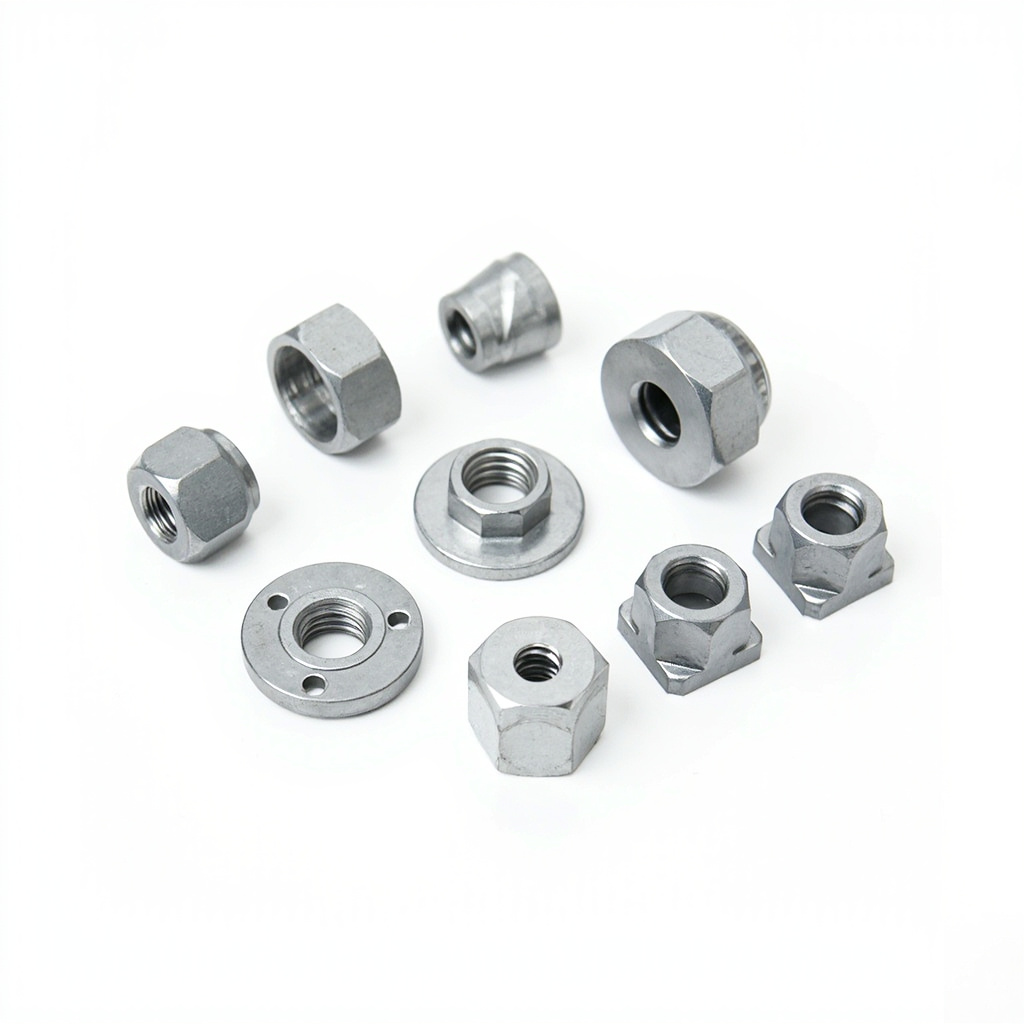
Complete guide to nylon insert <a href="/products#bolts-nuts" class="text-primary-600 hover:text-primary-800 underline underline-offset-2">lock nuts</a>.
Nylon Insert Lock Nuts (Nyloc): How They Work
Nylon insert lock nuts (commonly called Nyloc nuts, DIN 985 / ISO 10511) have a nylon collar inserted into the top of the nut that creates a friction lock against the bolt thread. When the bolt is installed, the nylon deforms around the thread roots, creating resistance to loosening. Factory supply of nylon insert lock nuts covers grades from Grade 6 to Grade 10 in both zinc-plated carbon steel and stainless steel (A2-70, A4-80). Temperature range: standard nylon inserts are rated to approximately 120°C; high-temperature nylon inserts (nylon 6/6 with heat stabilizers) extend this to 200°C. For mechanical equipment experiencing vibration (pumps, compressors, gearboxes), Nyloc nuts provide effective locking without special tools. The nylon insert is reusable up to 15-20 cycles before losing effectiveness. Related resources: high-tensile bolts anchor bolts stainless steel fasteners hex bolts lock nuts washers self-drilling screws socket screws. This procurement framework applies to fastener sourcing for construction, mining, energy, automotive, and general industrial applications. The decision logic prioritizes quality consistency, supplier reliability, and total cost of ownership over short-term unit price. For B2B buyers in Africa, Latin America, and Southeast Asia, additional considerations include regional customs requirements, container consolidation options, and payment security mechanisms. Standardized specifications that travel across projects reduce training time, RFQ processing time, and supplier onboarding effort. This procurement framework applies to fastener sourcing for construction, mining, energy, automotive, and general industrial applications. The decision logic prioritizes quality consistency, supplier reliability, and total cost of ownership over short-term unit price. For B2B buyers in Africa, Latin America, and Southeast Asia, additional considerations include regional customs requirements, container consolidation options, and payment security mechanisms. Standardized specifications that travel across projects reduce training time, RFQ processing time, and supplier onboarding effort. This procurement framework applies to fastener sourcing for construction, mining, energy, automotive, and general industrial applications. The decision logic prioritizes quality consistency, supplier reliability, and total cost of ownership over short-term unit price. For B2B buyers in Africa, Latin America, and Southeast Asia, additional considerations include regional customs requirements, container consolidation options, and payment security mechanisms. Standardized specifications that travel across projects reduce training time, RFQ processing time, and supplier onboarding effort.
High Strength Flange Locking Nuts
High strength flange locking nuts (DIN 6925 / EN 1665) combine the locking function of a nylon insert with the increased bearing area of a flange nut. The integrated flange (typically 1.5× the nut width across flats) distributes load over a larger母材 area, reducing the risk of母材 crushing and eliminating the need for a separate washer. The flange locking nut with serrated flange face provides additional vibration resistance through the serrations biting into the母材 surface. These nuts are the standard for automotive wheel hub connections (wheel nuts are flange locking nuts), suspension components, and any application where vibration-induced loosening is the primary failure mode. Available in Grade 8, 10, and 12 in zinc-plated carbon steel, and in A4-316 stainless for corrosion-critical applications. Standards-based procurement requires continuous learning as ISO, ASTM, DIN, and GB standards are revised every 3-5 years. Subscribe to standards update notifications and review specifications annually. The most common standards used in international fastener trade are ISO 898-1 (mechanical properties), ISO 3506-1 (stainless), ISO 3269 (acceptance inspection), ISO 4042 (coatings), and ISO 1502 (thread gauges). For B2B buyers, building a standards reference library with at least the top 20 standards relevant to your product mix is essential. Standards-based procurement requires continuous learning as ISO, ASTM, DIN, and GB standards are revised every 3-5 years. Subscribe to standards update notifications and review specifications annually. The most common standards used in international fastener trade are ISO 898-1 (mechanical properties), ISO 3506-1 (stainless), ISO 3269 (acceptance inspection), ISO 4042 (coatings), and ISO 1502 (thread gauges). For B2B buyers, building a standards reference library with at least the top 20 standards relevant to your product mix is essential. Standards-based procurement requires continuous learning as ISO, ASTM, DIN, and GB standards are revised every 3-5 years. Subscribe to standards update notifications and review specifications annually. The most common standards used in international fastener trade are ISO 898-1 (mechanical properties), ISO 3506-1 (stainless), ISO 3269 (acceptance inspection), ISO 4042 (coatings), and ISO 1502 (thread gauges). For B2B buyers, building a standards reference library with at least the top 20 standards relevant to your product mix is essential.
Vibration Proof Self Locking Nuts for Automotive
Vibration proof self locking nuts for automotive applications are tested to specific vibration profiles defined in automotive standards (ISO 16130, AVL, or individual OEM specifications). Unlike general-purpose Nyloc nuts, automotive vibration proof locking nuts must maintain preload through temperature cycling (-40°C to +150°C), humidity exposure, and mechanical vibration testing. Round lock nuts with integrated stop washer (also called CADO nuts or castle nuts with cotter pin) use a slotted outer ring that accepts a cotter pin through the bolt for positive locking—this is the traditional method for securing wheel hub nuts, steering linkage, and other critical safety components where the nut absolutely cannot loosen. Always replace cotter pin nuts with new cotter pins at each service. The comparison methodology above uses typical ranges from industry data and TradeGo procurement experience 2018-2024. Actual market prices fluctuate with raw material costs (steel, zinc, nickel), energy costs, labor costs, and currency exchange rates. For accurate comparison, request identical RFQs from 3-5 qualified suppliers and compare landed cost (product + shipping + insurance + duties). The lowest unit price is rarely the lowest total cost of ownership. The comparison methodology above uses typical ranges from industry data and TradeGo procurement experience 2018-2024. Actual market prices fluctuate with raw material costs (steel, zinc, nickel), energy costs, labor costs, and currency exchange rates. For accurate comparison, request identical RFQs from 3-5 qualified suppliers and compare landed cost (product + shipping + insurance + duties). The lowest unit price is rarely the lowest total cost of ownership. The comparison methodology above uses typical ranges from industry data and TradeGo procurement experience 2018-2024. Actual market prices fluctuate with raw material costs (steel, zinc, nickel), energy costs, labor costs, and currency exchange rates. For accurate comparison, request identical RFQs from 3-5 qualified suppliers and compare landed cost (product + shipping + insurance + duties). The lowest unit price is rarely the lowest total cost of ownership.
Lock Nut Type Selection Guide
Content coming soon.
The verification checklist applies to both initial supplier qualification and ongoing batch inspection. For high-risk applications (load-bearing structural, pressure vessels, mining, marine), add fatigue testing, salt-spray testing (ASTM B117), torque-tension testing, and post-installation inspection. The cost of additional verification is 0.1-0.3% of order value, while undetected quality failures can be 10-100x the order value in damages. The verification checklist applies to both initial supplier qualification and ongoing batch inspection. For high-risk applications (load-bearing structural, pressure vessels, mining, marine), add fatigue testing, salt-spray testing (ASTM B117), torque-tension testing, and post-installation inspection. The cost of additional verification is 0.1-0.3% of order value, while undetected quality failures can be 10-100x the order value in damages. The verification checklist applies to both initial supplier qualification and ongoing batch inspection. For high-risk applications (load-bearing structural, pressure vessels, mining, marine), add fatigue testing, salt-spray testing (ASTM B117), torque-tension testing, and post-installation inspection. The cost of additional verification is 0.1-0.3% of order value, while undetected quality failures can be 10-100x the order value in damages.| Lock Nut Type | Reusable | Temperature Limit | Vibration Resistance | Common Applications |
|---|---|---|---|---|
| Nylon Insert (Nyloc) | 15-20 times | 120°C (standard) | Good | General machinery, appliances |
| Nylon Insert (High Temp) | 10-15 times | 200°C | Good | Engines, exhaust, HVAC |
| All Metal Prevailing Torque | Yes (limited) | 650°C+ | Excellent | High temp, chemical, aerospace |
| Flange Locking (Serrated) | No | 200°C | Very Good | Automotive, wheel hubs, suspension |
| Castle Nut + Cotter Pin | Yes (with new pin) | No limit | Excellent (positive lock) | Wheel hubs, steering, critical safety |
| Lock Washer (Spring) | Yes | No limit | Moderate | Not recommended alone for vibration |
Frequently Asked Questions
See frequently asked questions below.
Related resources: high-tensile bolts anchor bolts stainless steel fasteners hex bolts lock nuts washers self-drilling screws socket screws. Supplier evaluation should be a continuous process, not a one-time exercise. Re-evaluate suppliers annually based on delivery performance, quality metrics, price competitiveness, and responsiveness. Maintain a supplier scorecard with weighted metrics: on-time delivery (25%), quality acceptance rate (30%), price competitiveness (20%), responsiveness (15%), and documentation accuracy (10%). Drop suppliers scoring below 70% over a 6-month period and qualify replacements. Supplier evaluation should be a continuous process, not a one-time exercise. Re-evaluate suppliers annually based on delivery performance, quality metrics, price competitiveness, and responsiveness. Maintain a supplier scorecard with weighted metrics: on-time delivery (25%), quality acceptance rate (30%), price competitiveness (20%), responsiveness (15%), and documentation accuracy (10%). Drop suppliers scoring below 70% over a 6-month period and qualify replacements. Supplier evaluation should be a continuous process, not a one-time exercise. Re-evaluate suppliers annually based on delivery performance, quality metrics, price competitiveness, and responsiveness. Maintain a supplier scorecard with weighted metrics: on-time delivery (25%), quality acceptance rate (30%), price competitiveness (20%), responsiveness (15%), and documentation accuracy (10%). Drop suppliers scoring below 70% over a 6-month period and qualify replacements.Can nylon insert lock nuts be reused?
Yes, nylon insert nuts can be reused approximately 15-20 times before the nylon loses its grip. Mark or discard after extended reuse cycles.
What temperature do nylon insert nuts fail at?
Standard nylon insert nuts begin losing effectiveness above 120°C. High-temperature versions (with heat stabilizers) are good to 200°C.
Get Lock Nut & Flange Nut Prices
Request Quote