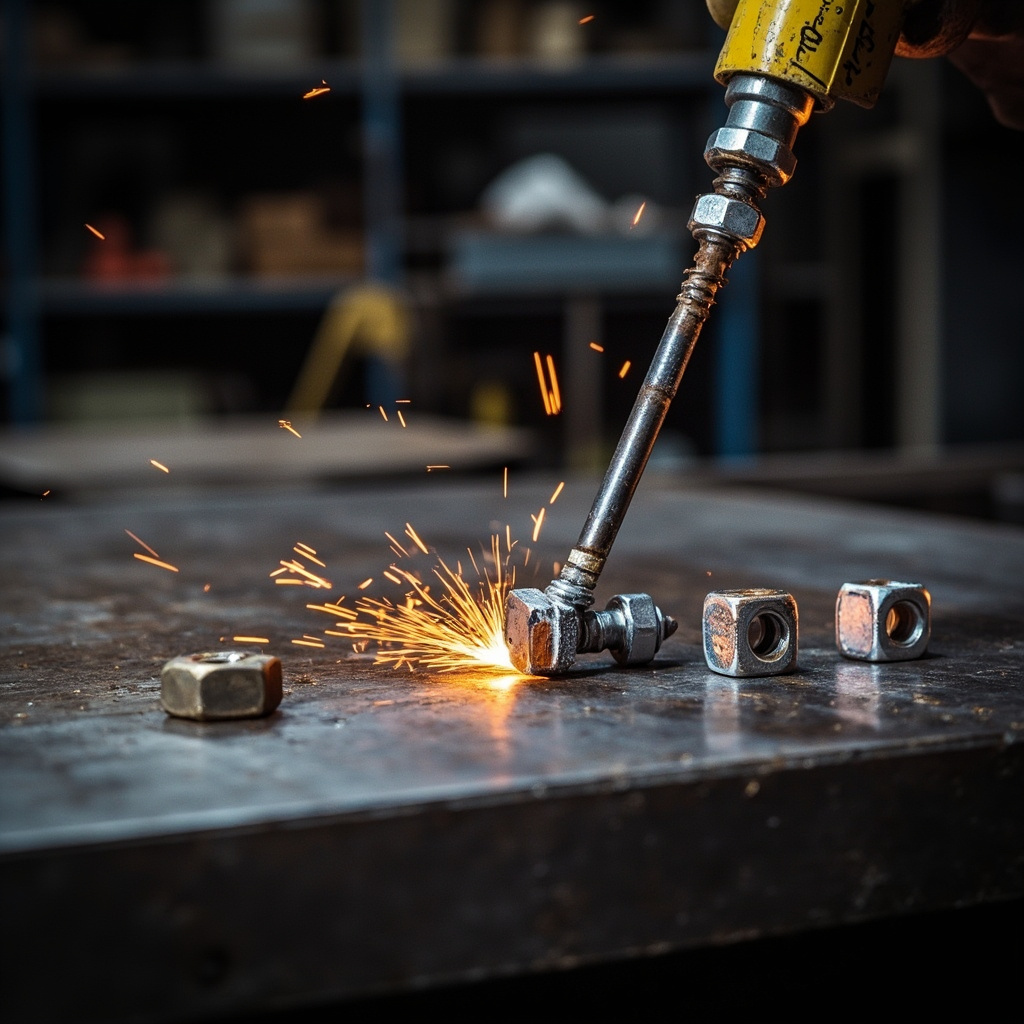
Guide to square welding <a href="/products#bolts-nuts" class="text-primary-600 hover:text-primary-800 underline underline-offset-2">nuts</a>.
Square Welding Nuts and Flange Welding Nuts
Square welding nuts (DIN 928) are designed to be resistance-welded to sheet metal or structural steel surfaces, creating a permanent threaded anchor point where only one side of the母材 is accessible. The square body shape prevents rotation during welding (weld spots are applied at each corner of the square). Flange welding nuts (DIN 929) have a hexagonal flange with welding projections (smallbumps on the underside) that concentrate the welding current for faster, more consistent welds. Hex nuts for embedded plate welding are installed in concrete or masonry during construction (embedded plates grouted into walls) with the nut accessible for later bolt installation. Available in carbon steel (zinc-plated or HDG) and stainless steel (304/316). Our factory wholesale stock includes common sizes M6 through M16. Related resources: high-tensile bolts anchor bolts stainless steel fasteners hex bolts lock nuts washers self-drilling screws socket screws. This procurement framework applies to fastener sourcing for construction, mining, energy, automotive, and general industrial applications. The decision logic prioritizes quality consistency, supplier reliability, and total cost of ownership over short-term unit price. For B2B buyers in Africa, Latin America, and Southeast Asia, additional considerations include regional customs requirements, container consolidation options, and payment security mechanisms. Standardized specifications that travel across projects reduce training time, RFQ processing time, and supplier onboarding effort. This procurement framework applies to fastener sourcing for construction, mining, energy, automotive, and general industrial applications. The decision logic prioritizes quality consistency, supplier reliability, and total cost of ownership over short-term unit price. For B2B buyers in Africa, Latin America, and Southeast Asia, additional considerations include regional customs requirements, container consolidation options, and payment security mechanisms. Standardized specifications that travel across projects reduce training time, RFQ processing time, and supplier onboarding effort. This procurement framework applies to fastener sourcing for construction, mining, energy, automotive, and general industrial applications. The decision logic prioritizes quality consistency, supplier reliability, and total cost of ownership over short-term unit price. For B2B buyers in Africa, Latin America, and Southeast Asia, additional considerations include regional customs requirements, container consolidation options, and payment security mechanisms. Standardized specifications that travel across projects reduce training time, RFQ processing time, and supplier onboarding effort.
Knurled Nuts, Step Nuts and Custom Special Nuts
Knurled round nuts have diamond or straight knurling on the outer diameter for finger-grip tightening—commonly used on camera tripods, machinery adjustment mechanisms, and hand-tightened collar applications. Step shape special nuts (step nuts or reduced-body nuts) have multiple diameter sections, allowing them to fit through different sized holes in an assembly while threading onto different母材 thicknesses. Custom special nut processing includes: left-hand thread nuts (for reverserotation applications), drill-down nuts (with integral drill tip for one-step installation into concrete), and PEM nuts (press-fit nuts for sheet metal). Minimum order quantities for custom non-standard nuts start at 1,000 pieces, with samples available in 10-15 working days. Standards-based procurement requires continuous learning as ISO, ASTM, DIN, and GB standards are revised every 3-5 years. Subscribe to standards update notifications and review specifications annually. The most common standards used in international fastener trade are ISO 898-1 (mechanical properties), ISO 3506-1 (stainless), ISO 3269 (acceptance inspection), ISO 4042 (coatings), and ISO 1502 (thread gauges). For B2B buyers, building a standards reference library with at least the top 20 standards relevant to your product mix is essential. Standards-based procurement requires continuous learning as ISO, ASTM, DIN, and GB standards are revised every 3-5 years. Subscribe to standards update notifications and review specifications annually. The most common standards used in international fastener trade are ISO 898-1 (mechanical properties), ISO 3506-1 (stainless), ISO 3269 (acceptance inspection), ISO 4042 (coatings), and ISO 1502 (thread gauges). For B2B buyers, building a standards reference library with at least the top 20 standards relevant to your product mix is essential. Standards-based procurement requires continuous learning as ISO, ASTM, DIN, and GB standards are revised every 3-5 years. Subscribe to standards update notifications and review specifications annually. The most common standards used in international fastener trade are ISO 898-1 (mechanical properties), ISO 3506-1 (stainless), ISO 3269 (acceptance inspection), ISO 4042 (coatings), and ISO 1502 (thread gauges). For B2B buyers, building a standards reference library with at least the top 20 standards relevant to your product mix is essential.
Fine Thread Round Lock Nuts: Custom Manufacturing
Fine thread round lock nuts with custom specifications (DIN 980 / ISO 16032 all-metal lock nuts, or DIN 929 flange weld nuts) are available on custom order for precision applications. Common custom specifications: non-standard fine threads (M10×1.0, M12×1.25, etc.), left-hand thread (all sizes), and special materials (Brass, Bronze, Titanium). For fine thread round lock nut matching a fine thread bolt (such as UNF or metric fine), always specify both the thread size AND the nut height class (standard or heavy). Custom manufacturing typically requires 3D CAD files or detailed engineering drawings. Our engineering team can reverse-engineer from samples or sketches. The comparison methodology above uses typical ranges from industry data and TradeGo procurement experience 2018-2024. Actual market prices fluctuate with raw material costs (steel, zinc, nickel), energy costs, labor costs, and currency exchange rates. For accurate comparison, request identical RFQs from 3-5 qualified suppliers and compare landed cost (product + shipping + insurance + duties). The lowest unit price is rarely the lowest total cost of ownership. The comparison methodology above uses typical ranges from industry data and TradeGo procurement experience 2018-2024. Actual market prices fluctuate with raw material costs (steel, zinc, nickel), energy costs, labor costs, and currency exchange rates. For accurate comparison, request identical RFQs from 3-5 qualified suppliers and compare landed cost (product + shipping + insurance + duties). The lowest unit price is rarely the lowest total cost of ownership. The comparison methodology above uses typical ranges from industry data and TradeGo procurement experience 2018-2024. Actual market prices fluctuate with raw material costs (steel, zinc, nickel), energy costs, labor costs, and currency exchange rates. For accurate comparison, request identical RFQs from 3-5 qualified suppliers and compare landed cost (product + shipping + insurance + duties). The lowest unit price is rarely the lowest total cost of ownership.
Matching Nuts for 10.9 Grade Bolts
When specifying matching nuts for 10.9 grade bolts, the minimum nut requirement is Grade 10 (proof load stress 1000 MPa). For structural applications per EN 14399, the specified nut grade must be confirmed with the bolt grade. Heavy hex nuts (DIN 6925) in Grade 10 are preferred for structural connections because the increased bearing area prevents母材 crushing. Extra large size heavy duty hex nuts for M36-M72 bolts must be specified with the thread class (6H for metric) and the coating/palte specification. For offshore or marine environments, specify A4-80 (316 stainless) nuts with 10.9 HDG bolts to avoid galvanic corrosion—never use stainless nuts with HDG bolts in seawater unless isolated. The verification checklist applies to both initial supplier qualification and ongoing batch inspection. For high-risk applications (load-bearing structural, pressure vessels, mining, marine), add fatigue testing, salt-spray testing (ASTM B117), torque-tension testing, and post-installation inspection. The cost of additional verification is 0.1-0.3% of order value, while undetected quality failures can be 10-100x the order value in damages. The verification checklist applies to both initial supplier qualification and ongoing batch inspection. For high-risk applications (load-bearing structural, pressure vessels, mining, marine), add fatigue testing, salt-spray testing (ASTM B117), torque-tension testing, and post-installation inspection. The cost of additional verification is 0.1-0.3% of order value, while undetected quality failures can be 10-100x the order value in damages. The verification checklist applies to both initial supplier qualification and ongoing batch inspection. For high-risk applications (load-bearing structural, pressure vessels, mining, marine), add fatigue testing, salt-spray testing (ASTM B117), torque-tension testing, and post-installation inspection. The cost of additional verification is 0.1-0.3% of order value, while undetected quality failures can be 10-100x the order value in damages.
Frequently Asked Questions
See frequently asked questions below.
Related resources: high-tensile bolts anchor bolts stainless steel fasteners hex bolts lock nuts washers self-drilling screws socket screws. Supplier evaluation should be a continuous process, not a one-time exercise. Re-evaluate suppliers annually based on delivery performance, quality metrics, price competitiveness, and responsiveness. Maintain a supplier scorecard with weighted metrics: on-time delivery (25%), quality acceptance rate (30%), price competitiveness (20%), responsiveness (15%), and documentation accuracy (10%). Drop suppliers scoring below 70% over a 6-month period and qualify replacements. Supplier evaluation should be a continuous process, not a one-time exercise. Re-evaluate suppliers annually based on delivery performance, quality metrics, price competitiveness, and responsiveness. Maintain a supplier scorecard with weighted metrics: on-time delivery (25%), quality acceptance rate (30%), price competitiveness (20%), responsiveness (15%), and documentation accuracy (10%). Drop suppliers scoring below 70% over a 6-month period and qualify replacements. Supplier evaluation should be a continuous process, not a one-time exercise. Re-evaluate suppliers annually based on delivery performance, quality metrics, price competitiveness, and responsiveness. Maintain a supplier scorecard with weighted metrics: on-time delivery (25%), quality acceptance rate (30%), price competitiveness (20%), responsiveness (15%), and documentation accuracy (10%). Drop suppliers scoring below 70% over a 6-month period and qualify replacements.What is the weld projection on flange welding nuts?
Flange welding nuts (DIN 929) have 3-4 smallbumps (projections) on the underside of the flange that concentrate resistance welding current, ensuring fast, strong welds at lower current.
Can I weld a standard hex nut directly to steel?
Standard hex nuts are not designed for welding—the steel composition and geometry are not optimized for weld strength. Use dedicated square welding nuts (DIN 928) or flange welding nuts (DIN 929).
Get Welding Nut & Special Nut Prices
Request Quote