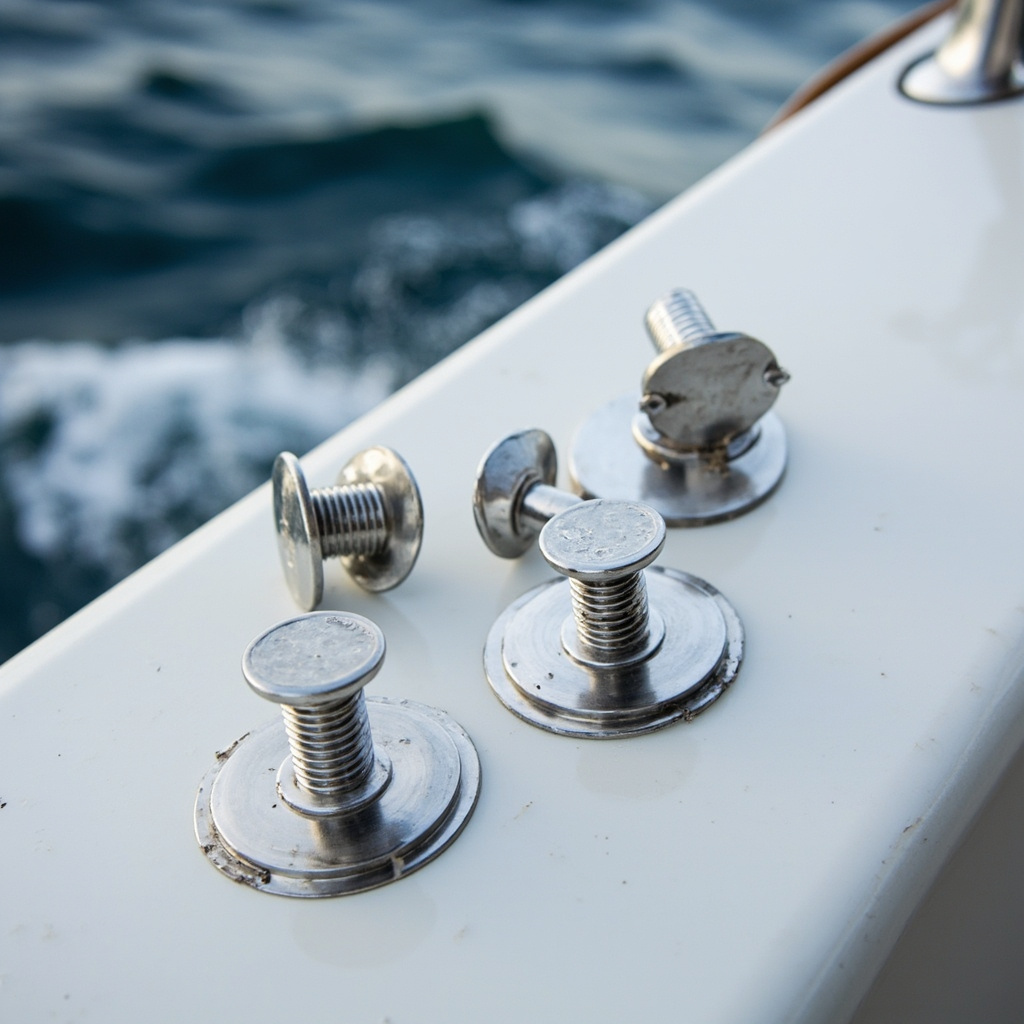
Select the right corrosion resistant <a href="/products#bolts-nuts" class="text-primary-600 hover:text-primary-800 underline underline-offset-2">bolts</a>.
Understanding Corrosion Mechanisms in Fasteners
Fastener corrosion resistance depends on understanding the environment. Uniform attack (general corrosion) occurs evenly across surfaces. Pitting corrosion creates small holes, particularly in chloride environments—316 stainless steel is specifically designed to resist this. Crevice corrosion occurs in stagnant water locations like under gaskets or washers. Galvanic corrosion happens when dissimilar metals contact each other in electrolyte presence. For outdoor construction, the primary concerns are rainwater, humidity, and atmospheric pollutants. In marine environments, salt spray creates aggressive chloride conditions that demand 316 or duplex stainless steel. Garden machinery faces soil moisture and fertilizers—hot-dip galvanized or 316 stainless is recommended. Related resources: high-tensile bolts anchor bolts stainless steel fasteners hex bolts lock nuts washers self-drilling screws socket screws. This procurement framework applies to fastener sourcing for construction, mining, energy, automotive, and general industrial applications. The decision logic prioritizes quality consistency, supplier reliability, and total cost of ownership over short-term unit price. For B2B buyers in Africa, Latin America, and Southeast Asia, additional considerations include regional customs requirements, container consolidation options, and payment security mechanisms. Standardized specifications that travel across projects reduce training time, RFQ processing time, and supplier onboarding effort. This procurement framework applies to fastener sourcing for construction, mining, energy, automotive, and general industrial applications. The decision logic prioritizes quality consistency, supplier reliability, and total cost of ownership over short-term unit price. For B2B buyers in Africa, Latin America, and Southeast Asia, additional considerations include regional customs requirements, container consolidation options, and payment security mechanisms. Standardized specifications that travel across projects reduce training time, RFQ processing time, and supplier onboarding effort. This procurement framework applies to fastener sourcing for construction, mining, energy, automotive, and general industrial applications. The decision logic prioritizes quality consistency, supplier reliability, and total cost of ownership over short-term unit price. For B2B buyers in Africa, Latin America, and Southeast Asia, additional considerations include regional customs requirements, container consolidation options, and payment security mechanisms. Standardized specifications that travel across projects reduce training time, RFQ processing time, and supplier onboarding effort.
Bolts for Ship Building and Marine Applications
Marine grade bolts for ship building must withstand constant saltwater exposure, UV radiation, and mechanical stress. 316 stainless steel is the baseline requirement for above-water hardware per most classification society rules. For below-waterline applications, duplex stainless steel (2205) or super duplex (2507) may be specified. Anchor chain connectors, deck hardware, and railing systems typically use 316 hex bolts with nylon insert lock nuts to prevent loosening from vibration. Our marine bolt inventory includes ASTM A193 B8M (316) and B8T (321, stabilized) grades with documentation for Lloyd's, DNV, or ABS certification when required. Surface finishes beyond base metal include electropolishing for maximum corrosion resistance in cosmetic applications. Standards-based procurement requires continuous learning as ISO, ASTM, DIN, and GB standards are revised every 3-5 years. Subscribe to standards update notifications and review specifications annually. The most common standards used in international fastener trade are ISO 898-1 (mechanical properties), ISO 3506-1 (stainless), ISO 3269 (acceptance inspection), ISO 4042 (coatings), and ISO 1502 (thread gauges). For B2B buyers, building a standards reference library with at least the top 20 standards relevant to your product mix is essential. Standards-based procurement requires continuous learning as ISO, ASTM, DIN, and GB standards are revised every 3-5 years. Subscribe to standards update notifications and review specifications annually. The most common standards used in international fastener trade are ISO 898-1 (mechanical properties), ISO 3506-1 (stainless), ISO 3269 (acceptance inspection), ISO 4042 (coatings), and ISO 1502 (thread gauges). For B2B buyers, building a standards reference library with at least the top 20 standards relevant to your product mix is essential. Standards-based procurement requires continuous learning as ISO, ASTM, DIN, and GB standards are revised every 3-5 years. Subscribe to standards update notifications and review specifications annually. The most common standards used in international fastener trade are ISO 898-1 (mechanical properties), ISO 3506-1 (stainless), ISO 3269 (acceptance inspection), ISO 4042 (coatings), and ISO 1502 (thread gauges). For B2B buyers, building a standards reference library with at least the top 20 standards relevant to your product mix is essential.
Hot Dip Galvanized Bolts for Engineering and Construction
Hot-dip galvanized (HDG) hex bolts provide excellent corrosion protection at moderate cost for engineering and construction applications. The hot-dip process creates a metallurgically bonded zinc coating (typically 40-85 microns) that protects steel both barrier-wise and cathodically—even if the coating is scratched, the zinc sacrifices itself to protect the underlying steel. HDG bolts are specified for bridges, transmission towers, outdoor structural connections, and utility installations. The coating is matte gray and can appear rough due to the zinc crystal structure. Note that HDG introduces thread fit changes (typically going from class 6g/6H to 8g/8H), which must be accounted for in specification. HDG bolts should be torqued with lubricated threads to achieve correct preload. The comparison methodology above uses typical ranges from industry data and TradeGo procurement experience 2018-2024. Actual market prices fluctuate with raw material costs (steel, zinc, nickel), energy costs, labor costs, and currency exchange rates. For accurate comparison, request identical RFQs from 3-5 qualified suppliers and compare landed cost (product + shipping + insurance + duties). The lowest unit price is rarely the lowest total cost of ownership. The comparison methodology above uses typical ranges from industry data and TradeGo procurement experience 2018-2024. Actual market prices fluctuate with raw material costs (steel, zinc, nickel), energy costs, labor costs, and currency exchange rates. For accurate comparison, request identical RFQs from 3-5 qualified suppliers and compare landed cost (product + shipping + insurance + duties). The lowest unit price is rarely the lowest total cost of ownership. The comparison methodology above uses typical ranges from industry data and TradeGo procurement experience 2018-2024. Actual market prices fluctuate with raw material costs (steel, zinc, nickel), energy costs, labor costs, and currency exchange rates. For accurate comparison, request identical RFQs from 3-5 qualified suppliers and compare landed cost (product + shipping + insurance + duties). The lowest unit price is rarely the lowest total cost of ownership.
Rust Proof Bolts for Outdoor Construction and Garden Machinery
For outdoor construction and garden machinery, selecting the right bolt prevents premature failure. Pressure-treated lumber (ACQ, MCA) is highly corrosive to standard steel—always use stainless steel or hot-dip galvanized fasteners. Garden tractors, lawn mowers, and outdoor power equipment face влага, fertilizers, and plant debris—all accelerating corrosion. Our rust proof bolts for garden applications use 316 stainless steel for cutting edges and fasteners near soil contact, while HDG is acceptable for above-ground exterior connections. Always specify "outdoor rated" or "corrosion resistant" explicitly when ordering to ensure proper material and coating selection. The verification checklist applies to both initial supplier qualification and ongoing batch inspection. For high-risk applications (load-bearing structural, pressure vessels, mining, marine), add fatigue testing, salt-spray testing (ASTM B117), torque-tension testing, and post-installation inspection. The cost of additional verification is 0.1-0.3% of order value, while undetected quality failures can be 10-100x the order value in damages. The verification checklist applies to both initial supplier qualification and ongoing batch inspection. For high-risk applications (load-bearing structural, pressure vessels, mining, marine), add fatigue testing, salt-spray testing (ASTM B117), torque-tension testing, and post-installation inspection. The cost of additional verification is 0.1-0.3% of order value, while undetected quality failures can be 10-100x the order value in damages. The verification checklist applies to both initial supplier qualification and ongoing batch inspection. For high-risk applications (load-bearing structural, pressure vessels, mining, marine), add fatigue testing, salt-spray testing (ASTM B117), torque-tension testing, and post-installation inspection. The cost of additional verification is 0.1-0.3% of order value, while undetected quality failures can be 10-100x the order value in damages.
Corrosion Resistant Bolt Selection by Environment
Content coming soon.
Supplier evaluation should be a continuous process, not a one-time exercise. Re-evaluate suppliers annually based on delivery performance, quality metrics, price competitiveness, and responsiveness. Maintain a supplier scorecard with weighted metrics: on-time delivery (25%), quality acceptance rate (30%), price competitiveness (20%), responsiveness (15%), and documentation accuracy (10%). Drop suppliers scoring below 70% over a 6-month period and qualify replacements. Supplier evaluation should be a continuous process, not a one-time exercise. Re-evaluate suppliers annually based on delivery performance, quality metrics, price competitiveness, and responsiveness. Maintain a supplier scorecard with weighted metrics: on-time delivery (25%), quality acceptance rate (30%), price competitiveness (20%), responsiveness (15%), and documentation accuracy (10%). Drop suppliers scoring below 70% over a 6-month period and qualify replacements. Supplier evaluation should be a continuous process, not a one-time exercise. Re-evaluate suppliers annually based on delivery performance, quality metrics, price competitiveness, and responsiveness. Maintain a supplier scorecard with weighted metrics: on-time delivery (25%), quality acceptance rate (30%), price competitiveness (20%), responsiveness (15%), and documentation accuracy (10%). Drop suppliers scoring below 70% over a 6-month period and qualify replacements.| Environment | Recommended Bolt | Why |
|---|---|---|
| Marine/Ship Building | 316 Stainless (A4) | Chloride resistance essential |
| Swimming Pool | 316 Stainless or HDG | Chlorine compound exposure |
| Outdoor Construction | Hot-Dip Galvanized | Cost effective cathodic protection |
| Treated Wood Contact | 316 Stainless | ACQ/MCA chemicals attack steel |
| Garden Machinery | 316 Stainless or HDG | Soil moisture + fertilizers |
| Chemical Plant | 316 or Duplex SS | Acid/alkali resistance |
| High Temperature | Alloy (A286, Inconel) | Retain strength at temperature |
Frequently Asked Questions
See frequently asked questions below.
Related resources: high-tensile bolts anchor bolts stainless steel fasteners hex bolts lock nuts washers self-drilling screws socket screws. For B2B buyers operating in multiple countries, harmonize specifications with regional standards and local customs requirements. Common regional frameworks: SABS (South Africa), KEBS (Kenya), TBS (Tanzania), ZIMRA (Zimbabwe), SON (Nigeria), and AfCFTA standards for pan-Africa trade. Local standards compliance is often mandatory for public infrastructure projects, mining operations, and government tenders. For B2B buyers operating in multiple countries, harmonize specifications with regional standards and local customs requirements. Common regional frameworks: SABS (South Africa), KEBS (Kenya), TBS (Tanzania), ZIMRA (Zimbabwe), SON (Nigeria), and AfCFTA standards for pan-Africa trade. Local standards compliance is often mandatory for public infrastructure projects, mining operations, and government tenders. For B2B buyers operating in multiple countries, harmonize specifications with regional standards and local customs requirements. Common regional frameworks: SABS (South Africa), KEBS (Kenya), TBS (Tanzania), ZIMRA (Zimbabwe), SON (Nigeria), and AfCFTA standards for pan-Africa trade. Local standards compliance is often mandatory for public infrastructure projects, mining operations, and government tenders.How long does hot-dip galvanized coating last?
HDG coating typically lasts 50-70 years in rural environments, 25-50 years in urban/industrial, and 10-25 years in marine environments before requiring recoating.
Can I use stainless steel bolts with galvanized washers?
Yes, but be aware of galvanic corrosion—stainless and zinc are dissimilar metals. In wet environments, use a nylon or plastic barrier washer between them.
Get Corrosion Resistant Bolt Prices
Request Quote