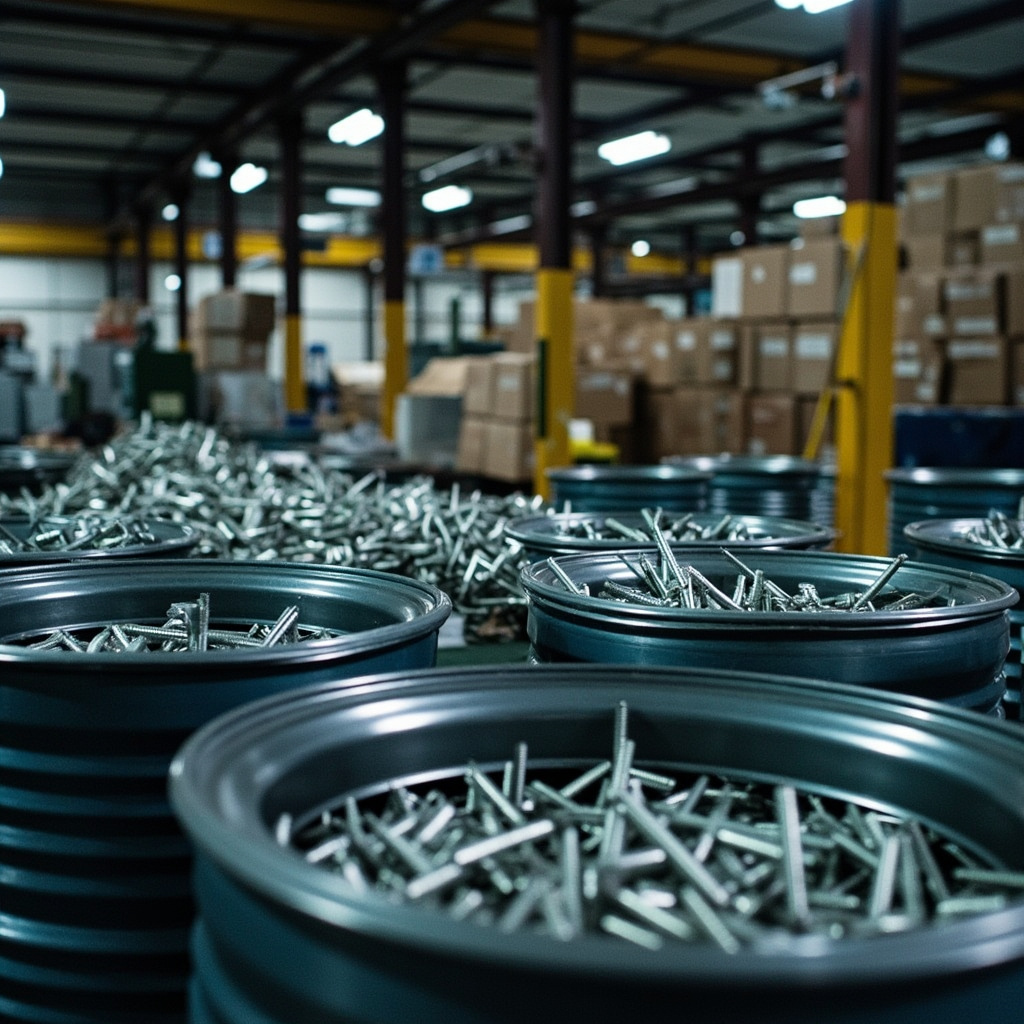
fasteners wholesale from China. Includes supplier selection, quality verification, shipping, customs, and landed cost calculation for Africa buyers.
Why Source Construction Fasteners from China?
fastener production with approximately 40% of world output. For African construction companies and distributors, sourcing from China offers: Cost Advantages: 30-50% savings compared to European or South African suppliers Product Range: Full range of construction fasteners (bolts, nuts, screws, anchors, washers) Custom Manufacturing: Can produce to specific DIN/ANSI/ISO standards Scalability: Capacity to fulfill orders from 1 ton to 1000+ tons Established Logistics: Efficient export infrastructure to African ports TradeGo Fasteners has served African construction markets since 2008, supplying major construction projects in South Africa, Nigeria, Kenya, and Ghana. Related resources: high-tensile bolts anchor bolts stainless steel fasteners hex bolts lock nuts washers self-drilling screws socket screws. This procurement framework applies to fastener sourcing for construction, mining, energy, automotive, and general industrial applications. The decision logic prioritizes quality consistency, supplier reliability, and total cost of ownership over short-term unit price. For B2B buyers in Africa, Latin America, and Southeast Asia, additional considerations include regional customs requirements, container consolidation options, and payment security mechanisms. Standardized specifications that travel across projects reduce training time, RFQ processing time, and supplier onboarding effort. This procurement framework applies to fastener sourcing for construction, mining, energy, automotive, and general industrial applications. The decision logic prioritizes quality consistency, supplier reliability, and total cost of ownership over short-term unit price. For B2B buyers in Africa, Latin America, and Southeast Asia, additional considerations include regional customs requirements, container consolidation options, and payment security mechanisms. Standardized specifications that travel across projects reduce training time, RFQ processing time, and supplier onboarding effort. This procurement framework applies to fastener sourcing for construction, mining, energy, automotive, and general industrial applications. The decision logic prioritizes quality consistency, supplier reliability, and total cost of ownership over short-term unit price. For B2B buyers in Africa, Latin America, and Southeast Asia, additional considerations include regional customs requirements, container consolidation options, and payment security mechanisms. Standardized specifications that travel across projects reduce training time, RFQ processing time, and supplier onboarding effort.
Construction Fasteners Product Range
fastener ranges: Structural Fasteners: - Hex bolts DIN 933/ISO 4017 (M12-M36) - High strength friction grip bolts - Anchor bolts (J-bolt, L-bolt, straight rod) - Tension control bolts General Construction: - Hex nuts DIN 934/ISO 4032 - Flat washers DIN 125/ISO 7089 - Spring lock washers DIN 127 - Threaded rods Specialty Fasteners: - Welded washers - Shear connector studs - Concrete anchors (wedge, sleeve, drop-in) - Post-installed anchors Standards-based procurement requires continuous learning as ISO, ASTM, DIN, and GB standards are revised every 3-5 years. Subscribe to standards update notifications and review specifications annually. The most common standards used in international fastener trade are ISO 898-1 (mechanical properties), ISO 3506-1 (stainless), ISO 3269 (acceptance inspection), ISO 4042 (coatings), and ISO 1502 (thread gauges). For B2B buyers, building a standards reference library with at least the top 20 standards relevant to your product mix is essential. Standards-based procurement requires continuous learning as ISO, ASTM, DIN, and GB standards are revised every 3-5 years. Subscribe to standards update notifications and review specifications annually. The most common standards used in international fastener trade are ISO 898-1 (mechanical properties), ISO 3506-1 (stainless), ISO 3269 (acceptance inspection), ISO 4042 (coatings), and ISO 1502 (thread gauges). For B2B buyers, building a standards reference library with at least the top 20 standards relevant to your product mix is essential. Standards-based procurement requires continuous learning as ISO, ASTM, DIN, and GB standards are revised every 3-5 years. Subscribe to standards update notifications and review specifications annually. The most common standards used in international fastener trade are ISO 898-1 (mechanical properties), ISO 3506-1 (stainless), ISO 3269 (acceptance inspection), ISO 4042 (coatings), and ISO 1502 (thread gauges). For B2B buyers, building a standards reference library with at least the top 20 standards relevant to your product mix is essential.
| Product Category | Standard Sizes | Typical MOQ | FOB Price Range |
|---|---|---|---|
| Hex bolts M12-M24 | M12 to M36 | 1 MT | $900-1,400/MT |
| Hex nuts M12-M24 | M12 to M36 | 1 MT | $800-1,200/MT |
| Washers | M12 to M36 | 0.5 MT | $700-1,000/MT |
| Anchor bolts | M16 to M30 | 0.5 MT | $1,200-1,800/MT |
| Threaded rod | M12 to M30 | 0.5 MT | $1,000-1,500/MT |
Selecting a Wholesale Supplier
fastener wholesale supplier: 1. Production Capacity: Minimum 500 MT/month for consistent supply 2. Export Experience: Verify Africa shipment history and documentation familiarity 3. Quality Certification: ISO 9001:2015 minimum; CE marking for European standards 4. Testing Capabilities: In-house tensile testing, hardness testing, coating analysis 5. Communication: English-speaking staff with responsive communication 6. Financial Stability: Established company with good credit rating TradeGo Fasteners maintains 5,000+ MT monthly capacity, ISO 9001:2015 certification, and exports to 47 countries including major African markets. The comparison methodology above uses typical ranges from industry data and TradeGo procurement experience 2018-2024. Actual market prices fluctuate with raw material costs (steel, zinc, nickel), energy costs, labor costs, and currency exchange rates. For accurate comparison, request identical RFQs from 3-5 qualified suppliers and compare landed cost (product + shipping + insurance + duties). The lowest unit price is rarely the lowest total cost of ownership. The comparison methodology above uses typical ranges from industry data and TradeGo procurement experience 2018-2024. Actual market prices fluctuate with raw material costs (steel, zinc, nickel), energy costs, labor costs, and currency exchange rates. For accurate comparison, request identical RFQs from 3-5 qualified suppliers and compare landed cost (product + shipping + insurance + duties). The lowest unit price is rarely the lowest total cost of ownership. The comparison methodology above uses typical ranges from industry data and TradeGo procurement experience 2018-2024. Actual market prices fluctuate with raw material costs (steel, zinc, nickel), energy costs, labor costs, and currency exchange rates. For accurate comparison, request identical RFQs from 3-5 qualified suppliers and compare landed cost (product + shipping + insurance + duties). The lowest unit price is rarely the lowest total cost of ownership.
Landed Cost Calculation for Africa
Hex Bolt to Durban, South Africa FOB Shanghai: $1,100/MT Ocean Freight (20ft container 20MT): $1,500/container = $75/MT Insurance (approx 1% CIF): $12/MT Port Handling Durban: $50/MT Customs Duty (South Africa - Chapter 73): 10% VAT (15%): Applied to (CIF + Duty) Clearing Agent Fee: $30-50/MT Inland Transport to Warehouse: $40-60/MT Total Landed Cost Estimate: $1,500-1,700/MT Compare this to local South African pricing of $2,200-2,500/MT for equivalent quality. The verification checklist applies to both initial supplier qualification and ongoing batch inspection. For high-risk applications (load-bearing structural, pressure vessels, mining, marine), add fatigue testing, salt-spray testing (ASTM B117), torque-tension testing, and post-installation inspection. The cost of additional verification is 0.1-0.3% of order value, while undetected quality failures can be 10-100x the order value in damages. The verification checklist applies to both initial supplier qualification and ongoing batch inspection. For high-risk applications (load-bearing structural, pressure vessels, mining, marine), add fatigue testing, salt-spray testing (ASTM B117), torque-tension testing, and post-installation inspection. The cost of additional verification is 0.1-0.3% of order value, while undetected quality failures can be 10-100x the order value in damages. The verification checklist applies to both initial supplier qualification and ongoing batch inspection. For high-risk applications (load-bearing structural, pressure vessels, mining, marine), add fatigue testing, salt-spray testing (ASTM B117), torque-tension testing, and post-installation inspection. The cost of additional verification is 0.1-0.3% of order value, while undetected quality failures can be 10-100x the order value in damages.
Wholesale Order Process
fasteners from China: 1. Initial Contact (Day 1): Submit inquiry with specifications, quantities, destination port 2. Quote Response (Day 1-2): Receive detailed quotation with FOB/CIF pricing 3. Sample Approval (Week 1-2): Order and approve samples 4. Contract Signing (Week 2): Sign purchase agreement with payment terms 5. Deposit Payment (30%): Initiate production 6. Production (Week 3-4): 15-20 days production 7. Quality Inspection (Day 1-2): Optional third-party inspection (SGS) 8. Final Payment (70%): Balance payment before shipment 9. Shipment (Day 3-5): Book vessel and load container 10. Transit (Weeks 4-6): Ocean freight to Africa 11. Customs Clearance (Day 1-5): Destination port processing 12. Delivery (Day 5-10): Inland transport to warehouse Total Timeline: 6-10 weeks from order confirmation to warehouse delivery Supplier evaluation should be a continuous process, not a one-time exercise. Re-evaluate suppliers annually based on delivery performance, quality metrics, price competitiveness, and responsiveness. Maintain a supplier scorecard with weighted metrics: on-time delivery (25%), quality acceptance rate (30%), price competitiveness (20%), responsiveness (15%), and documentation accuracy (10%). Drop suppliers scoring below 70% over a 6-month period and qualify replacements. Supplier evaluation should be a continuous process, not a one-time exercise. Re-evaluate suppliers annually based on delivery performance, quality metrics, price competitiveness, and responsiveness. Maintain a supplier scorecard with weighted metrics: on-time delivery (25%), quality acceptance rate (30%), price competitiveness (20%), responsiveness (15%), and documentation accuracy (10%). Drop suppliers scoring below 70% over a 6-month period and qualify replacements. Supplier evaluation should be a continuous process, not a one-time exercise. Re-evaluate suppliers annually based on delivery performance, quality metrics, price competitiveness, and responsiveness. Maintain a supplier scorecard with weighted metrics: on-time delivery (25%), quality acceptance rate (30%), price competitiveness (20%), responsiveness (15%), and documentation accuracy (10%). Drop suppliers scoring below 70% over a 6-month period and qualify replacements.
Frequently Asked Questions
See frequently asked questions below.
Related resources: high-tensile bolts anchor bolts stainless steel fasteners hex bolts lock nuts washers self-drilling screws socket screws. For B2B buyers operating in multiple countries, harmonize specifications with regional standards and local customs requirements. Common regional frameworks: SABS (South Africa), KEBS (Kenya), TBS (Tanzania), ZIMRA (Zimbabwe), SON (Nigeria), and AfCFTA standards for pan-Africa trade. Local standards compliance is often mandatory for public infrastructure projects, mining operations, and government tenders. For B2B buyers operating in multiple countries, harmonize specifications with regional standards and local customs requirements. Common regional frameworks: SABS (South Africa), KEBS (Kenya), TBS (Tanzania), ZIMRA (Zimbabwe), SON (Nigeria), and AfCFTA standards for pan-Africa trade. Local standards compliance is often mandatory for public infrastructure projects, mining operations, and government tenders. For B2B buyers operating in multiple countries, harmonize specifications with regional standards and local customs requirements. Common regional frameworks: SABS (South Africa), KEBS (Kenya), TBS (Tanzania), ZIMRA (Zimbabwe), SON (Nigeria), and AfCFTA standards for pan-Africa trade. Local standards compliance is often mandatory for public infrastructure projects, mining operations, and government tenders.What is the minimum order quantity (MOQ) for bulk fastener orders from China?
Typical MOQ ranges from 100-500 kg per size, with total order of 1-5 tons for mixed product orders. Some manufacturers accept smaller MOQ for standard sizes with price premiums. Custom specifications typically require higher MOQ.
Request EN 10204 3.1 Mill Test Certificates showing chemical composition and mechanical properties. Order samples before bulk. Use third-party inspection agencies like SGS, Bureau Veritas, or Intertek for container inspection. What is the typical lead time for fastener orders from China?
Production takes 15-30 days depending on order size and complexity. Sea freight to African ports adds 20-35 days depending on destination. Total lead time: 5-10 weeks from order confirmation to port arrival.
FOB (Free on Board) price includes the product cost and packaging. It excludes freight charges, insurance, and handling from the port. CIF price includes cost, insurance, and freight to your destination port. What payment terms are standard for China fastener orders?
Common terms: 30% deposit, 70% balance against copy of Bill of Lading (TT). For established relationships, some suppliers offer open account or letter of credit (L/C) terms. New customers typically pay 100% upfront or 30/70.
Get Wholesale Quote
Request Quote